


Sessions Courts cannot impose Life Imprisonment till Natural Life: Supreme Court
 Copy Link
 Share
 Save
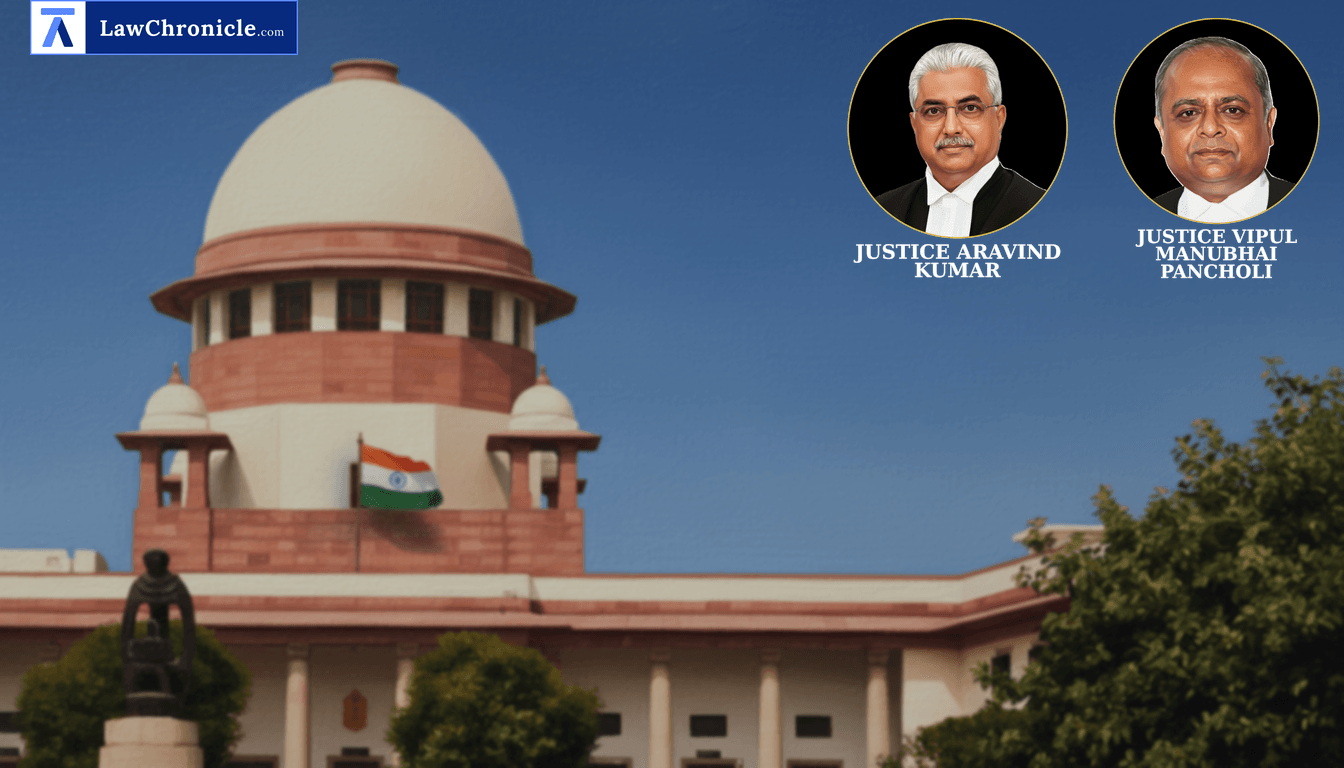
The Supreme Court has clarified that the power to impose life imprisonment till natural life of the convict to bridge the gap between 14 years' imprisonment and the death penalty rests exclusively with Constitutional Courts.
A Bench comprising Justice Aravind Kumar and Justice Vipul M. Pancholi addressed a criminal appeal challenging a High Court order that affirmed a Sessions Court verdict sentencing murder convicts to remain in jail for the rest of their natural lives under Section 302 read with Section 34 of the Indian Penal Code, 1860.
Key Takeaways
- Jurisdictional Boundaries Reinforced: Trial courts cannot issue sentencing orders that deprive convicts of statutory remission under the Code Of Criminal Procedure, 1973.
- Exclusive Constitutional Court Power: Modifying a life sentence to a specific term without remission (e.g., 20 or 25 years) or till the end of natural life is a power reserved solely for High Courts and the Supreme Court.
- Legislative Intent on Life Terms: Where Parliament intends for life imprisonment to strictly mean natural life without ordinary remission, it explicitly states so in specific penal provisions, unlike Section 302 of the Indian Penal Code, 1860.
Power to Sentence Life Imprisonment till Natural Life
The Apex Court declared that while Sessions Courts possess the authority to award life imprisonment under Section 302 of the Indian Penal Code, 1860, they cannot exclude statutory remission regimes or mandate imprisonment for the remainder of natural life. The Supreme Court observed that "Prescribing punishments is essentially a legislative function and that the Courts must operate within the punishment prescribed by the legislature and while the Constitutional Courts may, in appropriate cases, mould a sentence within the permissible limits of the punishment prescribed, the exercise of such power is circumscribed by the constitutional and statutory scheme."
Therefore, The Bench set aside the direction for appellants "to remain in prison till the rest of their life". In substitution the Supreme Court sentenced both the appellants to undergo rigorous imprisonment for a period of 25 years, without the benefit of any statutory remission.
Ratio
Trial Courts are not competent to impose a modified or special category sentence of life imprisonment that curtails statutory remission or directs incarceration for the rest of a convict's natural life under Section 302 of the Indian Penal Code, 1860. The power to grant alternate sentencing beyond 14 years without remission to bridge the hiatus between life imprisonment and the death penalty is exclusively vested in Constitutional Courts: the High Courts and the Supreme Court. Furthermore, statutory powers of remission under Sections 432 to 435 of the Code Of Criminal Procedure, 1973 and constitutional powers under Constitution of India, 1950 of the Constitution of India, 1950 cannot be curtailed by an inferior court.
Background
The case arose from the brutal murder of a woman and her two minor daughters in December 2009 in Ludhiana. The Trial Court convicted three individuals, including the appellants, under Section 302 read with Section 34 of the Indian Penal Code, 1860, sentencing them to rigorous imprisonment for life with a specific direction "to remain in prison till rest of their life." The High Court of Punjab and Haryana affirmed the conviction and sentence without examining the trial judge's competence to add such a restrictive direction.
When the matter reached the Supreme Court, the Bench affirmed the conviction in November 2025 but agreed to examine the validity of the sentence. The appellants submitted that Section 302 of the Indian Penal Code, 1860 does not statutory mandate natural life imprisonment and relied on precedents like Swamy Shraddananda (2) v. State of Karnataka ( "(2008) 13 SCC 767": 2008 CaseBase(SC) 1365), Union of India v. V. Sriharan alias Murugan ( "(2016) 7 SCC 1": 2015 CaseBase(SC) 480), Kiran v. State of Karnataka ( "2025 SCC OnLine SC 2863": 2025 CaseBase(SC) 1407), Ravinder Singh v. State (NCT of Delhi), and Navas alias Mulanavas v. State of Kerala to argue that trial courts lack the jurisdiction to bar remissions.
The Supreme Court analyzed the precedent set in Swamy Shraddananda (2) v. State of Karnataka ( "(2008) 13 SCC 767": 2008 CaseBase(SC) 1365), as affirmed by the Constitution Bench in Union of India v. V. Sriharan alias Murugan ( "(2016) 7 SCC 1": 2015 CaseBase(SC) 480), noting that special category sentences removing remission options exist to avoid nudging courts into awarding capital punishment in cases just short of the rarest of rare. However, this authority is strictly confined to Constitutional Courts. The Court also referred to its recent ruling in Kiran v. State of Karnataka ( "2025 SCC OnLine SC 2863": 2025 CaseBase(SC) 1407), where a similar direction by a Sessions Court was modified to life imprisonment simpliciter.
Evaluating the legislative scheme, the Supreme Court noted that when Parliament intended life imprisonment to strictly mean natural life, as seen in Section 376AB, 376DA, or 376DB introduced by the Criminal Law (Amendment) Act, 2018, it used explicit phrasing. In contrast, Section 302 of the Indian Penal Code, 1860 remains unamended in this regard, meaning Sessions Courts cannot read such extra-statutory terms into it.
Considering the gravity of the crime involving three deaths alongside the appellants' clean prison conduct records and over 11–12 years of actual custody, the Supreme Court substituted the Trial Court's natural life sentence with 25 years of rigorous imprisonment without statutory remission.
Case Details:
Case No.: Criminal Appeal No. _____ of 2026 (Arising out of SLP(Crl.) No.____________ of 2026) [Diary No. 56431 of 2025]
Neutral Citation: 2026 INSC 1048
Case Title: NAVAL KISHORE & ANR. v. STATE OF PUNJAB
Appearances:
For the Petitioner(s): Ms. Sampa Sengupta Ray, Advocate
For the Respondent(s): Mr. Vivek Jain, Additional Advocate General, Mr. Siddhant Sharma, Advocate
Source: 2026 CaseBase(SC) 7959
Similar Articles
 Breaking News


