


Signatory of MOU Becomes 'Drawer' for NI Act Liability: Supreme Court
 Copy Link
 Share
 Save
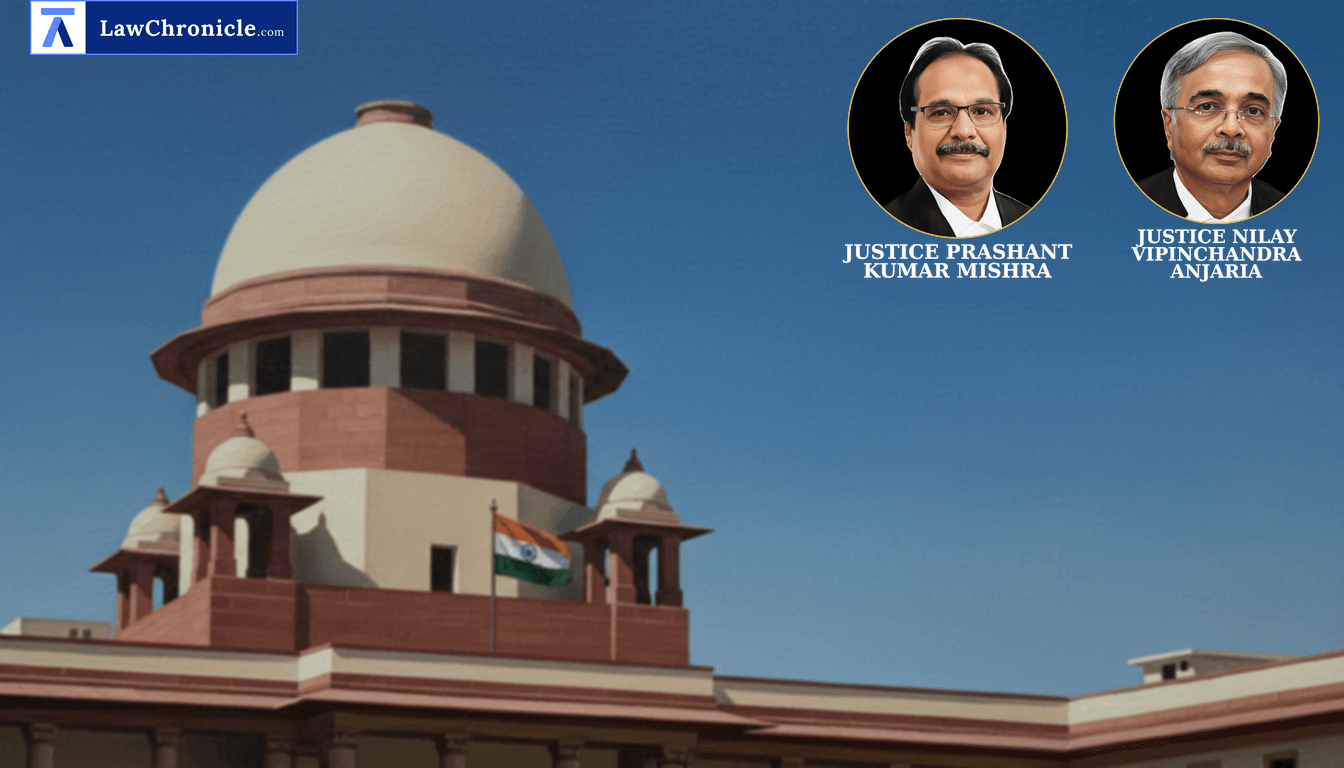
The Supreme Court, in K. Ranganayakulu v. State of Telangana & Ors., clarified that an authorized signatory who acts as the primary representative of an organization and signs a Memorandum of Understanding (MoU) can be held liable as the "drawer" of a cheque under the Negotiable Instruments Act, 1881, in cases of cheque dishonour. In a notable ruling, the Court maintained the conviction of a Treasurer, observing that he alone was responsible for the rights and liabilities arising from the specific contractual agreement.
A division bench of Justice Prashant Kumar Mishra and Justice N.V. Anjaria heard the appeal against a High Court judgment that had convicted the appellant under Section 138 of the Negotiable Instruments Act, 1881. While the Court refused to set aside the conviction, it modified the sentence from active imprisonment to a substantial fine, considering the appellant's role as a Treasurer.
Defining the 'Drawer' in Corporate Liability
The primary legal question revolved around whether an authorized signatory, who is not the 'drawer' in a personal capacity, could be held vicariously liable. The appellant's counsel argued that penal statutes must be interpreted strictly and cited Unnamed Case (2024) 7 SCR 1211 to contend that a signatory merely signs on behalf of a company and does not personally become the drawer. However, the Court looked into the specific terms of the MOU between the NGO and the electricity corporation.
The Court, in its reasoning, observed: "If the NGO i.e. TIMES has made the appellant as its front face by authorizing him to sign all the negotiable instruments and to make payment of the account to APCPDCL (Presently Telangana CPDCL) through cheque/RTGS online transaction, it is only the appellant who shall be responsible for all the consequences thereof. In practicality, by virtue of the terms of the MOU, it is the appellant who becomes the drawer of the cheque on behalf of the TIMES as the document do not recognize any other entity who shall be responsible for any action in its transactions with APCPDCL (Telangana CPDCL)."
Court's Directions on Sentencing
While upholding the conviction, the Supreme Court exercised its discretion regarding the sentence. The Court has the following directions: "the appellant shall pay a fine amount of Rs.1.5 crore to Respondent No.2 (now Telangana CPDCL or Southern Power Distribution Company of Telangana Limited (TSSPDCL)) in default to undergo Rigorous Imprisonment of one year. The fine shall be paid within a period of two months from today. If the amount is not paid within two months from today, the appellant shall immediately surrender or taken into custody to undergo the default sentence of rigorous imprisonment of one year.”
Background:
The dispute originated from a 2009 MOU where 'TIMES' (an NGO) was tasked with collecting electricity bill payments from domestic consumers for APCPDCL. The appellant, acting as the Treasurer, signed the MOU. When a cheque issued for the remittance of these collections was dishonored, proceedings were initiated under Section 138 of the Negotiable Instruments Act, 1881. The High Court had initially sentenced the appellant to one year of rigorous imprisonment along with a fine of Rs. 1.5 crore. The Supreme Court partially allowed the appeal, removing the substantive prison term while retaining the fine and default sentence.
Case Details:
Case No.: CRIMINAL APPEAL NO.2472 of 2026
NeutralCitation: 2026 INSC 555
Case Title: K RANGANAYAKULU VERSUS STATE OF TELANGANA & ORS.
Appearances:
For the Petitioner(s): Mr. Santosh Kumar, Senior Counsel
For the Respondent(s): Mr. Ravi Shankar Jandhyala, Senior Counsel
Source: 2026 CaseBase(SC) 584
Similar Articles
 Breaking News


