


Larger Bench Asked to Decide If Section 148 Deposit Can Be Imposed on Directors When Company Is Unprosecutable
 Copy Link
 Share
 Save
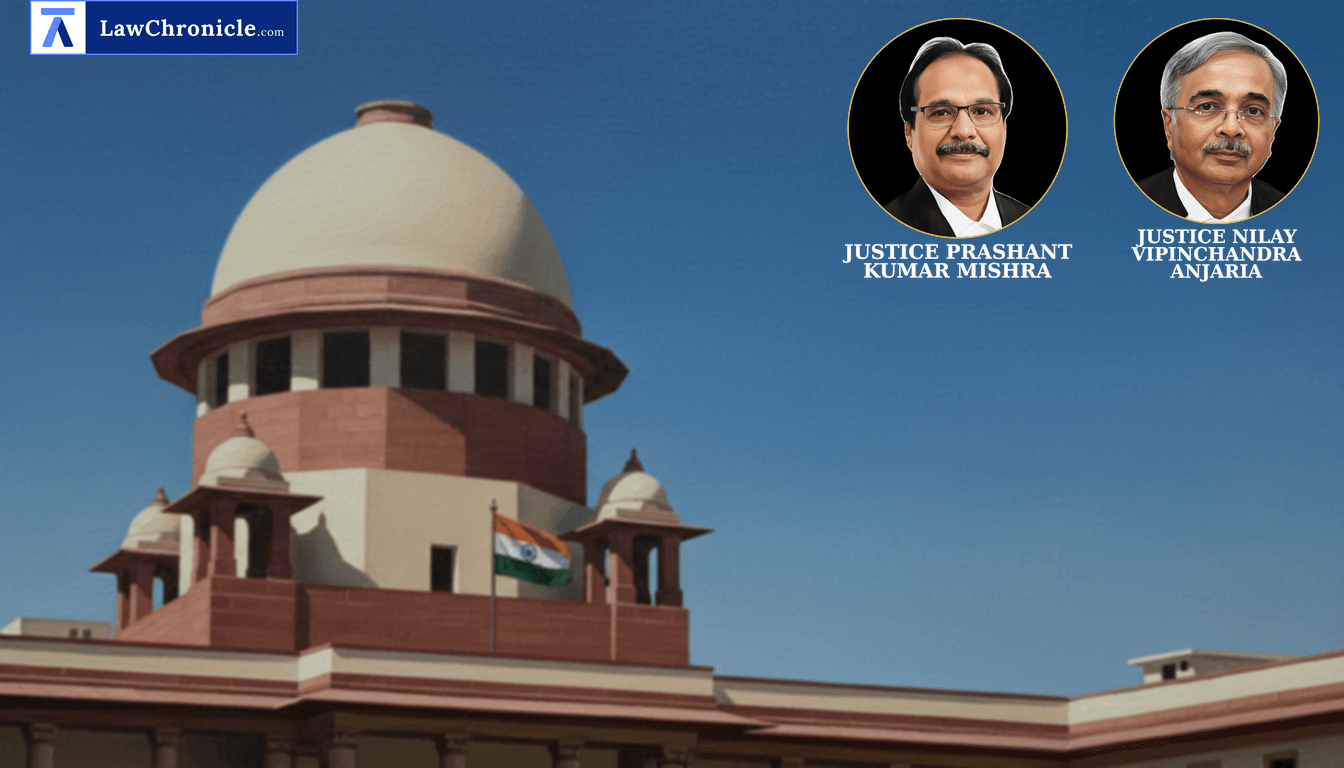
A bench of Justices Aravind Kumar and N.V. Anjaria heard an appeal by Bharat Mittal challenging orders that required him to deposit 20% of the compensation awarded under Section 357 CrPC as a condition for suspension of sentence in proceedings under Section 138 of the Negotiable Instruments Act. The narrow issue was whether an appellate court could direct the statutory 20% deposit under Section 148 against a director or authorised signatory when the company itself could not be prosecuted due to a legal snag such as winding up or liquidation.
The Court summarised that the appellate deposit under Section 148 did not entitle a director to a blanket exemption simply because the corporate drawer was unprosecutable; whether exemption was warranted must turn on the facts of each case. The bench recorded that Sections 143A and 148 were enacted to secure timely compensation to payees and to curb dilatory tactics — quoting the legislative object “to provide relief to payees of dishonoured cheques and to discourage frivolous and unnecessary litigation.” The Court, in its reasoning, observed: “Therefore, in order to answer the question formulated in Paragraph 8, we are of the considered view that a director of a company cannot be granted a blanket exemption from the deposit contemplated under Section 148 of the Act, as suggested in Bijay Agarwal. Whether such exemption is warranted must necessarily depend upon the factual matrix of each individual case.” While noting precedent that ordinarily required arraignment of the company (Aneeta Hada), the bench disagreed with the coordinate-bench conclusions in Gurudatta Sugars and Bijay Agarwal to the extent they produced a categorical exemption, and held that the interpretative conflict warranted determination by a Larger Bench.
Background The dispute arose from supply contracts between Steel Authority of India Limited (SAIL) and Shiv Mahima Ispat Pvt. Ltd.; the company issued a cheque dated 03.01.2013 for Rs. 4,82,72,269/-, signed by the appellant, which was dishonoured with endorsement “Exceeds Arrangement”. The complainant filed a Section 138 complaint; the company was wound up by the Rajasthan High Court on 22.04.2016 and formally wound up on 01.12.2016. The trial court convicted the appellant under Section 138 read with Section 141 and sentenced him to two years’ simple imprisonment, besides awarding compensation of Rs. 8,10,00,000/-. On appeal the trial court’s sentence was suspended by the appellate court subject to a condition that the appellant deposit 20% of the compensation under Section 148; non-compliance led to issuance of a non-bailable warrant.
The appellant sought exemption from the deposit on grounds that the company had been wound up, partial recovery had been effected through the Official Liquidator, and that imposing personal liability would cause double recovery and render his right of appeal illusory. He relied on this Court’s decisions in Bijay Agarwal and Gurudatta Sugars which, the appellant contended, held that an authorised signatory was not the “drawer” for purposes of Sections 143A/148. The High Court dismissed his petition, holding that directors in charge could be vicariously liable under Section 141 and that resignation or winding up did not absolve past liability; it also imposed costs and restrained alienation of assets.
The Supreme Court reviewed the statutory scheme, the 2018 amendments introducing Sections 143A and 148, and the line of precedents including Aneeta Hada, Surinder Singh Deswal, Jamboo Bhandari and Muskan Enterprises. The bench reiterated that prosecution normally required arraignment of the company but recognised the exception where the company could not be prosecuted due to a legal impediment. The Court agreed that Section 148 usually required a deposit but accepted that appellate courts retained a limited discretion in exceptional circumstances. Finding a direct conflict in the coordinate-bench decisions on whether the term “drawer” in Section 148 always confined the deposit to the juristic drawer, the bench declined to authoritatively resolve the question and directed that the matter be placed before the Chief Justice for constitution of a Larger Bench to decide: whether Section 148’s appellate deposit may be directed against a convicted director/authorised signatory or is confined to the juristic drawer/company alone.
Case Details: Case No.: 2025 INSC 1459 (SLP (Crl.) No. 12327 of 2025 / Criminal Appeal @ SLP No.) Case Title: Bharat Mittal v. State of Rajasthan & Ors. Appearances: For the Petitioner(s): Sri R. Basant, Senior Advocate For the Respondent(s): Sri Nagamuthu, Senior Advocate (for Respondent No.2/SAIL)
Similar Articles


 Breaking News


