


State Cannot Create Two Pay Scales Within A Single Unified Cadre: Allahabad HC
 Copy Link
 Share
 Save
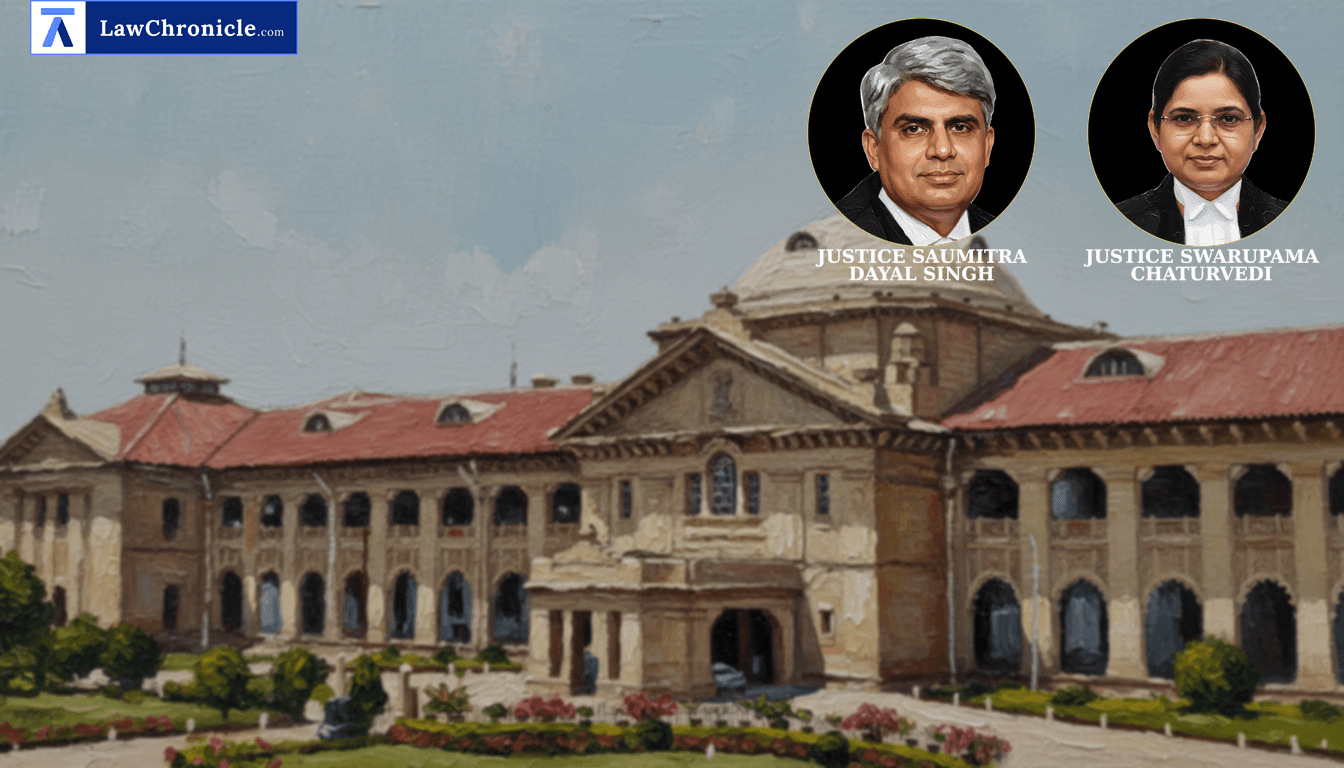
The Allahabad High Court has slammed the State of Uttar Pradesh for attempting to maintain artificial pay disparities within a single unified cadre, ruling that once posts are merged with retrospective effect, any classification based on erstwhile identity is a fatal violation of constitutional equality. The Court held that denying pay parity to integrated employees while requiring identical duties constitutes an impermissible classification that revives the very disparity the merger intended to resolve.
In a decisive verdict, a Division Bench comprising Justice Saumitra Dayal Singh and Justice Swarupama Chaturvedi dismissed the State's appeal against a Single Judge order, reinforcing the doctrine of 'Equal Pay for Equal Work' for merged cadres. The dispute centered on Livestock Extension Inspectors who were merged into a single cadre of Livestock Extension Officers but were later denied the higher pay scale of Rs. 1350–2200/- given to those who held the post prior to 1986.
The Arbitrariness of Post-Merger Pay Differentiation
The Bench scrutinized the State’s decision to modify pay structures through a 1992 Government Order, which selectively granted higher pay scales. The Court noted that since the posts of Livestock Extension Inspector and Livestock Extension Officer were unified as one cadre under U.P. Animal Husbandry Live Stock Extension and Poultry Development Service Rules, 2002 and executive orders, all members constituted a homogeneous class.
The Court, in its reasoning, observed: "...the classification introduced by Government Order dated 02.04.1992 is not based upon any difference in qualifications, duties, responsibilities or nature of work attached to the post after merger. On the contrary, after issuance of Government Orders dated 03.03.1990 and 05.06.1991, all employees became members of one unified cadre and were holding the same post... such distinction cannot be sustained once the State Government itself decided to merge the two posts retrospectively."
Impact of Cadre Integration on Identity
Referring to the precedent set in S. Sivaguru Vs State of Tamilnadu, the High Court emphasized that the legal consequence of integration is the cessation of separate identities. The Bench found that the State's justification protecting the interests of senior employees could not override the constitutional mandate under Article 14 and Article 16 of the Constitution of India.
The Court has following directions:
"The State authorities shall extend the benefit of the pay scale of Rs. 1350–2200/- to the respondents with effect from 01.01.1986 with all consequential benefits. The aforesaid exercise shall be completed within a period of three months from the date of production of a certified copy of this judgment before the competent authority."
Key Takeaways
Cessation of Erstwhile Cadre Identity
Once two cadres are merged retrospectively into a single unified cadre, the previous identities of the employees are extinguished for the purpose of pay scales.
Impermissibility of Source-Based Classification
Courts will not allow the 'source of recruitment' or pre-merger status to justify differential pay for employees discharging identical duties within the same cadre.
Equal Pay for Equal Work Enforcement
Determinations of pay scales must be based on current status and responsibilities in a unified cadre rather than historical seniority or designation.
Ratio
After the merger of two different posts into a single homogeneous cadre with retrospective effect, any executive action creating different pay scales for members of that unified cadre based solely on their pre-merger status is arbitrary and violative of the right to equality under Articles 14 and 16 of the Constitution of India.
Background:
The respondents were initially appointed between 1981 and 1986 as Livestock Development Assistants. In 1990, the State Government merged this post with that of Livestock Extension Officers into a single unified cadre, following a Task Force Committee report which found both roles shared identical qualifications and duties. However, a subsequent Government Order dated 02.04.1992 created a split in the pay scale, granting Rs. 1350-2200/- only to those who were original 'Officers' prior to 1986, while the merged 'Inspectors' were kept at Rs. 1200-2040/-.
The State argued that this was to protect the seniority and interests of those already holding the higher post. A Single Judge quashed this distinction in 2019, leading to the current Special Appeal. The High Court, while dismissing the State's appeal, held that once integration is complete, all members are on par, and the State cannot revive resolved disparities through new classifications.
Case Details:
Case No.: SPECIAL APPEAL No. - 70 of 2020
Case Title: State of U.P. and 8 others Versus Sant Lal Sonkar and 8 others
Appearances:
For the Petitioner(s): Ratan Deep Mishra, Pranab Kumar Ganguli
For the Respondent(s): Rajesh Kumar, Shravan Kumar Panday
Source: 2026 CaseBase(ALL) 574
Similar Articles


 Breaking News


