


State Cannot Delegate Section 17(2) Referral Power Under Working Journalists Act: SC
 Copy Link
 Share
 Save
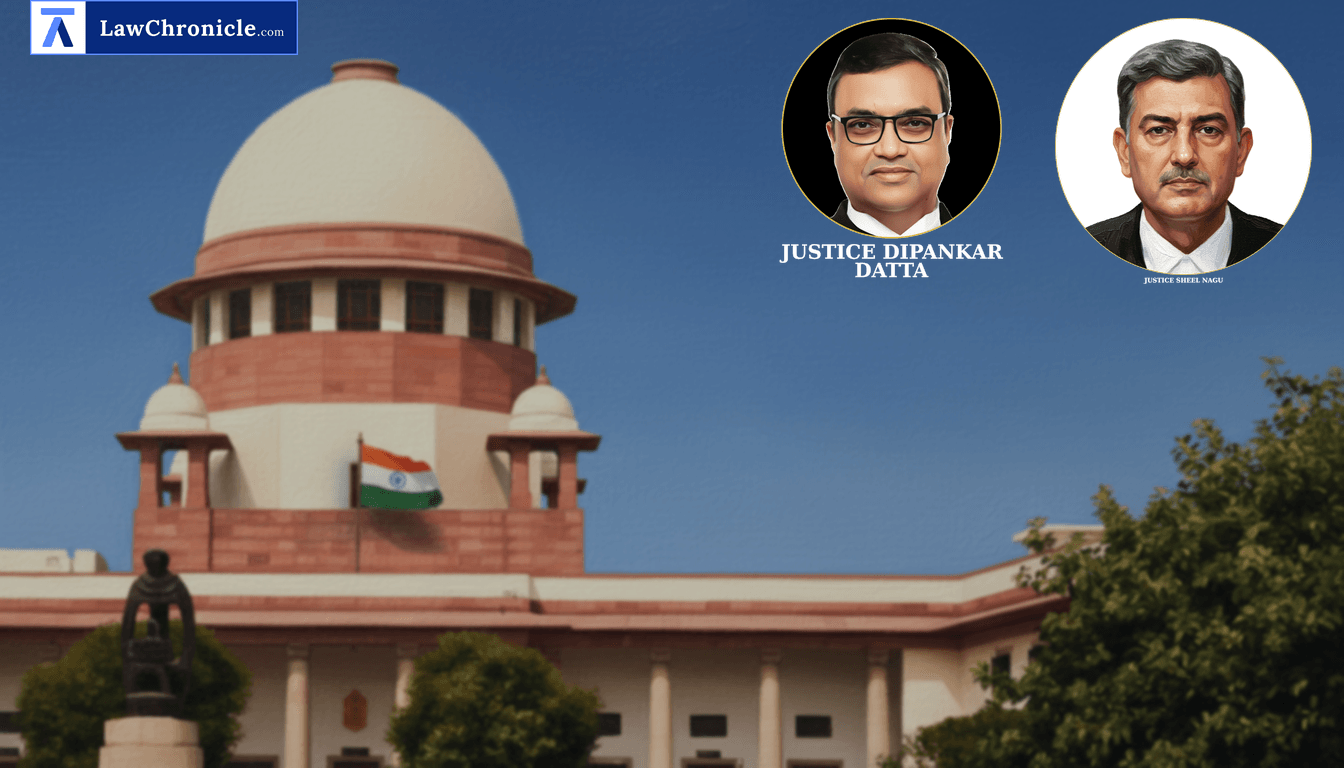
Striking down the State Government's attempt to outsource its statutory dispute-referral power, the Supreme Court has ruled that the administrative discretion to refer working journalists' wage disputes to Labour Courts under Section 17(2) of the Working Journalists and Other Newspaper Employees (Conditions of Service) and Miscellaneous Provisions Act, 1955 rests exclusively with the State Government and cannot be delegated to subordinate officers. However, to prevent hundreds of pending labour litigations from collapsing into total chaos, the apex court invoked its extraordinary powers under Article 142 of the Constitution of India, 1950 to order a state-wide ratification drive for all past references.
A Bench comprising Justice Dipankar Datta and Justice Sheel Nagu adjudicated a batch of civil appeals challenging the decisions of the Bombay High Court (Aurangabad and Nagpur Benches). The key question before the Court was whether Section 17(2) of the Working Journalists and Other Newspaper Employees (Conditions of Service) and Miscellaneous Provisions Act, 1955 empowered the State Government to delegate its authority to refer wage quantum disputes to officers such as Additional Commissioners or Deputy Commissioners of Labour.
Key Takeaways
No Delegation of Referral Power: The State Government alone holds the statutory authority under Section 17(2) to refer wage disputes to Labour Courts; delegating this function to subordinate administrative officers is legally impermissible.
Article 142 Relief for Pending Litigations: To avert administrative collapse and protect litigants, the Supreme Court directed the State Government to independently review and validate existing references rather than terminating pending court proceedings.
Overruling Contrary Precedent: The Supreme Court explicitly disapproved the contrary interpretation taken by the Allahabad High Court, affirming decisions that enforce strict limits on administrative delegation.
Analyzing the legislative framework, the Supreme Court held that while Section 17(1) explicitly permits delegation of administrative functions for recovery certificates where claims are undisputed, Section 17(2) deliberately contains no such provision. The Court noted that the legislature's conscious omission of delegation in sub-section (2) prohibits subordinate officers from making valid references on their own motion.
The Court, in its reasoning, observed: "On a plain interpretation of Section 17(2), there is absolutely no ambiguity with regard to the requirement that it is the State Government alone which can refer the matter to the Labour Court."
Addressing the validity of past referrals made under the notification issued by the Industries, Energy and Labour Department, Government of Maharashtra, the Court issued specific directions to rectify procedural defects. The Court has following directions:
"In exercise of the power conferred on this Court by Article 142 of the Constitution of India, we further direct that the GoM in the appropriate department shall revisit all references made to the Labour Courts by the respective specified authorities. Upon an independent exercise being undertaken in each case and uninfluenced by the satisfaction reached by the specified authorities, the GoM shall be under an obligation to record fresh satisfaction that there existed a dispute as to amount due which was worthy of being referred. In those cases where satisfaction is reached, a fresh reference shall be made by the GoM outlining the terms for the same to be decided in accordance with law. The proceedings shall, however, be taken forward from the stage the Labour Courts have reached."
Ratio
When a statutory provision explicitly confers a power of delegation in one sub-section but remains silent in a subsequent sub-section governing a follow-up statutory function, the principle of expressio unius est exclusio alterius applies. The administrative discretion to form satisfaction and refer a dispute for judicial adjudication under such silent sub-section rests solely with the designated statutory authority and cannot be validly sub-delegated to any subordinate officer.
Background
The dispute arose after the Government of Maharashtra issued a notification delegating its referral power under Section 17(2) of the Working Journalists and Other Newspaper Employees (Conditions of Service) and Miscellaneous Provisions Act, 1955 to Additional Commissioners and Deputy Commissioners of Labour. Relying on this notification, references were made to Labour Courts regarding unpaid dues of newspaper employees against establishments like Dainik Bhaskar Group and All India Reporter Private Limited.
Employers raised preliminary objections challenging the jurisdiction of the delegatees to refer disputes. The Nagpur Bench and the Aurangabad Bench of the Bombay High Court upheld these objections, setting aside Labour Court awards and references. Appeals were subsequently filed before the Supreme Court by affected employees and unions, including the Brihanmumbai Union of Journalists and the All India Reporter Karmachari Sangh.
While interpreting the statutory scheme, the Supreme Court relied on the decisions in Pradyot Kumar Bose v. The Hon’ble The Chief Justice of Calcutta High Court ( "(1955) 2 SCC 791": 1955 CaseBase(SC) 148) and Sahni Silk Mills (P) Ltd. v. Employees State Insurance Corporation to hold that ultimate responsibility for exercising administrative discretion cannot be delegated without explicit statutory authority. The Court approved the decision of the Punjab and Haryana High Court in Jagran Parkashan Limited v. State of Punjab and overruled the decision of the Allahabad High Court in Pradhan Prabandhak/Unit Head M/s. Amar Ujala v. State of Uttar Pradesh.
Case Details:
Case No.: Civil Appeal Nos. ………. Of 2026 [Arising out of SLP (C) Nos. 2824-2839 of 2023]
Neutral Citation: 2026 INSC 834
Case Title: Sudhir & Ors. v. Head of Human Resource, Dainik Bhaskar Group (D.B. Corp. Ltd.) & Ors.
Source: 2026 CaseBase(SC) 771
Similar Articles
 Breaking News


