


State Cannot Re-Evaluate Candidate Eligibility Finalized By PSC: SC
 Copy Link
 Share
 Save
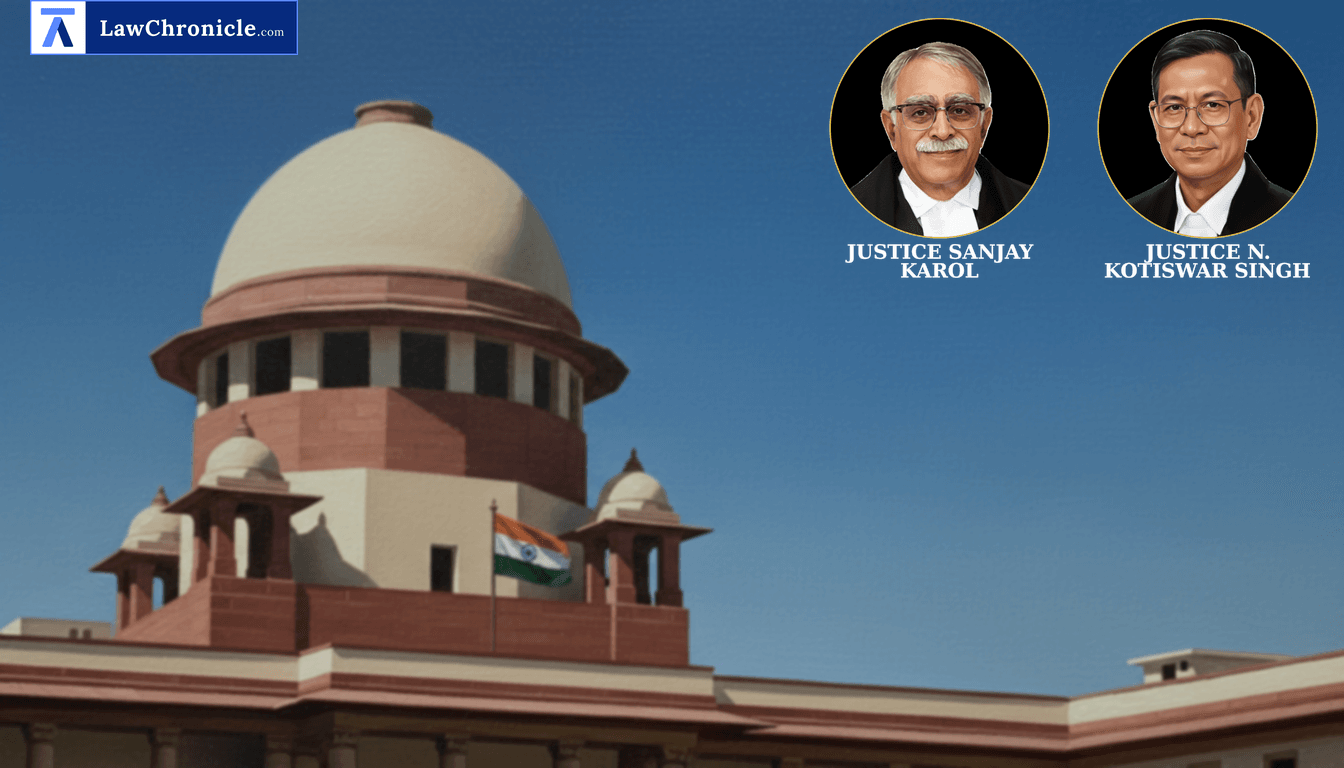
State authorities cannot launch de-novo inquiries to recheck the eligibility of candidates shortlisted by Public Service Commissions once statutory selection rules assign finality to the selection panel's decision. Reaffirming the constitutional autonomy of selection bodies, the apex court ruled that appointing authorities hold no untrammelled power to subject recommended candidates to subjective post-selection eligibility reviews.
A Division Bench comprising Justice Sanjay Karol and Justice Nongmeikapam Kotiswar Singh adjudicated the appeal challenging the decision of the Chhattisgarh High Court, which had upheld the State Government's actions declaring a selected candidate ineligible for the post of Registrar.
Key Takeaways
- Primacy of Constitutional Selection Bodies: Appointing authorities cannot usurp the statutory function of Public Service Commissions by conducting exhaustive de-novo assessments of candidate eligibility.
- Limits on Post-Selection Verification: Post-selection verification by the State is restricted strictly to verifying the genuineness of documents or identifying patent, demonstrable deficiencies.
- Mandatory Reference Procedure: If an appointing authority entertains genuine doubts regarding eligibility, it must refer the matter back to the Commission rather than declaring candidates ineligible independently.
Court Observations and Directions
The Supreme Court observed that while selection does not confer an absolute right to appointment, the discretion to withhold an appointment is strictly circumscribed by statutory rules and must be free from arbitrariness.
The Court, in its reasoning, observed: "In the light of the statutory provision attaching finality to the view of the Commission, we hold that it was not open for the Government to independently re-examine the issue of eligibility and arrive at a different conclusion, based on the detailed re-examination that the candidate is not eligible, that area of consideration having been taken away statutorily from the Appointing Authority and specifically assigned to the Commission."
The Court issued the following directions:
"(i) The inquiry report dated 28.06.2023 submitted by the committee of experts constituted by the Higher Education Department shall not be given effect to qua the Appellant.
(ii) The Appellant is declared eligible for the post of Registrar, in terms of the Advertisement dated 09.02.2021. Consequently, the order dated 31.10.2022 passed by the State Government declaring the Appellant as ineligible is set aside.
(iii) The State Department shall issue the necessary appointment order in favour of the Appellant to the post of Registrar in any State University of Chhattisgarh in terms of the public advertisement dated 09.02.2021 within a period of three weeks from the date of this judgment.
(iv) As we have already held that the Appellant is eligible, he is entitled to be appointed to the post of Registrar from the date on which others who were selected and recommended along with him were given appointment to the post of Registrar, and the Appellant shall be entitled to all the service benefits from that date. However, as the Appellant was given provisional appointment to the post of Registrar on 10.04.2023, the Appellant shall not be entitled to arrears of pay with effect from the said appointed date till 10.04.2023, and his seniority shall also be determined in accordance with the statutory Rules;"
Ratio
Under Rule 10 of the Chhattisgarh State Universities Service Rules, 1983, the determination of a candidate's eligibility by the Public Service Commission is final. An appointing authority cannot conduct an independent, exhaustive re-evaluation of candidate eligibility to supplant the statutory decision of the Public Service Commission.
Background
The dispute arose after the candidate participated in a selection process conducted by the Chhattisgarh Public Service Commission pursuant to an advertisement issued on February 9, 2021, for the post of Registrar under the Chhattisgarh Vishwavidyalaya Adhiniyam, 1973. After expert scrutiny, the candidate was declared successful under the OBC category and recommended for appointment.
However, instead of issuing a final appointment order, the State Government constituted an inquiry committee to re-verify his teaching experience and declared him ineligible on October 31, 2022. The candidate challenged this before the High Court of Chhattisgarh, which allowed the State to conduct an inquiry while granting provisional appointment. The committee subsequently concluded that he lacked requisite experience, and the State posted him to the Higher Education Department rather than a University.
Both the Single Judge and the Division Bench of the High Court dismissed the writ petitions, relying on precedents such as Commissioner of Police v. Umesh Kumar ( "(2020) 10 SCC 448": 2020 CaseBase(SC) 703), Tej Prakash Pathak v. Rajasthan High Court ( "(2025) 2 SCC 1": 2024 CaseBase(SC) 948), Shankarsan Dash v. Union of India ( "(1991) 3 SCC 47": 1991 CaseBase(SC) 594), and Punjab State Electricity Board v. Malkiat Singh ( "(2005) 9 SCC 22": 2004 CaseBase(SC) 1237) to hold that selection confers no indefeasible right to appointment. The High Court further cited principles from H. Mukherjee (Dr) v. Union of India and Asha Kaul (Mrs.) & Anr. Vs. State of Jammu and Kashmir & Ors. ( "(1993) 2 SCC 573": 1992 CaseBase(SC) 821) while evaluating executive discretion.
Reversing the High Court judgment, the Supreme Court noted that statutory provisions must be adhered to, citing Patna Improvement Trust v. Smt. Lakshmi Devi ( "AIR 1963 SC 1077": 1962 CaseBase(SC) 172) and Tata Chemicals Ltd. v. Commissioner of Customs (Preventive), Jamnagar. While recognizing principles surrounding public employment from Ram Ashray Yadav (Dr), Chairman, Bihar Public Service Commission, In Re, Ram Kumar Kashyap v. Union of India, Anoop Mishra v. State of Chhattisgarh, and Manoj Manu v. Union of India ( "(2013) 12 SCC 171": 2013 CaseBase(SC) 564), the Court ruled that the State exceeded its jurisdiction by undertaking a subjective de-novo inquiry in violation of Rule 10 of the Chhattisgarh State Universities Service Rules, 1983 and Article 14 and Article 16 of the Constitution of India.
Case Details:
Case No.: Civil Appeal No. 238 of 2026
Neutral Citation: 2026 INSC 902
Case Title: Shailendra Kumar Patel v. State of Chhattisgarh & Ors.
Source: 2026 CaseBase(SC) 813
Similar Articles
 Breaking News


