


Statutory Power To Evict Unauthorized Occupants Cannot Be Stayed Without Reasoning: Delhi HC
 Copy Link
 Share
 Save
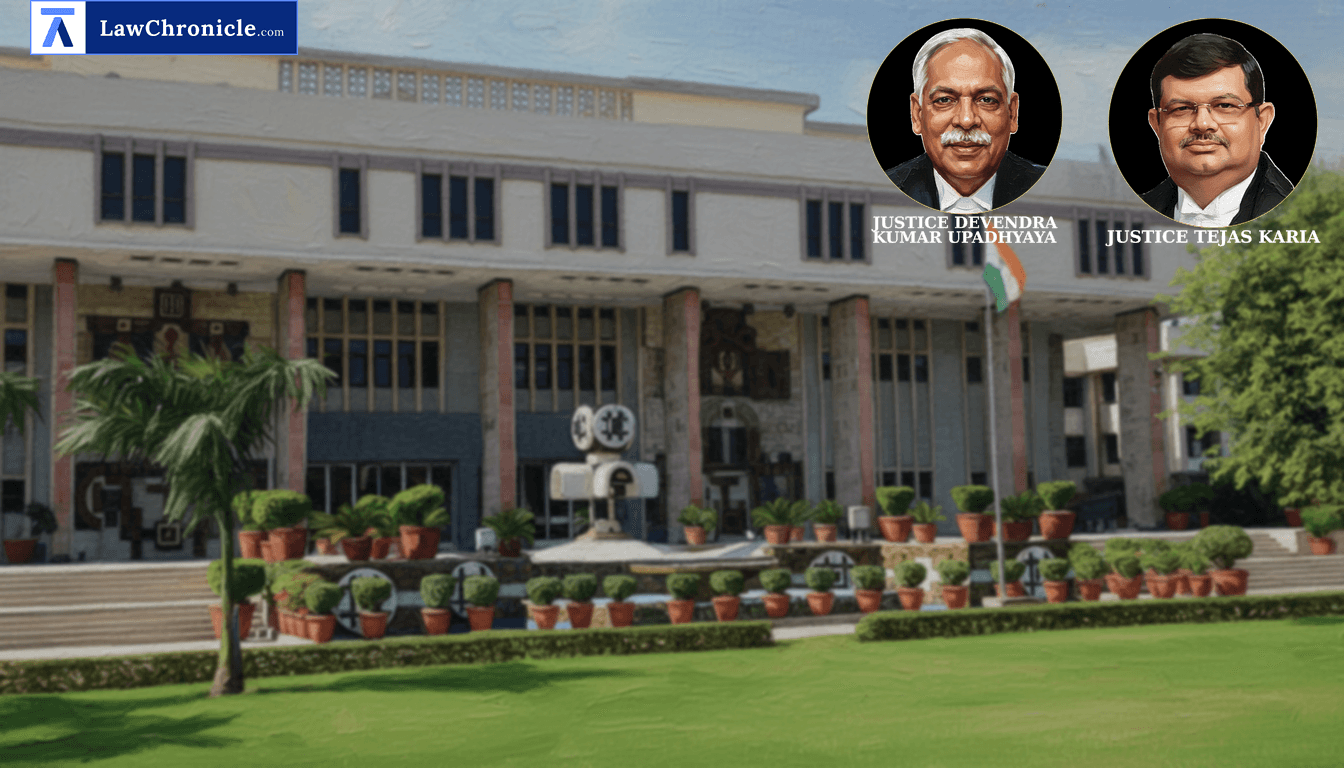
The Delhi High Court set aside an interim stay on eviction proceedings, emphasizing that judicial interference with statutory notices requires a high standard of prima facie evidence and detailed reasoning on irreparable loss and balance of convenience. The Court underscored that the State's right to recover public premises from occupants whose leases have expired is a vital statutory right that cannot be casually restrained.
A Division Bench comprising Chief Justice Devendra Kumar Upadhyaya and Justice Tejas Karia adjudicated an intra-court appeal filed by the Union of India against an interlocutory order that had deferred proceedings before an Estate Officer. The dispute centered around a vast tract of land held by a race club since 1926, where the lease had determined by efflux of time in 1994.
The Definition of Unauthorized Occupation
The Court analyzed the scope of Section 2(g) of the Public Premises (Eviction of Unauthorized Occupants) Act, 1971. Relying on the precedent in Escorts Heart Institute & Research Centre Ltd. v. DDA & Anr., the Bench observed that the term 'unauthorized occupation' is not limited to initial trespassers but explicitly includes persons who were initially authorized to occupy the premises but whose authority has since ceased or determined for any reason.
The Court, in its reasoning, observed: "The expression 'unauthorised occupation' occurring in Section 2(g) has not to be confined to only a person who is found to have occupied any public premises without lawful authority, but it needs to be extended to those occupants whose occupation was initially permissible at the inception, but subsequently ceased to be authorised. Thus, on the basis of the lease, the respondent was validly in occupation and possession of the subject land; however, once the term of the lease had expired way back in the year 1994, such occupation ceased to be authorised in terms of the provisions of the PP Act."
High Threshold for Interim Stays on Eviction
Addressing the legality of the stay order, the Court noted that the learned Single Judge failed to provide findings on the essential trifecta for interim relief: a strong prima facie case, balance of convenience, and irreparable injury. The Bench referred to Deoraj v. State of Maharashtra ( "(2004) 4 SCC 697": 2004 CaseBase(SC) 1317) and Union of India v. Era Educational Trust ( "(2000) 5 SCC 57": 2000 CaseBase(SC) 1597) to highlight that when an interim relief effectively grants the final relief or halts a statutory process, the court must be satisfied that withholding such relief would 'prick the conscience of the court'.
The Court's Directions
The Court has the following directions:
"For the discussions made and reasons given above, the instant appeal is allowed and the order dated 24.04.2026 passed by the learned Single Judge, so far as it directs the Estate Officer to not proceed further with the show-cause notice dated 17.04.2026 is hereby set aside."
Background:
The Union of India (Appellants) challenged an order dated 24.04.2026, which stayed a show-cause notice issued under Section 4 of the Public Premises (Eviction of Unauthorized Occupants) Act, 1971. The Respondent, Delhi Race Club, had occupied 84.484 acres of land under a 1926 lease. While the lease was extended periodically, it finally expired on 31.12.1994. Despite the expiry and subsequent rejection of renewal representations following previous litigation in W.P.(C) 7822/1999, the respondent remained in possession.
The Appellants argued that the Single Judge erred in entertaining a writ petition against a mere show-cause notice, citing Anant Raj Agencies Pvt. Ltd. v. Delhi Development Authority to argue that the only legal recourse for a noticee is to respond to the Estate Officer. The Respondent contended the appeal was not maintainable, arguing the order was purely interlocutory and did not constitute a 'judgment' under Clause 10 of the Delhi High Court Act, 1966.
The Division Bench rejected this, applying tests from Shah Babulal Khimji v. Jayaben D. Kania ( "(1981) 4 SCC 8": 1981 CaseBase(SC) 100), Midnapore Peoples' Coop. Bank Ltd. v. Chunilal Nanda, and Central Mine Planning and Design Institute Ltd. v. Union of India ( "(2001) 2 SCC 588": 2001 CaseBase(SC) 1557) to conclude that the order impacted the statutory rights of the Union and thus qualified as a 'judgment'. The Court further referenced Section 5 and Section 10 of the Delhi High Court Act, 1966 and the Constitution of India, 1950 to affirm its appellate jurisdiction. Ultimately, the Bench found that the statutory process under the Public Premises (Eviction of Unauthorized Occupants) Act, 1971 constitutes 'due process of law' and set aside the stay.
Case Details:
Case No.: LPA 336/2026 & CM APPLs. 30157-59/2026
Case Title: UNION OF INDIA AND ANR v. DELHI RACE CLUB (1940) LTD
Appearances:
For the Petitioner(s): Mr. Chetan Sharma, ASG with Mr. Ashish K. Dixit, CGSC, Mr. Umar Hashmi, Mr. R. V. Prabhat, Mr. Shubham Sharma, Mr. Yash Wardhan Sharma, Mr. Naman, Ms. Iqra Sheikh, Mr. Gaurav, Advs, Mr. Bipin Bhatt, S.O.
For the Respondent(s): Mr. Suhail Dutt, Sr. Adv. with Mr. Azhar Alam, Mr. Sankalp Goswami, Advs.
Source: 2026 CaseBase(DEL) 379
Similar Articles


 Breaking News


