


Strict Liability Governs Electrocution Claims Against State Utilities: SC
 Copy Link
 Share
 Save
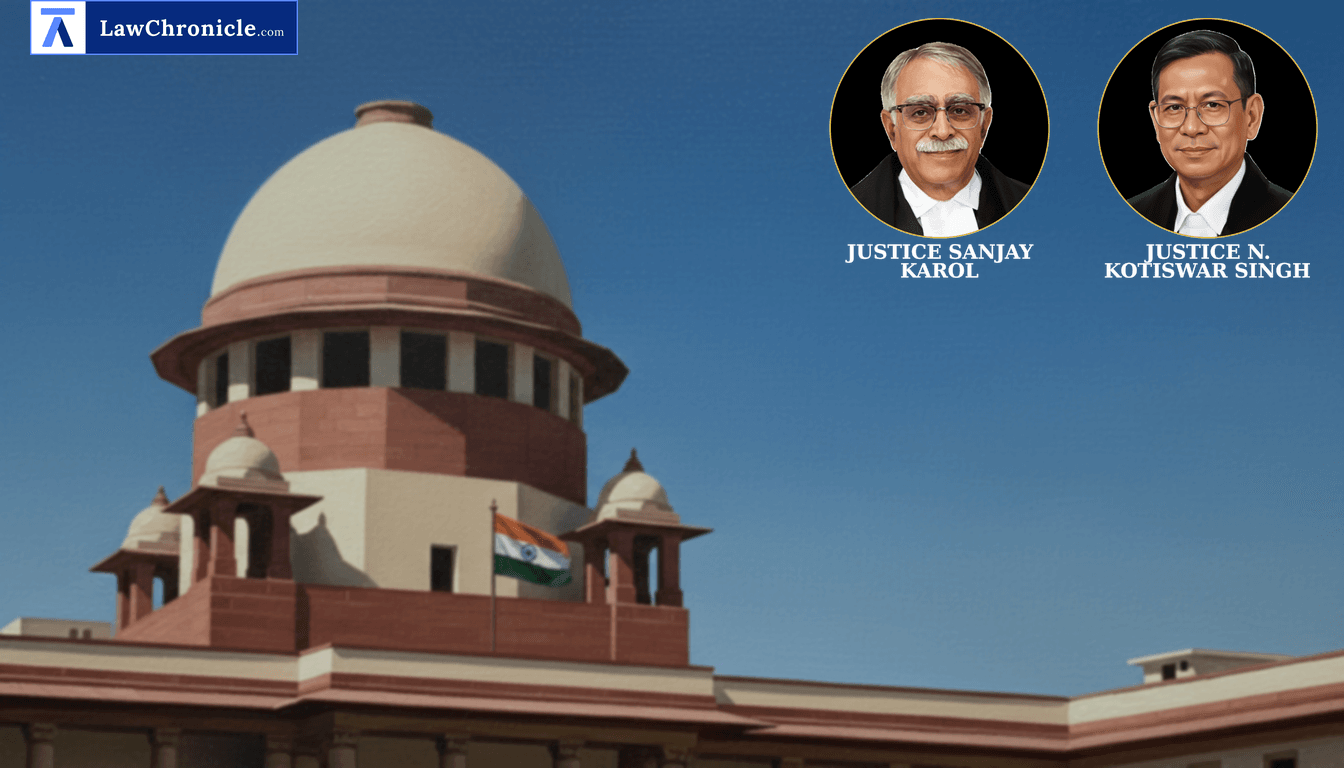
Setting aside orders that awarded writ-based compensation for electrocution fatalities, the Supreme Court ruled that public utility boards are governed by the principle of strict liability which admits legal exceptions rather than absolute liability. The Apex Court declared that writ petitions under Article 226 of the Constitution of India, 1950 are not maintainable for electrocution compensation claims when disputed questions of fact arise regarding negligence or statutory compliance.
A bench comprising Justice Sanjay Karol and Justice Nongmeikapam Kotiswar Singh adjudicated the appeals challenging orders of the Karnataka High Court. The High Court had invoked the principle of absolute liability and used the multiplier framework under the Motor Vehicles Act, 1988 to grant compensation to victims of fatal and severe electrocution incidents. Reversing this approach, the Supreme Court clarified the applicability of strict liability and the procedural limits of constitutional writ jurisdiction in tortious claims against state electricity providers.
Key Takeaways
Strict Liability Standard Applies: State power utilities are governed by strict liability rather than absolute liability, allowing utilities to raise established legal exceptions when faced with compensation claims.
High Court Writ Jurisdiction Limited: Writs under Article 226 are improper remedies for electrocution claims when fundamental factual disputes exist regarding negligence or contributory actions.
Motor Vehicles Act Multiplier Inapplicable: The multiplier framework under the Motor Vehicles Act cannot be applied automatically to compute compensation for electrocution cases.
Clarifying the legal landscape surrounding tortious actions for electrical accidents, the Supreme Court set aside the compensation granted by the High Court while preserving the liberty of the claimants to approach civil courts or appropriate forums for relief. The Court explicitly ruled that interim compensation already paid to the victims shall not be recovered from them.
The Court has following directions:
"The impugned judgment of the Learned Division Bench as also the Single Judge are quashed and set aside. However, the end result here would be of no consequence to the remedy available to the respondent to take recourse to such alternate remedies as are available against the appellant before the concerned forum. As and when filed, the same shall be decided in accordance with law, on an expeditious basis, uninfluenced by any observations made herein. It is further clarified that the amount of compensation paid in these proceedings shall not be recovered from the respondents and neither will it influence the total compensation as may be awarded in the appropriate proceedings, should it arrive at such a conclusion."
The Court, in its reasoning, observed:
"We are of the considered view that to impose strict liability would be more appropriate, for not in all cases can it be said that the electricity boards are liable. The transmission of electricity is undoubtedly inherently dangerous. Those who carry out the inherently dangerous activity should bear the burden, and the State is no exception to that rule. Such enterprises operate on a loss distribution mechanism i.e. they are in the best position to spread the loss incurred through insurance or higher prices, as the case may be. It can also be said that they are expected to factor in these possibilities. It is for these reasons that they are liable to compensate the injured/deceased irrespective of any fault on their part, provided that none of the exceptions to the rule of strict liability apply to the case at hand."
Ratio
Public utilities transmitting electricity are subject to strict liability, not absolute liability, for injuries or fatalities arising from power lines. Where key factual questions concerning negligence, statutory compliance, or contributory acts are disputed, writ petitions under Article 226 are not maintainable, and compensation must be adjudicated through civil remedies under general principles of fair and just assessment rather than the statutory multiplier method of the Motor Vehicles Act, 1988.
Background
The dispute arose from two electrocution incidents in Karnataka. In the first instance, an individual died of electrocution involving an 11 KV line while using an aluminum ladder in a coffee plantation. In the second instance, a young man suffered severe injuries upon coming into contact with a 66KV line while retrieving a ball from a roof. The victims' families filed writ petitions seeking compensation. The state power distribution enterprise contested the petitions on grounds of maintainability, arguing that disputed factual issues existed regarding contributory negligence, equipment status, and statutory clearance distances.
Rejecting these objections, both the Single Judge and Division Bench of the Karnataka High Court awarded substantial compensation by holding the utility absolutely liable and applying the multiplier mechanism under the Motor Vehicles Act, 1988. Reinterpreting the doctrine, the Supreme Court relied on precedent in Radha Krishan Industries v. State of H.P. ( "(2021) 6 SCC 771": 2021 CaseBase(SC) 1575) and T.N. Cements Corpn. Ltd. v. Unicon Engineers to outline exceptions to Article 226 jurisdiction. The Court analyzed Chairman, Grid Corpn. of Orissa Ltd. (Gridco) v. Sukamani Das regarding non-maintainability of writs in factual disputes and discussed the origin of absolute liability in Oleum Gas Leak Case (M.C. Mehta v. Union of India (Shriram - Oleum Gas) ( "(1987) 1 SCC 395": 1987 CaseBase(SC) 158) versus strict liability under the rule in Rylands v. Fletcher and Rajkot Municipal Corpn. v. Manjulben Jayantilal Nakum. Citing Quebec Railway, Light, Heat & Power Co. Ltd. v. Vandry, Union of India v. Prabhakaran Vijaya Kumar ( "(2008) 9 SCC 527": 2008 CaseBase(SC) 1499), M.P. Electricity Board v. Shail Kumari ( "(2002) 2 SCC 162": 2002 CaseBase(SC) 22), and Kaushnuma Begum & Ors. vs New India Assurance Co. Ltd., the Court affirmed that electricity transmission attracts strict liability, which remains subject to exceptions such as plaintiff default or act of a stranger as noted in Raman v. Uttar Haryana Bijli Vitran Nigam Ltd. ( "(2014) 15 SCC 1": 2014 CaseBase(SC) 676). Additionally, relying on Balram Prasad v. Kunal Saha and Raman v. Uttar Haryana Bijli Vitran Nigam Ltd. ( "(2014) 15 SCC 1": 2014 CaseBase(SC) 676), the Apex Court held that the Electricity Act, 2003 does not specify calculation formulas and that the statutory multiplier under motor vehicle law cannot be applied mutatis mutandis. Consequently, the Supreme Court set aside the High Court's judgments, granting liberty to the claimants to seek remedies before appropriate civil forums.
Case Details:
Case No.: Civil Appeal No(s). OF 2026 (Arising out of SLP(C) No(s). 24849 of 2025)
Neutral Citation: 2026 INSC 847
Case Title: KARNATAKA POWER TRANSMISSION CORPORATION LIMITED v. REKHA & ORS.
Source: 2026 CaseBase(SC) 779
Similar Articles

 Breaking News


