


Subordinate Rules Cannot Supplant Parent Acts: Himachal Pradesh HC
 Copy Link
 Share
 Save
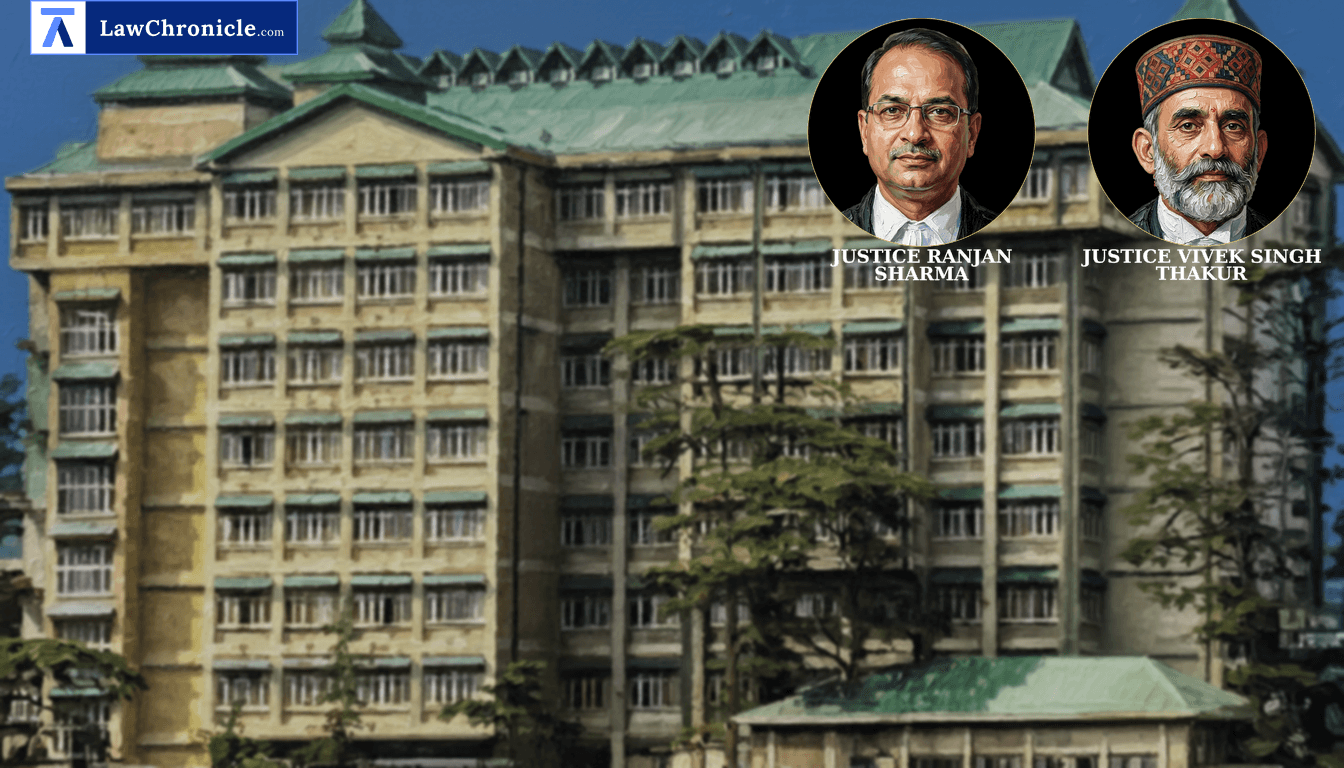
The High Court of Himachal Pradesh has delivered a decisive blow to executive overreach, ruling that subordinate rules cannot impose restrictive conditions that contradict the primary mandate of their parent legislation. By striking down parts of the State Para Veterinary Council Rules, the Court has reinforced the principle that administrative bodies must operate strictly within the legislative framework established by the parent Act.
A bench of Justice Vivek Singh Thakur and Justice Ranjan Sharma heard a petition challenging the refusal of the Himachal Pradesh Para Veterinary Council to register a practitioner who completed her diploma from a University established by the Punjab State Legislature. The Court examined whether a rule could mandate additional state recognition for a University already established by law under the Himachal Pradesh Para Veterinary Council Act, 2010.
Invalidity of Rule 14 of the HPPVC Rules
The Court scrutinized Section 2(j) of the Himachal Pradesh Para Veterinary Council Act, 2010, which distinguishes between 'Universities established by law' and 'any other institution recognized by the State Government.' The bench observed that the Petitioner, having graduated from Guru Angad Dev Veterinary and Animal Sciences University Act (a University established by statute), possessed a 'recognized Para-veterinary qualification' as per the Act. However, Rule 14 of the Himachal Pradesh Para Veterinary Council Rules, 2011 sought to restrict eligibility only to institutions recognized by the Himachal Pradesh State Government.
The Court, in its reasoning, observed: "It is settled law that Rules and Regulations can supplement the Act, but cannot supplant the same. Rule 14 of the Himachal Pradesh Para Veterinary Council Rules, 2011, to the extent it provides that institutions/Universities imparting training shall have to be registered with the State Council, as well as providing that only Universities recognized by the State Government shall be eligible for registration in the State Council, is in direct conflict with the provisions of the Himachal Pradesh Para Veterinary Council Act, 2010."
Delegated Legislation Must Not Travel Beyond the Parent Act
In reaching its conclusion, the bench relied on established constitutional principles regarding delegated legislation. Citing Som Krishan vs. Paras Ram & Ors. ( "AIR 1958 (Himachal Pradesh) 26": 1958 CaseBase(HP) 6), the Court noted that rules must be for the purpose of carrying out the provisions of the Act and cannot take away what is given by the Act. Furthermore, the Court referred to Nedurimili Janardhana Reddy vs. Progressive Democratic Students’ Union and Ors. ( "(1994) 6 SCC 506": 1994 CaseBase(SC) 496) and St. Johns Teachers Training Institute vs. Regional Director, National Council for Teacher Education & Anr. ( "(2003) 3 SCC 321": 2003 CaseBase(SC) 129) to emphasize that while regulations are in aid of enforcement, they cannot supplant the enabling statute.
The Court also invoked the doctrine of ultra vires as discussed in Union of India & Ors. vs. S. Srinivasan ( "(2012) 7 SCC 683": 2012 CaseBase(SC) 77) and Ram Chandra Choudhary & Ors. vs. Roop Nagar Dugdh Utpadak Sahakari Samiti Limited & Ors. ( "2026 SCC OnLine SC 583": 2026 CaseBase(SC) 307), holding that rule-making bodies derive power only from the statute and must function within its confines. The bench noted that the University Grants Commission Act, 1956 and Constitution of India ensure quality standards for Universities, and the State Council cannot impose additional hurdles that the parent Act never intended.
Directions Issued by the Court
The Court has the following directions:
"(i) Part of Rule 14 of Himachal Pradesh Para Veterinary Council Rules, 2011 is quashed and set aside to the extent it provides that Universities imparting Para Veterinary Science training shall have to be got registered with the Council and Universities recognized by the State Government shall be eligible for registration in the Council.
(ii) Consequently, petitioner is held entitled to be registered with Himachal Pradesh Para Veterinary Council ('State Council') and the State Council is directed to register the petitioner within one week, subject to completion of all other codal formalities. Registration certificate be issued to the petitioner accordingly."
Key Takeaways:
Primacy of Parent Legislation
Subordinate legislation that introduces new disabilities or restrictions not contemplated by the parent Act will be struck down as ultra vires.
Statutory Definitions Bind the Executive
When an Act explicitly defines 'recognized qualifications' to include degrees from any University established by law, rules cannot narrow that definition to only 'State-recognized' entities.
Limitation of Delegated Power
The power to make rules 'for carrying out the purposes of the Act' is ancillary and cannot be used to bring into existence substantive rights or obligations inconsistent with the parent statute.
Ratio Decidendi:
A rule-making authority cannot exercise delegated power to supplement a statute in a manner that creates a conflict or imposes restrictive conditions that are not present in the parent Act. Specifically, if a parent statute recognizes qualifications from all Universities established by law, a subordinate rule requiring additional 'State Government recognition' for such Universities is ultra vires and void.
Background:
The petitioner completed a Diploma in Veterinary Science from a constituent college of Guru Angad Dev Veterinary and Animal Sciences University Act, a university established by Punjab Act No. 16 of 2005. Upon applying for registration with the Himachal Pradesh Para Veterinary Council, her application was rejected. The Council argued that under Rule 14 of the Himachal Pradesh Para Veterinary Council Rules, 2011, only Universities recognized by the H.P. State Government and registered with the State Council were eligible. The petitioner challenged this as being contrary to the Himachal Pradesh Para Veterinary Council Act, 2010, which granted recognition to any University established by law. The High Court agreed, quashing the restrictive portions of the Rule and the rejection communication.
Case Details:
Case No.: CWP No. 14874 of 2025
NeutralCitation: 2026:HHC:28741
Case Title: Riya Sharma v. State of Himachal Pradesh & Ors.
Appearances:
For the Petitioner(s): Mr. Vikas Rajput, Advocate.
For the Respondent(s): Mr. Ramakant Sharma, Additional Advocate General for respondents No.1 & 2; Ms. Kiran Dhiman, Advocate, for respondent No.3.
Source: 2026 CaseBase(HP) 42
Similar Articles
 Breaking News


