


Supreme Court Acquits Two in Brutal Murder Case Citing Broken Chain of Circumstantial Evidence
 Copy Link
 Share
 Save
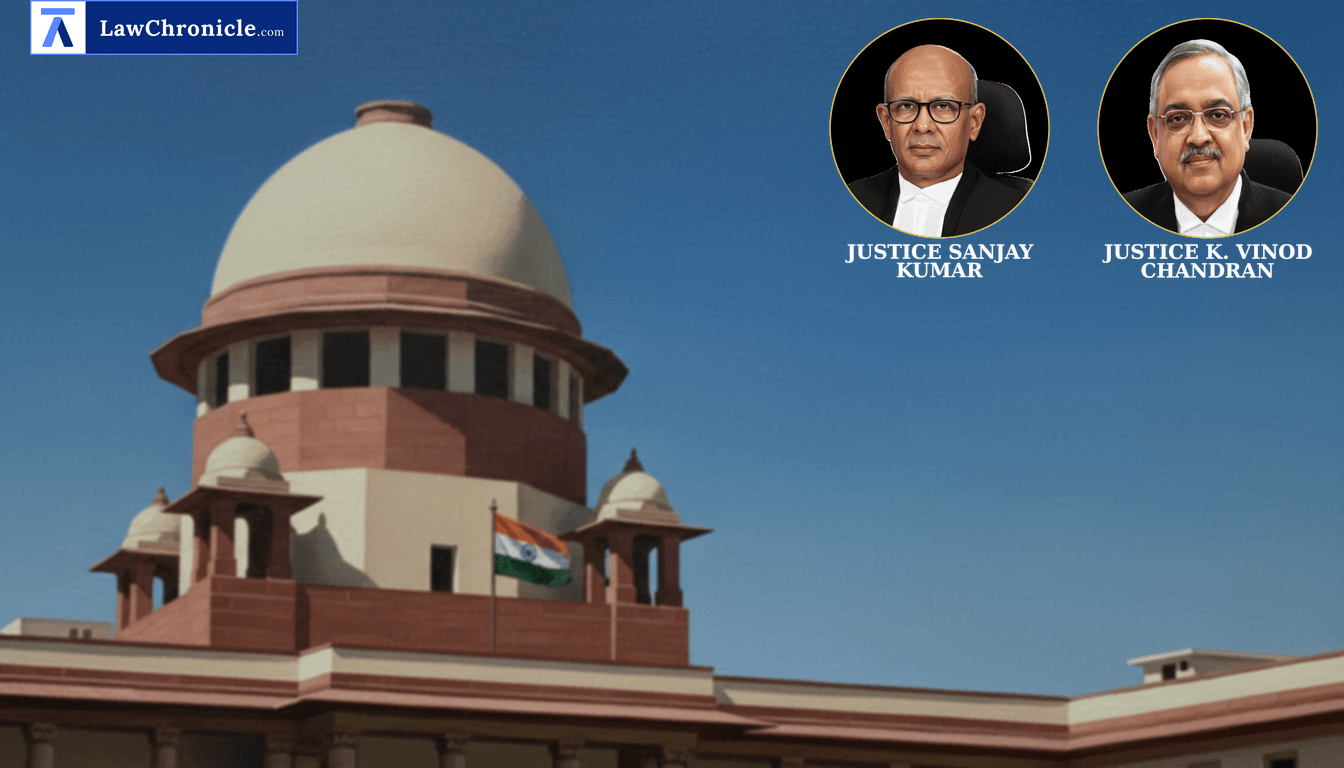
The Supreme Court overturned the conviction of two individuals in a decade-old murder case, emphasizing that a conviction cannot be based solely on a weak 'last seen together' theory and doubtful extra-judicial confessions.
A division bench comprising Justice Sanjay Kumar and Justice K. Vinod Chandran set aside the judgments of the Trial Court and the High Court, which had previously sentenced the appellants for the premeditated murder of a village youth. The Court noted that the prosecution failed to establish a complete and clinching chain of circumstances required to sustain a conviction in cases based purely on circumstantial evidence.
The Fragility of the 'Last Seen Together' Theory
While the prosecution relied heavily on the fact that the deceased was last seen with the accused on the evening of October 30, 2012, the Court found the time gap between this sighting and the estimated time of death to be too large. Referring to the principles laid down in State of Goa v. Sanjay Thakran and Another, the bench observed that when the time gap is substantial, intervening circumstances can snap the link between the accused and the crime.
The Court, in its reasoning, observed: "The time frame being quite large to term death as proximate, there can be no conviction based on the last seen together theory in the present case. We have to hence, necessarily look at the other circumstances, which together, if found incriminating enough, the last seen together theory also would offer a link, though a weak one, in the chain of circumstances."
Inadmissibility of Extra-Judicial Confessions and Faulty Recoveries
The bench further scrutinized the alleged extra-judicial confessions, noting that they were made while the accused were detained by a mob, suggesting undue duress. One such statement was even found to be exculpatory rather than confessional, as the accused had blamed his co-accused while absolving himself.
Regarding the recovery of a stone and glass piece allegedly used as weapons, the Court highlighted serious procedural lapses under Section 27 of the Indian Evidence Act, 1872. The Court noted that there were no recorded statements of the accused regarding the concealment of these objects, which is a mandatory requirement for such evidence to be admissible.
Failure to Establish Motive and Weaponry
The Court also pointed out that the alleged murder weapons were never shown to the medical officer for an opinion on whether they could have caused the injuries. Additionally, the lack of a clear motive in a case of such brutality raised further reasonable doubts.
The Court has the following directions:
"We direct the Member Secretary, National Legal Services Authority to get in touch with the Member Secretary of the West Bengal State Legal Services Authority, who shall through the Secretary of the District/Taluk Legal Services Authority, having jurisdiction over the prison in which A3 is imprisoned, provide sufficient assistance to A3 and ensure that an appeal is filed before this Court from the impugned judgment. The same shall be done within a period of two months and the compliance be reported to us, for which purpose alone the matter is posted on 20th of July, 2026."
Background:
The case originated in 2012 when the son of the de-facto complainant went missing after going out with the three accused on motorbikes. His body was discovered the following day in a field with severe facial injuries. The prosecution built its case on the testimonies of villagers, alleged confessions made while under mob detention, and the recovery of items from the crime scene. While the Trial Court and the High Court found these circumstances sufficient for conviction, the Supreme Court meticulously dismantled each piece of evidence, finding the testimonies of key witnesses like PW11 and PW4 to be unreliable.
Ultimately, the Supreme Court allowed the appeals, ordering the immediate release of the appellants. In an act of judicial empathy, the Court also took notice of the third accused, who had not filed an appeal, and directed legal aid authorities to assist him in challenging his conviction.
Case Details:
Case No.: Criminal Appeal No. 2507 of 2026
Case Title: Papan Sarkar @ Pranab v. State of West Bengal
Appearances:
For the Petitioner(s): Ms. Ashima Mandla, Advocate
For the Respondent(s): Ms. Shraddha Chirania, Advocate
Source: 2026 CaseBase(SC) 450
Similar Articles

 Breaking News


