


Supreme Court Allows Debenture Trustee’s Section 7 Claim, Holds DTD Procedure Cannot Be Circumvented
 Copy Link
 Share
 Save
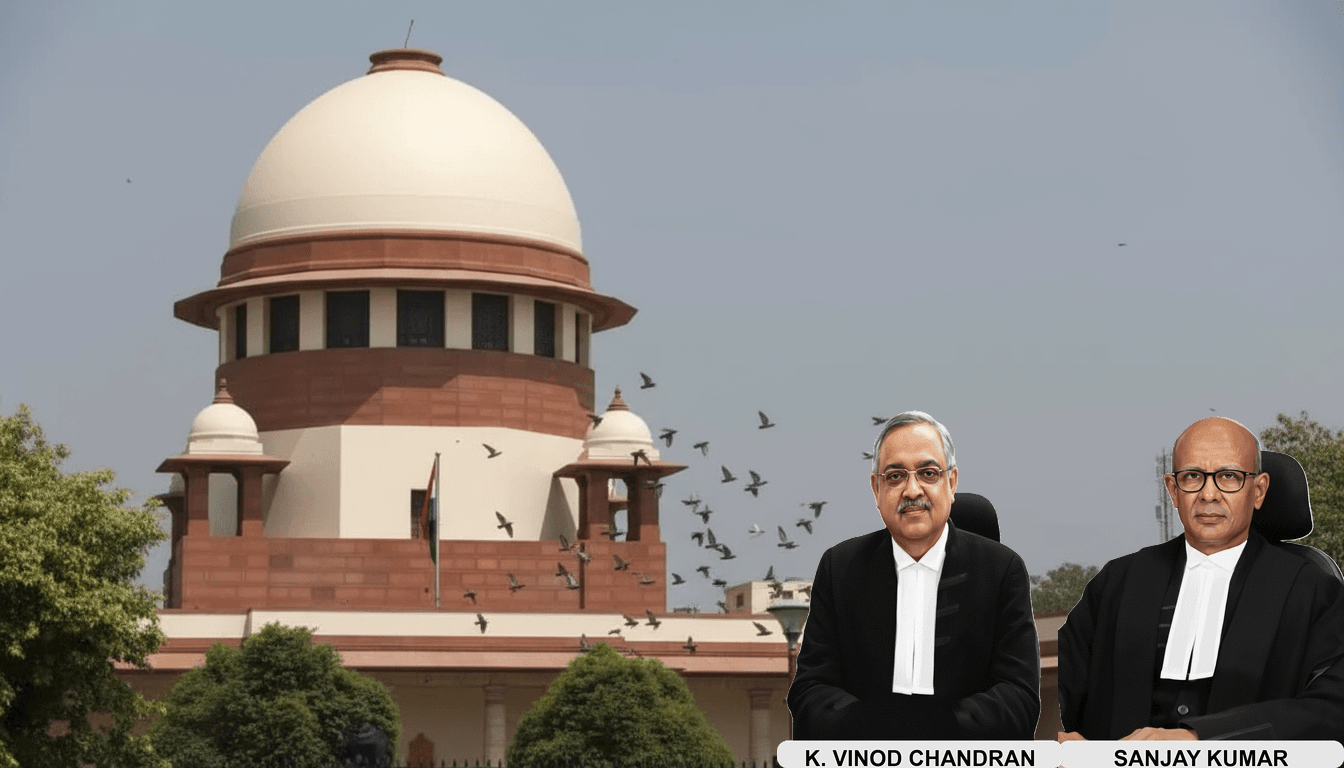
A bench of Justices Sanjay Kumar and K. Vinod Chandran heard an appeal by Catalyst Trusteeship Ltd. challenging the dismissal of its application under Section 7 of the Insolvency and Bankruptcy Code seeking initiation of corporate insolvency resolution process against Ecstasy Realty Pvt. Ltd. The question before the Court was whether the NCLT and the NCLAT erred in finding that a moratorium or an effective restructuring had negated the existence of a default under the Debenture Trust Deed (DTD).
The Supreme Court allowed the appeal and held that the adjudicating authorities had “erred in ignoring the binding terms of the Debenture Trust Deed dated 27.03.2018 and in reframing the terms thereof on the strength of surmises, conjectures and assumptions, which were not borne out on facts and were completely unsustainable in law.” The Court reiterated the settled principle that for admission under Section 7 the adjudicating authority only had to be satisfied that a financial debt existed and there was default; a pre-existing dispute doctrine applicable to operational creditors did not prevent admission by a financial creditor. The Court, in its reasoning, observed: “In this regard, we may note the settled legal position that for admission of an application under Section 7 of the Code, the adjudicating authority is only required to examine and satisfy itself that a financial debt exists and there is default in relation thereto. In this context, the observations of this Court in Innoventive Industries Limited vs. ICICI Bank and another are of relevance and are extracted hereunder: ‘30. On the other hand, as we have seen, in the case of a corporate debtor who commits a default of a financial debt, the adjudicating authority has merely to see the records of the information utility or other evidence produced by the financial creditor to satisfy itself that a default has occurred. It is of no matter that the debt is disputed so long as the debt is “due” i.e. payable unless interdicted by some law or has not yet become due in the sense that it is payable at some future date. It is only when this is proved to the satisfaction of the adjudicating authority that the adjudicating authority may reject an application and not otherwise.’” The Court further remarked that adverse findings against the debenture trustee for alleged collusion were “without basis” and set those aside.
Background
The dispute arose after Ecstasy Realty issued Series A redeemable non-convertible debentures aggregating ₹600 crore under a DTD dated 27.03.2018; Series B of ₹250 crore was not issued. In March 2022 Ecstasy proposed restructuring and an 18‑month moratorium to one majority debenture holder (ECL Finance Ltd.), but did not obtain the written approvals or follow the amendment procedure prescribed by clause 33 of the DTD nor inform all debenture holders or the trustee of the negotiations. The debenture trustee issued demand notices and, after rejection of the restructuring by over 94% of debenture holders, issued a recall notice. The trustee filed a Section 7 petition which the NCLT dismissed on the view that a moratorium had come into effect; the NCLAT confirmed that decision. Catalyst appealed to the Supreme Court.
The Supreme Court examined DTD clauses requiring any modification to be effected by “approved instructions” of debenture holders, compliance with Schedule 2 voting requirements, and that waivers be in writing. It noted the respondent’s failure to produce authorization showing that communications with a representative of one holder bound the others. The Court observed that certain releases of funds and assets related to specific DTD provisions and fresh funding, and that correspondence did not evidence an agreed modification of the DTD. The Court followed precedent including Innoventive and Indus Biotech and held that a corporate debtor could not indirectly raise a pre‑existing dispute to defeat a financial creditor’s Section 7 claim where the contractual amendment procedure had not been complied with. The Supreme Court set aside the orders of the NCLT and NCLAT, restored Company Petition (IB) 922/MB/C‑I/2022 to the NCLT file and directed that it be admitted and proceeded with in accordance with law.
Case Details:
Case No.: 2026 INSC 186; Civil Appeal No. 7424 of 2025
Case Title: Catalyst Trusteeship Ltd. v. Ecstasy Realty Pvt. Ltd.
Appearances:
For the Petitioner(s): [Not indicated in judgment]
For the Respondent(s): [Not indicated in judgment]
Source: 2026 CaseBase(SC) 150
Similar Articles
 Breaking News


