


Supreme Court directs 12% Interest on delayed payment of Provident Fund
 Copy Link
 Share
 Save
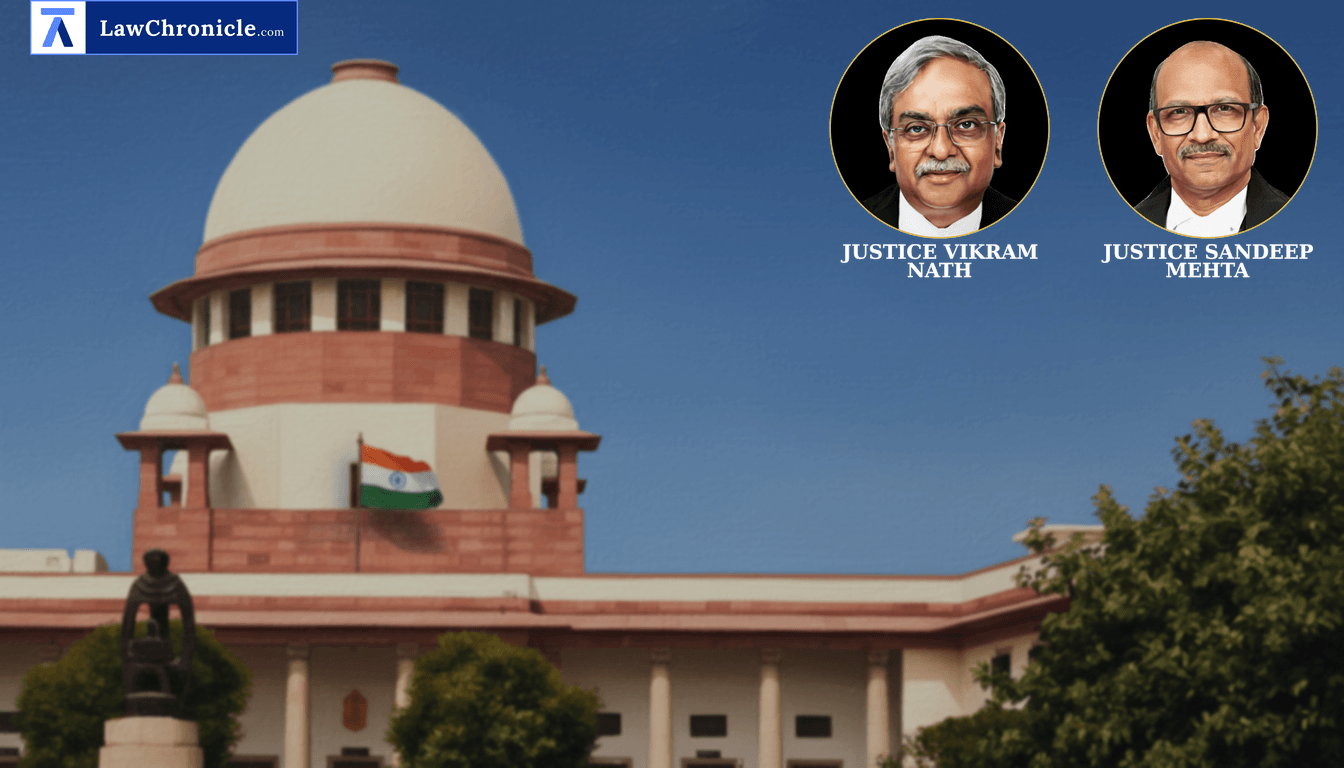
Resolving a long-standing inter-State dispute following corporate reorganizations, the Supreme Court has mandated the payment of 12% interest on delayed payment of provident fund and 6% interest on back wages to workers left in limbo for decades. Settling the residual issues stemming from the dissolution of five State-owned corporations, the Apex Court held that corporate restructuring cannot strip employees of their fundamental statutory rights or accrued financial security.
A bench of Justice Vikram Nath and Justice Sandeep Mehta addressed the lingering disputes arising out of the reorganisation of the erstwhile State of Bihar under the Bihar Reorganisation Act, 2000. The matter pertained to non-payment and delay in disbursal of dues of employees belonging to five State-owned inter-State corporations following the creation of the State of Jharkhand.
Key Takeaways
- Statutory Interest Mandate: Employers are strictly bound to pay 12% per annum simple interest on delayed payment of provident fund dues as a non-negotiable statutory consequence.
- Relief for Daily-Wagers: Recognized daily-wage workers of defunct public corporations receive a lump-sum compensation of Rs. 1,00,000 to balance equities after decades of delay.
- Finality for Residual Claims: Untraced or unverified employees are given a final 12-month window to present claims before designated Nodal Officers.
- Digital Transparency Mandate: States must publish comprehensive list and status of settled and pending worker dues on official public portals.
Addressing the substantive issues on interest, daily wagers' entitlements, and identification of remaining employees, the Supreme Court issued a set of comprehensive directions, as follows:
"a. Though the States of Bihar and Jharkhand have substantially complied with the directions issued by this Court in paragraph 37 of the order dated 29th May, 2026, as per their compliance affidavits, certain aspects of such implementation continue to remain pending. The respective States shall, therefore, take all necessary steps to complete the implementation of the aforesaid directions in respect of the cases which remain pending and bring the same to its logical conclusion, in accordance with law.
b. The exercise for identification and verification of the remaining employees/workmen shall stand closed. The untraced/unverified employees/workmen or their legal heirs, as the case may be, upon being traced or upon otherwise gaining knowledge of these proceedings would be at liberty to approach the concerned Nodal Officer appointed for the respective Corporation, within a period of 12 months from the date of this order, with the requisite documents for verification, whereupon their claims shall be duly processed and the amounts found payable shall be disbursed in accordance with law.
c. With a view to ensuring transparency and facilitating verification of the claims of the employees/workmen of the erstwhile defunct Corporations, the States of Bihar and Jharkhand shall:
(i) compile and publish, in the public domain, updated particulars of all employees/workmen, including those whose dues have been paid or whose liability has otherwise been discharged and those whose claims remain pending;
(ii) in respect of employees/workmen whose dues have been paid or liability discharged, publish their name, designation, period of service, amount payable, amount disbursed, date of disbursement and such other particulars as may be relevant for identification and verification of the claim;
(iii) in respect of employees/workmen whose claims remain pending on account of their being untraced, unverified or for want of requisite documents, indicate the present status of the claim, the reason for pendency and the documents or steps required for its processing, together with the contact particulars of the concerned Nodal Officer;
(iv) post the aforesaid information on the official websites of the Information and Public Relations Department of the States, as also on the website of the concerned parent Administrative Department of the erstwhile Corporations; and
(v) complete the aforesaid publication within four weeks from the date of this order and thereafter update the information periodically to reflect any subsequent verification, payment or discharge of liability.
d. The States of Bihar and Jharkhand are directed to pay a one-time sum of Rs.1,00,000/- to each of the concerned daily-wage employees/workmen who were engaged during the relevant period.
e. The States of Bihar and Jharkhand shall ensure payment of simple interest at the rate of 12% per annum on the delayed EPF dues, and at the rate of 6% per annum on the delayed salary, wages and other monetary entitlements, for the period commencing from the date on which the respective amounts became due and payable until the date of their actual payment.
f. The liability of the respective State shall be determined in accordance with the mechanism already approved by this Court vide its order dated 29th May, 2026."
Examining the legal character of provident fund dues under Section 7-Q of the Employees Provident Funds and Miscellaneous Provisions Act, 1952, the Supreme Court stressed that such interest is an inescapable statutory obligation. The Bench observed that "Section 7-Q of the Act is not founded upon any discretionary determination of compensation; it is a liability which arises by operation of the statute upon delayed payment of an amount due under the Act. Accordingly, such interest is liable to be computed from the date on which the amount became due and continues to accrue until the date of its actual payment."
Regarding interest on unpaid salary and back wages, the Supreme Court highlighted the nature of interest as recompense for unjust deprivation of money lawfully due to workers. The Bench noted that "Interest, in its ordinary legal sense, represents compensation for the deprivation of the use of money to which a person is otherwise lawfully entitled. The concept of interest is not confined to a return upon money borrowed or advanced, but extends to compensation for the unjust deprivation occasioned by the withholding of money beyond the time when it becomes due and payable."
Ratio
Statutory interest under Section 7-Q of the Employees' Provident Funds and Miscellaneous Provisions Act, 1952 accrues by operation of law automatically upon delayed deposit and cannot be denied or reduced. Furthermore, state instrumentalities cannot escape liability for interest on delayed salaries of employees belonging to defunct corporations under the shield of separate juristic personality where workers have been deprived of their legitimate dues for decades.
Background
The history of the litigation traces back to the aftermath of the Bihar Reorganisation Act, 2000 and earlier proceedings in Kapila Hingorani v. State of Bihar ( "(2003) 6 SCC 1": 2003 CaseBase(SC) 353). The reorganisation created five defunct or struggling inter-State corporations whose employees faced non-payment of salaries, retiral benefits, and provident fund contributions for extended periods. Following extensive inquiries and report evaluations by a Court-appointed Committee headed by Justice Dinesh Maheshwari (Retd.), the Supreme Court oversaw the verification and payment of principal dues to over 2,074 verified employees across Bihar and Jharkhand.
While interpreting statutory provisions under Section 7-Q of the Employees Provident Funds and Miscellaneous Provisions Act, 1952, the Supreme Court relied on the law laid down in Arcot Textile Mills Ltd. v. Regl. Provident Fund Commissioner & Ors. ( "(2013) 16 SCC 1": 2013 CaseBase(SC) 134), which established that interest on delayed EPF payments serves a beneficial social-welfare purpose as compensatory protection for affected workers. Furthermore, regarding the general entitlement to interest on delayed wage payments under constitutional principles and public law, the Bench relied on the Constitution Bench judgment in Central Bank of India v. Ravindra & Ors. ( "(2002) 1 SCC 367": 2001 CaseBase(SC) 2408) to affirm that any person deprived of the legitimate use of money is entitled to compensation for such deprivation. The Court also emphasized that the extraordinary delay severely impacted workers' dignity and fundamental rights under Article 21 of the Constitution of India.
Case Details:
Case No.: Writ Petition (Civil) No(s). 932 of 2022
Neutral Citation: 2026 INSC 1061
Case Title: Bihar State Ardh Sarkari Arajpati Karamchari Maha Sangh and Others v. State of Bihar and Others
Source: 2026 CaseBase(SC) 8120
Similar Articles
 Breaking News


