


Supreme Court Questions Mandatory Penalties under EPF Act, Refers Issue to Larger Bench
 Copy Link
 Share
 Save
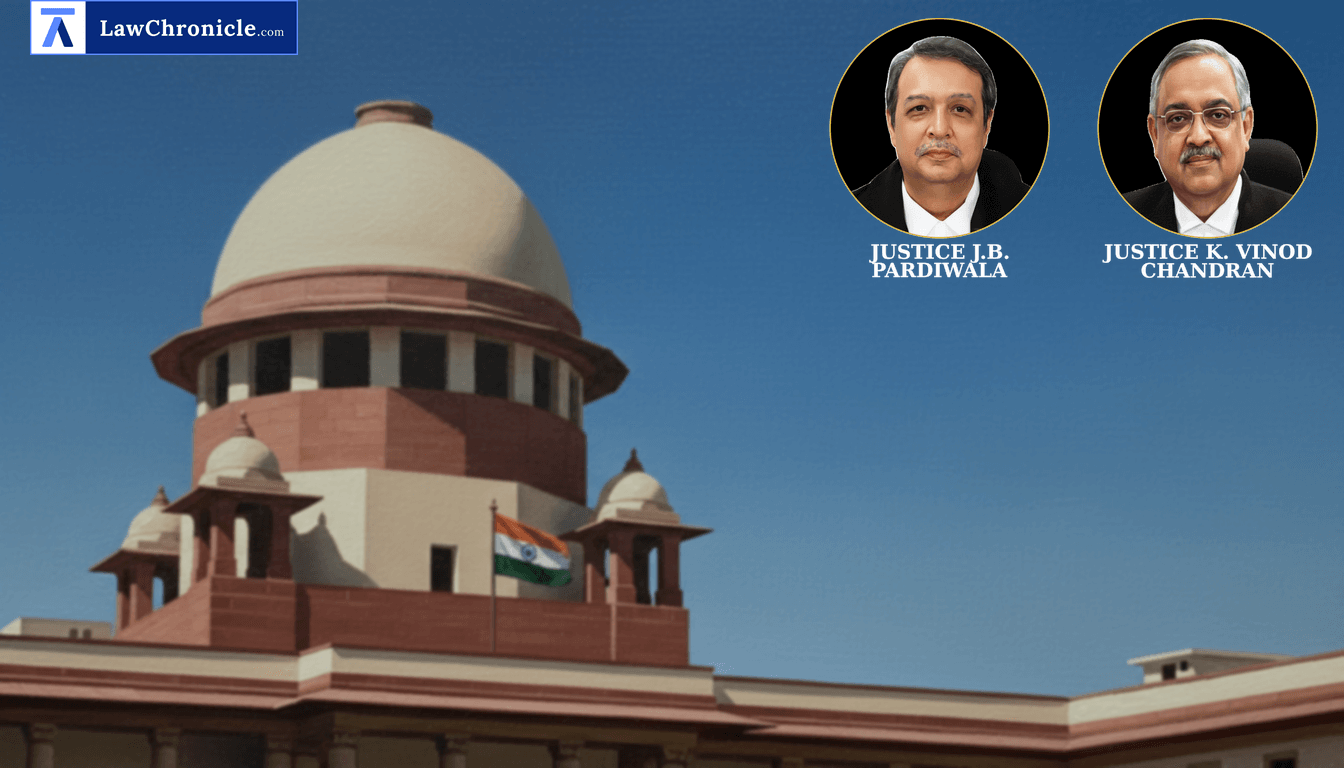
In a major development for corporate resolution applicants, the Supreme Court has questioned the mandatory imposition of penalties under EPF Act, referring the issue of judicial discretion in levying damages to a larger Bench.
A Division Bench comprising Justice J.B. Pardiwala and Justice K. Vinod Chandran was hearing a batch of appeals filed by Successful Resolution Applicants (SRAs), including M/s Kerala Industrial Infrastructure Development Corporation, challenging orders that mandated full payment of provident fund dues and damages under the Employees Provident Funds Miscellaneous Provisions Act, 1952.
Key Takeaways
Discretionary Penalties Under Scrutiny: The Supreme Court has expressed doubts over whether damages under Section 14B of the Employees Provident Funds Miscellaneous Provisions Act, 1952 are automatic or subject to administrative discretion.
Full PF Protection Maintained: Successful Resolution Applicants remain strictly liable to clear provident fund dues and Section 7Q statutory interest without routing them through IBC waterfall mechanisms.
Rehabilitation Parity for SRAs: Resolution plans under the Insolvency And Bankruptcy Code, 2016 are recognized as akin to SICA rehabilitation schemes, enabling SRAs to seek penalty waivers from the Central Board.
Staggered Payment Relief Granted: The Court permitted SRAs to satisfy their outstanding EPF liabilities and interest in four quarterly installments extending up to late 2027.
On Mandatory Penalties under EPF Act
The Supreme Court reaffirmed the binding precedent that provident fund and gratuity dues must be paid in full by SRAs to save a resolution plan from invalidation under Section 30(2)(e) of the Insolvency And Bankruptcy Code, 2016. However, expressing doubt regarding the automatic nature of penalty damages under Section 14B, the Bench referred the question of discretion to a larger Bench.
The Apex Court issued the following directions:
"17. We, therefore, direct the Registry of this Court to place the matter before the Hon’ble the Chief Justice of India for consideration by a larger Bench.
- We make it clear that the reference would not impair the right of the appellants herein, SRAs, to approach the Central Board under the Second Proviso of Section 14B.
- On the request made by the learned Counsel appearing for the respective appellants, we also deem it fit to direct the appellants to pay the due amounts under the EPF & MP Act, along with Section 7Q interest, in four quarterly instalments, the first instalment starting on 15th December, 2026 and then falling on 15th March, 2027, 15th June, 2027 and 15th September, 2027. The interest accrued under Section 7Q due to the deferred instalments, would also be levied and communicated by the Authorized Officer to the SRA after the last instalment is paid, which would be satisfied before 15th October, 2027. If any single default is committed, the EPFO can proceed for recovery."
The Supreme observed that "...the words employed under the amended Section 14B, is to the effect that the Commissioner or the Authorized Officer, 'may recover' by way of penalty such damages. Hence, the discretion is still left with the authority to decide as to whether there should be an imposition of penatly at all. If the Authorized Officer is satisfied that the imposition of penalty has to be made in the facts and circumstances, then the levy shall be under the scheme; which alone is outside the discretion of the authority."
Ratio
Section 14B of the Employees Provident Funds Miscellaneous Provisions Act, 1952 confers quasi-judicial discretion on the authorized officer to decide whether or not to levy damages by way of penalty based on the extenuating circumstances of a default, whereas the statutory interest under Section 7Q remains mandatory and non-discretionary. Furthermore, Resolution Plans sanctioned under the Insolvency And Bankruptcy Code, 2016 are functionally equivalent to rehabilitation schemes under the former Sick Industrial Companies (Special Provisions) Act, 1985 for the purpose of seeking penalty reduction or waiver from the Central Board.
Background
The Central Board of Trustees, EPFO, asserted that workmen's provident fund dues must be paid in full by SRAs outside the liquidation waterfall under Section 53(1) of the Insolvency And Bankruptcy Code, 2016, relying on Maharashtra State Cooperative Bank Limited v. Assistant Provident Fund Commissioner and Others ( "(2009) 10 SCC 123": 2009 CaseBase(SC) 97) and Jet Aircraft Maintenance Engineers Welfare Association v. Ashish Chhawchharia, Resolution Professional of Jet Airways (India) Ltd. and Others. This position was reaffirmed in Jalgaon District Central Coop. Bank Ltd. v. State of Maharashtra and Others, Jalan Fritsch Consortium v. Regional Provident Fund Commissioner, Jalan Fritsch Consortium v. Jet Aircraft Maintenance Engineers Welfare Association, and State Bank of India v. Murari Lal Jalan & Florian Fritsch (Consortium), establishing that statutory first charges under Section 11(2) of the Employees Provident Funds Miscellaneous Provisions Act, 1952 override non-obstante provisions in other enactments, including the Securitisation and Reconstruction of Financial Assets and Enforcement of Security Interest Act, 2002.
While acknowledging this settled liability, the Bench examined Section 14B damages post the 1988 amendment and the insertion of Section 7Q. Distinguishing the ruling in Horticulture Experiment Station Gonikoppal, Coorg v. Regional Provident Fund Organization ( "(2022) 4 SCC 516": 2022 CaseBase(SC) 219)—which held damages to be automatic upon civil default, the Apex Court analyzed Organo Chemical Industries and Another v. Union of India and Others ( "(1979) 4 SCC 573": 1979 CaseBase(SC) 422) to hold that the statutory shift separating interest under Section 7Q leaves Section 14B strictly as a penal mechanism where the word 'may' retains judicial discretion. Considering that resolution plans under the Insolvency And Bankruptcy Code, 2016 serve the objective of business rehabilitation previously handled under Section 4 of the Sick Industrial Companies (Special Provisions) Act, 1985, the Supreme Court clarified that SRAs may seek penalty waivers under the second proviso to Section 14B from the Central Board, while referring the core question of statutory discretion under Section 14B to the Chief Justice of India for larger Bench adjudication.
Case Details:
Case No.: Civil Appeal No.7724 of 2023
Neutral Citation: 2026 INSC 990
Case Title: M/s Kerala Industrial Infrastructure Development Corporation v. Central Board of Trustees and Anr.
Source: 2026 CaseBase(SC) 8082
Similar Articles


 Breaking News


