


Supreme Court dissolves marriage under Article 142 and orders Rs.1 crore as full and final alimony
 Copy Link
 Share
 Save
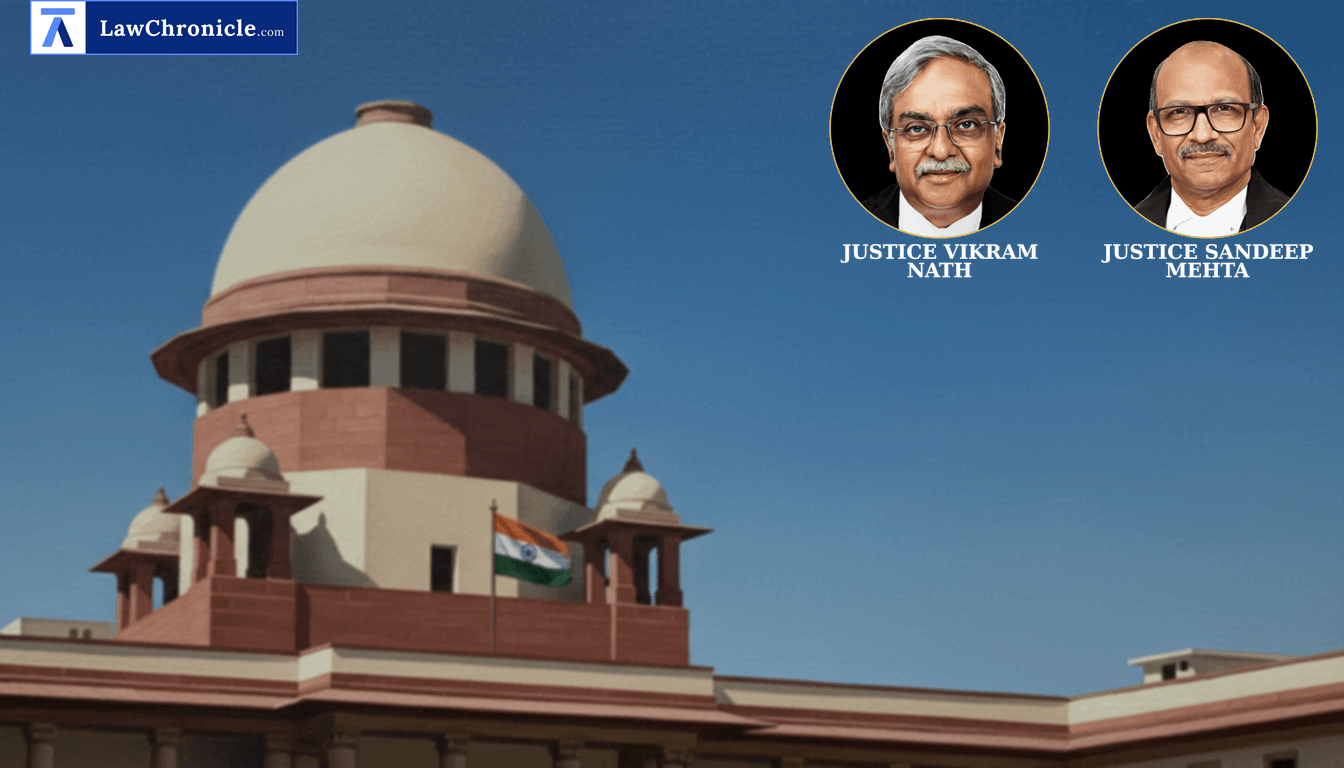
A bench of Justice Vikram Nath and Justice Sandeep Mehta heard an appeal challenging the Rajasthan High Court’s dismissal of a wife’s criminal revision petition arising out of matrimonial disputes and cross-revisions by the husband; the Court considered entitlement to maintenance, compensation under the Protection of Women from Domestic Violence Act and the question of dissolution of marriage after prolonged separation.
The Supreme Court allowed the appeal in part and exercised its powers under Article 142 of the Constitution to dissolve the marriage, directing the respondent-husband to pay Rs.1,00,00,000 as permanent alimony and a full and final settlement of all claims within three months, and quashing all pending civil and criminal proceedings arising out of the marriage upon receipt of payment. The Court recorded that “the relationship between the parties has irretrievably broken down” and noted that reconciliation efforts through the Supreme Court Mediation Centre had failed. The Court, in its reasoning, observed: “Dealing with the question of dissolution of marriage, it is evident to us that the relationship between the parties has irretrievably broken down. The parties have been living separately since 15 April 2010, more than fifteen years now. Further, even the attempt at reconciliation through the Supreme Court Mediation Centre did not yield any positive result. Years of acrimony and bitterness have defined their relationship, and despite the appellant-wife contesting the grant of divorce, we find that no marital bond survives between them. In these circumstances, there is no purpose in perpetuating a legal relationship that has ceased to have any meaning. Therefore, we find this a fit case to grant a decree of divorce using our powers under Article 142 of the Constitution of India. ... This amount shall be treated as a full and final settlement of all claims between the parties including those of the minor child represented by his guardian mother i.e. the appellant Rekha Minocha, and upon receipt thereof neither party shall raise any further claim against the other. However, this shall not preclude the respondent father from contributing for the child’s education. All pending proceedings, civil or criminal, arising out of this marriage, shall by virtue of this order, stand quashed and closed.”
Background The marriage was solemnised on 5 October 2009 and the wife left the matrimonial home on 15 April 2010 alleging mental and physical harassment by in-laws. The couple’s son was born on 28 December 2010. The appellant filed for maintenance under Section 125 CrPC on 9 July 2013 and for relief under the Domestic Violence Act on 16 January 2019. The trial court granted interim relief: monthly payments for rent and maintenance, custody of the minor child to the mother under Section 21 DV Act, and Rs.4,00,000 as compensation under Section 22. The Family Court in Section 125 proceedings later directed modest additional monthly payments. Appeals were dismissed by the Appellate Court on 29 July 2021. The High Court, in a tagged hearing of multiple revision petitions, dismissed the wife’s revision and allowed aspects of the husband’s petitions: it set aside the Family Court’s maintenance order and struck down the Rs.4,00,000 compensation while otherwise dismissing the husband’s challenges.
The parties approached this Court by special leave petitions; the husband’s SLP was dismissed earlier by this Court. The Supreme Court recorded that the husband had already been directed to clear outstanding maintenance arrears and had earlier submitted bank drafts. On 29 July 2025 the husband, through counsel, offered to pay Rs.1,00,00,000 “as permanent alimony and for settlement of all pending dues,” and the wife was granted two weeks to respond. After hearing submissions, the Court found the marriage irretrievably broken, accepted the offer as “just, fair and reasonable,” and directed payment within three months with the decree to be drawn upon proof of payment. The order preserved the father’s obligation to contribute to the child’s education and dismissed pending applications.
Case Details: Case No.: Criminal Appeal No.1595 of 2025 (2025 INSC 1265) Case Title: Rekha Minocha … Appellant v. Amit Shah Minocha & Ors. … Respondents Appearances: For the Petitioner(s): [Not indicated in the judgment] For the Respondent(s): [Not indicated in the judgment]
Similar Articles

 Breaking News


