


Supreme Court Explains When Quo Warranto can be Issued
 Copy Link
 Share
 Save
The Supreme Court has simplified the writ petition rules for when quo warranto can be issued, stating the conditions requisite for issuance of writ of quo warranto. The Apex Court held that a writ of quo warranto cannot be issued if the candidate satisfies the mandatory minimum qualifications, even if allegations surround a desirable qualification. However, invoking its extraordinary powers under Article 142 of the Constitution of India, the Apex Court ordered a fresh inquiry into allegations of a fake doctorate degree used to gain additional recruitment marks.
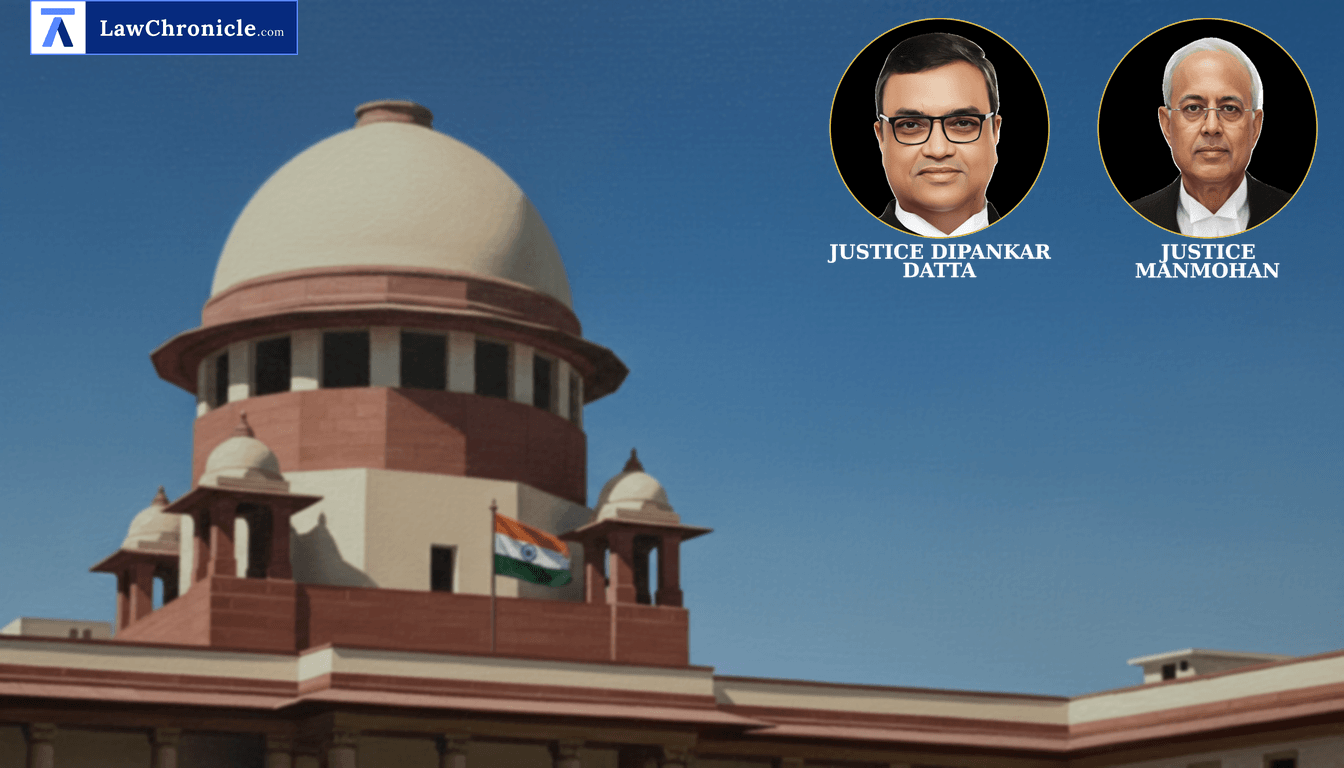
A Bench comprising Justice Dipankar Datta and Justice Manmohan heard the appeals challenging a decision of the High Court of Punjab and Haryana, which had dismissed a writ petition seeking a writ of quo warranto against an Assistant Professor.
Key Takeaways
- Proof Required for Quo Warranto: The burden of proof lies strictly on the petitioner to establish that an appointee lacks mandatory qualifications or suffers from a legal disqualification to occupy a public office.
- Desirable vs Essential Qualifications: Allegations of fraud regarding a non-essential or desirable qualification will not automatically render the candidate ineligible if the statutory mandatory qualification is independently satisfied.
- Unsuccessful Candidates Cannot Misuse Public Writs: Litigants who fail in a selection process cannot invoke quo warranto as a mechanism to settle personal grievances or individual claims.
- Invocation of Article 142 Against Fraud: Courts will not let technical dismissals act as a protective shield where prima facie evidence points to deceit in public recruitment processes.
When Quo Warranto can be Issued
The Supreme Court affirmed that a writ of quo warranto requires unimpeachable evidence establishing that an appointee lacks the mandatory qualification for a public office. The Apex Court noted that since qualifying the UGC-NET was the mandatory requirement under the relevant rules and the candidate possessed it, he could not be said to lack basic eligibility.
Conditions Requisite for Issuance of Writ of Quo Warranto
The Bench clarified that "To seek and succeed in a proceeding for a writ or in the nature of quo warranto, it is absolutely necessary for the writ petitioner, who could even be a stranger, to establish that an appointee, not having the requisite qualification for occupying a public office or suffering from such other disability, thereby attracting a disqualification to hold such office, was appointed and, in the process, has usurped a public office. While questioning an appointment on a public office on the ground of lack of authority of the appointee to occupy the same, the burden of proof has to be discharged by the writ petitioner by producing unimpeachable evidence in support of his assertion."
Addressing the severe allegations regarding the fake doctoral degree, the Court held that it could not turn a blind eye to material indicating deceit. The Court allowed the Maharshi Dayanand University full liberty to undertake an inquiry to sift the grain from the chaff. The Court accordingly ordered the respondent to produce his Ph. D. degree in original in the presence of the officials of Bundelkhand University who, in turn, are required to produce documentary evidence based on which the affidavit was filed before the Supreme Court. The Court ensured reasonable opportunity for the respondent to raise effective defence and to cross-examine witnesses. Depending on the inquiry, which is to be conducted in accordance with principles of natural justice, further steps as permitted in law may be taken.
The Court further added that "It is also made clear that should the outcome of inquiry be unfavourable to the sixth respondent, that is, the Ph. D. degree is found to be a forged document, it shall be open to Maharshi Dayanand University or Sat Jinda Kalyana College or Bundelkhand University or anyone else to lay information before the police to prosecute the sixth respondent for a criminal offence, in accordance with law."
Ratio
A writ of quo warranto cannot be issued to oust an appointee who fulfills all mandatory statutory qualifications required for a public office, even if an additional or desirable qualification is alleged to be fraudulent; however, equity and constitutional power under Article 142 permit the Court to order a formal inquiry to prevent fraud from insulating the appointment.
Background
The dispute arose from the recruitment of an Assistant Professor of Physical Education advertised on February 14, 2018, by Sat Jinda Kalyana College, Rohtak, affiliated with Maharshi Dayanand University. The sixth respondent was selected as the most-qualified candidate. Unsuccessful candidates challenged his appointment, invoking the Right to Information Act, 2005, which revealed information from Bundelkhand University claiming that the sixth respondent was never enrolled in their Ph.D. programme.
The appellants filed a writ petition seeking a writ of quo warranto under Article 226 of the Constitution of India. The Single Judge dismissed the petition, observing that the appointee independently satisfied the mandatory eligibility criteria by qualifying the UGC-NET examination, as prescribed by the applicable rules. On appeal, the Division Bench held that the appellants lacked locus standi, as unsuccessful candidates cannot use quo warranto to redress personal selection grievances, relying on A.N. Shastri v. State of Punjab, R.K. Jain v. Union of India ( "(1993) 4 SCC 119": 1993 CaseBase(SC) 949), Dr B. Singh v. Union of India ( "(2004) 3 SCC 363": 2004 CaseBase(SC) 317), and B. Srinivasa Reddy v. Karnataka Urban Water Supply & Drainage Board Employees Association ( "(2006) 11 SCC 731": 2006 CaseBase(SC) 240).
While upholding the High Court's legal conclusion on quo warranto, the Supreme Court observed that affidavits filed by Bundelkhand University prima facie indicated the Ph.D. degree was fake. Consequently, the Supreme Court exercised its powers under Article 142 of the Constitution of India to order a full inquiry with liberty to initiate criminal prosecution if the degree is found to be forged.
Case Details:
Case No.: Civil Appeal Nos. /2026 [@ Special Leave Petition (C) Nos. 24737-24739/2023]
Neutral Citation: 2026 INSC 968
Case Title: Annu Kumar & Anr. v. Maharshi Dayanand University Rohtak & Ors.
Source: 2026 CaseBase(SC) 5881
Similar Articles

 Breaking News


