


Supreme Court Grants Bail to Former Amtek Promoter, Quashes High Court Order Citing Right to Speedy Trial
 Copy Link
 Share
 Save
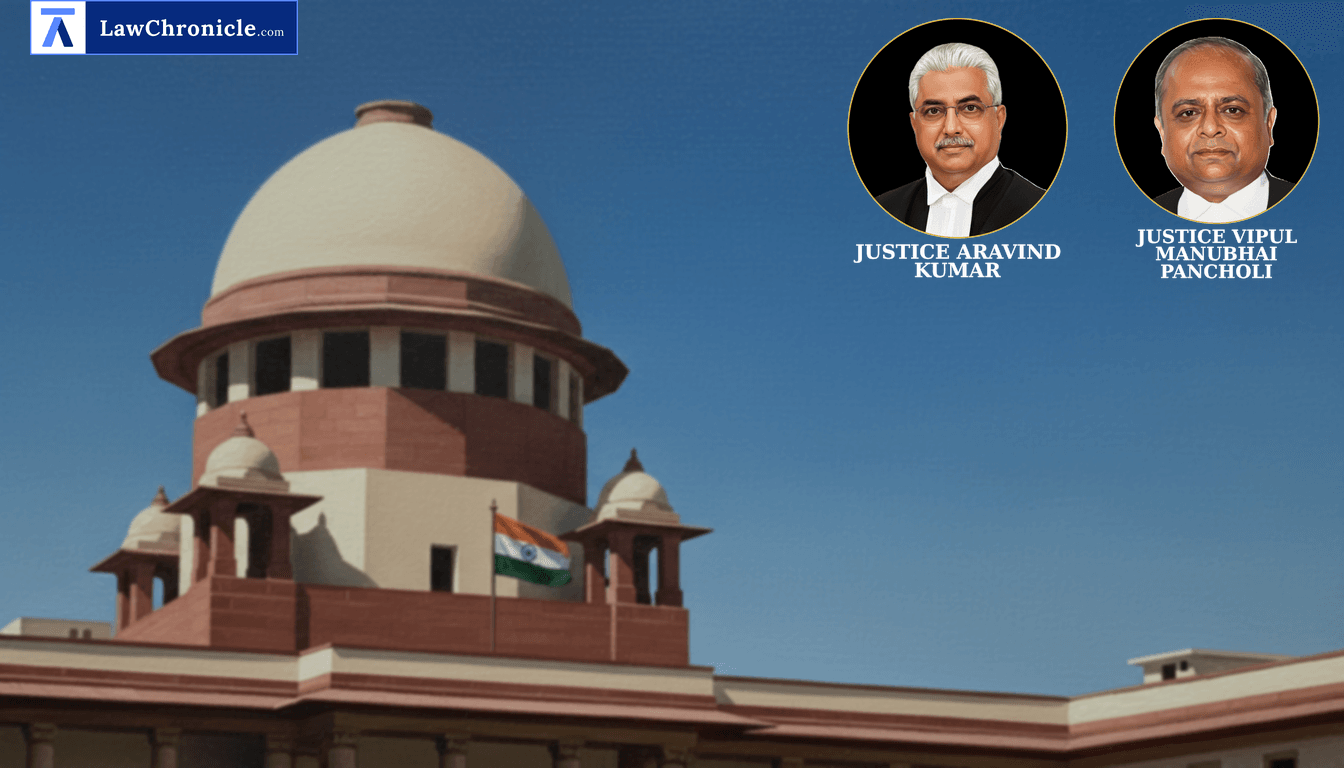
A bench of Justices Sanjay Kumar and Alok Aradhe heard the criminal appeal filed by Arvind Dham challenging the Delhi High Court’s order dated 19.08.2025 which had rejected his application for regular bail under Section 483 of the Bharatiya Nagarik Suraksha Sanhita, 2023 (BNSS) read with Section 45 of the Prevention of Money Laundering Act, 2002 (PMLA). The appeal concerned allegations of bank fraud and money‑laundering arising from transactions involving the Amtek Group and raised questions about prolonged pre‑trial detention under statutory bail restrictions.
The Court allowed the appeal, quashed the High Court’s order and directed that the appellant be released on bail during the pendency of trial before the Special Judge (PC Act) (CBI)-02, Rouse Avenue District Court. The Court recorded that the appellant had cooperated with the investigation, that investigation qua the appellant was complete, and that there was no immediate prospect of trial commencement given the number of witnesses and the stage of proceedings. The Court emphasised the primacy of Article 21 and the right to a speedy trial, observing that prolonged pre‑trial incarceration must not be permitted merely because the case involved economic offences. The Court, in its reasoning, observed: "A two-Judge Bench of this Court in V. Senthil Balaji’s case has held that under the statutes such as PMLA, where maximum sentence is seven years, prolonged incarceration pending trial may warrant grant of bail by Constitutional Courts, if there is no likelihood of the trial concluding within a reasonable time. Statutory restrictions cannot be permitted to result in indefinite pretrial detention in violation of Article 21." The judgment further held that "the continued incarceration ... violates the right of the appellant to speedy trial under Article 21 of the Constitution of India."
Background The appellant, a former promoter and non‑executive chairman of Amtek Auto Ltd. and non‑executive director of ACIL Ltd., faced FIRs lodged on 21.12.2022 by IDBI Bank and Bank of Maharashtra alleging offences under various penal and anti‑corruption provisions and alleging frauds of Rs.385.35 crores and Rs.289 crores. On 21.03.2023 the Enforcement Directorate registered two ECIRs for alleged laundering of proceeds of crime. The appellant’s statement was recorded under Section 50 PMLA on 19.06.2024; searches followed on 20.06.2024 and he was arrested on 09.07.2024. A prosecution complaint dated 06.09.2024 (and a supplementary complaint dated 02.08.2025) named multiple individuals and companies; cognizance was yet to be taken and the matter remained at document scrutiny, with 208–210 prosecution witnesses listed.
The appellant moved for bail before the Special Judge under Section 45 PMLA; the Special Judge declined relief on 21.01.2025. The High Court rejected his subsequent application under Section 483 BNSS and Section 45 PMLA on 19.08.2025. The appellant contended that he had cooperated with the probe, suffered multiple health ailments, had been in custody for about 16 months and 20 days, and that there was no likelihood of trial in the near future; he denied risk of flight, tampering or dissipation of assets. The Enforcement Directorate opposed bail, stressing the gravity of offences, allegations of witness influence and dissipation of properties, and reliance on statutory bail restrictions.
The Supreme Court examined precedents including Manish Sisodia, Padam Chand Jain, V. Senthil Balaji and P. Chidambaram and reiterated that economic offences were not a homogeneous class for denying bail. The Court found that the appellant had cooperated with investigation, that the allegation of instructing a witness not to join investigation was "incredible" given the appellant’s custody predating the witness’ formal arrayal, and that the alleged dissipation of certain properties did not show a material link to the appellant. Noting that the maximum sentence under the relevant provisions was seven years and that trial was unlikely to commence soon, the Court held prolonged detention would convert pre‑trial custody into punishment and thus set aside the High Court order.
The appeal was allowed. The Court directed that bail conditions be fixed by the trial court; specified interim measures required the appellant to provide a contact mobile/telephone number, surrender his passport to the trial court and not leave India without its permission.
Case Details: Case No.: REPORTABLE 2026 INSC 12; Criminal Appeal (@ S.L.P. (Crl.) No. 15478 of 2025) Case Title: Arvind Dham v. Directorate of Enforcement Appearances: For the Petitioner(s): Senior Counsel for the appellant (name not specified in judgment) For the Respondent(s): Additional Solicitor General / Counsel for Directorate of Enforcement (as recorded in proceedings)
Similar Articles
 Breaking News


