Supreme Court holds expired licence renewed after a gap does not satisfy “continuous” two‑year requirement for driver recruitment
 Copy Link
 Share
 Save
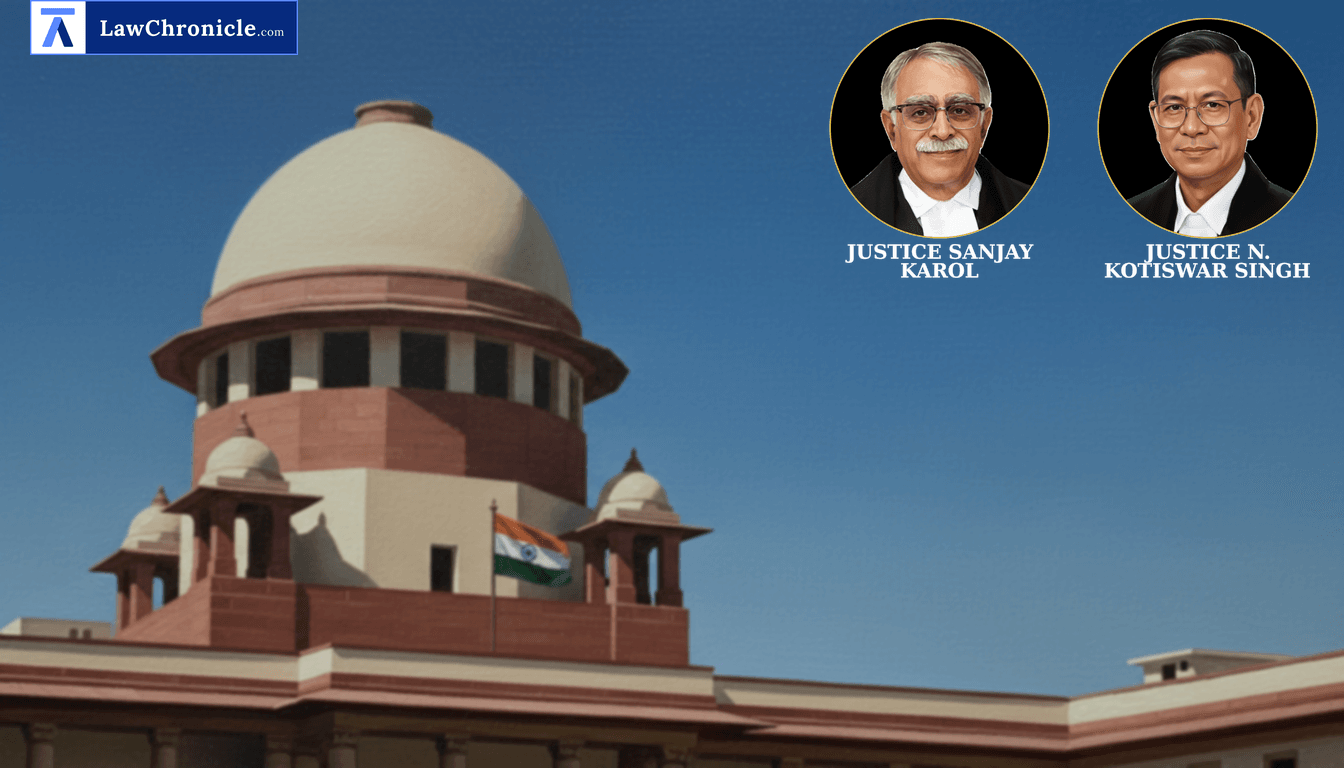
A bench of Justices Ahsanuddin Amanullah and S. V. N. Bhatti heard appeals by the Telangana State Level Police Recruitment Board challenging a Division Bench judgment of the Telangana High Court that had upheld Single Judge orders allowing candidates to be treated as eligible for driver recruitment despite gaps between expiry and renewal of driving licences. The appeals raised the question whether a licence that expired within the two years preceding a recruitment notification, but was subsequently renewed within the statutory window, could be treated as having been held “continuously” for two years as required by the notification.
The Court allowed the appeals and set aside the High Court and Single Judge orders, holding that the statutory scheme and the literal meaning of “continuously” precluded treating a post‑expiry renewal as retroactively curing an intervening period of legal disability to drive. The Court observed that the Motor Vehicles (Amendment) Act, 2019 had deliberately omitted the earlier 30‑day currency proviso and replaced renewal windows in Section 15 with a one‑year pre‑ and post‑expiry window, but that did not mean the licence remained legally effective during the interregnum. The Court, in its reasoning, observed: "The Act as it stands now clearly stipulates that from the date of expiry of licence, its holder is barred under law from driving. The theory that once a licence is renewed, even after a gap, the renewal would operate from a back date implying that the licence was continuing and valid even for and during the interregnum cannot be countenanced." The Supreme Court directed the recruitment process to be completed expeditiously and within three months.
Background
The recruitment notifications dated 25 April 2022 and 20 May 2022 sought to fill 325 driver posts and required candidates to have possessed an LMV (Transport with Badge) or HMV licence “continuously for a period of full two years and above as on date of this Notification.” Several candidates whose licences had expired within the previous two years but were renewed subsequently (many within one year of expiry) were not permitted to sit for the written test. Those candidates obtained interim orders from a Single Judge directing the Board to allow them to participate; the Single Judge later held that post‑renewal the licences were deemed to be effective from the date of expiry and directed the Board to treat them as continuously valid for two years. The Division Bench of the High Court affirmed that order without detailed reasons.
The Board appealed to the Supreme Court, contending that the 2019 Amendment removed the 30‑day post‑expiry currency and that the statutory change could not be read as allowing drivers to be treated as having uninterrupted legal capacity to drive during a period when the licence had in fact expired. Petitioners relied on pre‑ and post‑amendment texts of Sections 14 and 15 of the Motor Vehicles Act, 1988 and authorities on licence renewal and insurance liability. Respondents urged that the legislative intent and the Statement of Objects and Reasons for the Amendment Act showed a liberalised renewal window and that renewals within one year of expiry should be treated as making the licence continuous; they also pointed to the recruitment-driving test as a safeguard of practical competence.
The Court analysed the post‑amendment statutory scheme, noting that the Amendment omitted the earlier proviso in Section 14 which had kept a licence effective for 30 days after expiry, and modified Section 15 to provide a renewal window extending one year before or after expiry while maintaining that renewal takes effect from the date of renewal. The Court emphasised that the word “continuously” in the notifications required literal and straightforward meaning — actual, legal and uninterrupted capacity to drive — and relied on a dictionary definition: "Uninterruptedly; in unbroken sequence; without intermission or cessation; without intervening time; with continuity or continuation." The Court rejected the argument that passing a subsequent driving test could cure the initial ineligibility or that post‑facto renewal should be backdated to confer continuity. On that basis the Supreme Court allowed the appeals, set aside the impugned judgments and dismissed the underlying writ petitions. The Court directed completion of the recruitment within three months and made no order as to costs.
Case Details:
Case No.: 2025 INSC 1452
Case Title: Telangana State Level Police Recruitment Board v. Penjarla Vijay Kumar & Ors.
Date of Judgment: December 18, 2025
Coram: Ahsanuddin Amanullah, J. and S. V. N. Bhatti, J.
Similar Articles
 Breaking News