


Supreme Court Holds Identical Allegations Require Equal Relief, Quashes Proceedings Against Parents‑in‑Law in Dowry Case
 Copy Link
 Share
 Save
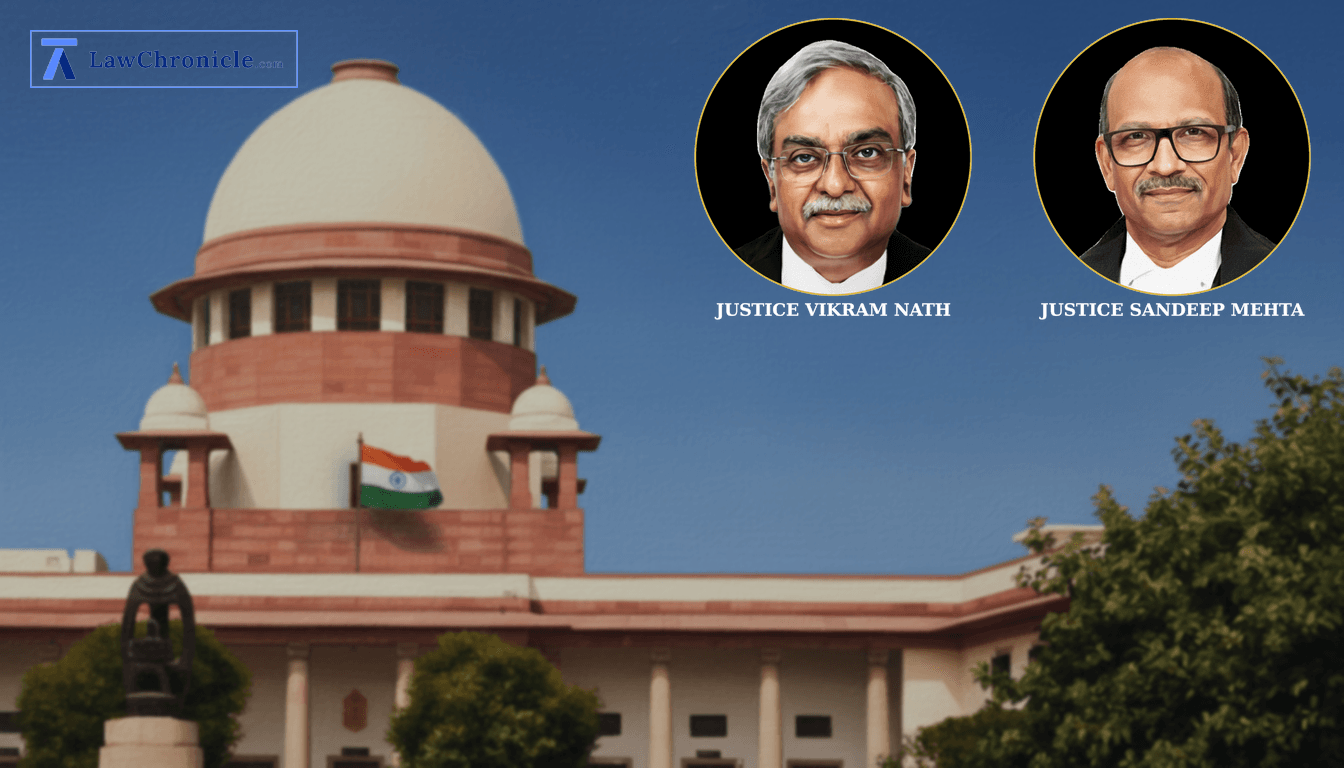
A bench of Justices Vikram Nath and Sandeep Mehta heard an appeal against a Patna High Court order that had quashed criminal proceedings only against the complainant’s sister‑in‑law while refusing similar relief to the complainant’s father‑in‑law and mother‑in‑law. The appeal arose from SLP(Crl.) No. 3075/2024 and challenged the High Court’s differential treatment of co‑accused summoned under Sections 341, 323, 498A and 34 IPC and Sections 3 and 4 of the Dowry Prohibition Act, 1961.
The Supreme Court allowed the appeal and set aside the High Court’s order insofar as it refused to quash proceedings against the parents‑in‑law, holding that the same standard applied to all accused who stood identically placed on the basis of the FIR. The Court observed that the allegations against the appellants and the sister‑in‑law were “in all material particulars, identical” and that no specific overt acts, dates, places or individual acts were attributed to the parents‑in‑law. The Court, in its reasoning, observed: “Having considered the submissions advanced by the parties and upon a careful perusal of the material on record, we are of the view that the High Court fell into error in restricting the quashing of criminal proceedings only to the sister‑in‑law (respondent no.3). A comparative reading of the FIR reveals that the allegations levelled against the sister‑in‑law and those against the present appellants are, in all material particulars, identical. The FIR does not assign any specific or overt act to either appellant; there are no particular dates, places, or individual acts attributed to them. The lone allegation that stands separately against the present appellants is that they would quarrel. This, however, does not constitute a criminal offence and cannot, by itself, sustain cognizance of the offences under Sections 341, 323, 498A & 34 of the IPC and Sections 3 & 4 of the Dowry Act for which the appellants have been summoned. The standard applied by the High Court in quashing proceedings against the sister‑in‑law, on the ground that the allegations against her were general and omnibus, applies with equal force to the present appellants, and there is no principled basis for distinguishing between them.” The Court further held that, viewed together with delay in lodging the complaint, “the continuation of the criminal proceedings against the present appellants cannot be sustained.”
Background
The complainant had married in July 2019. The husband filed a petition for divorce under Section 13 of the Hindu Marriage Act in March 2021. On 18 March 2022 the complainant lodged an FIR alleging persistent cruelty, demands for a BMW and other valuables, physical assault and an attempt to strangle her on 18 March 2022. FIR No. 81/2022 was registered at Lalit Narayan University Police Station, Darbhanga, and a separate complaint was filed before the Chief Judicial Magistrate, Hajipur. The trial court granted anticipatory bail to the parents‑in‑law on 12 April 2022 and the police submitted its report in June 2022; the magistrate took cognizance on 7 September 2022.
The parents‑in‑law and the sister‑in‑law moved the High Court under Section 482 CrPC to quash the cognizance order. The High Court quashed proceedings only as against the sister‑in‑law, finding the allegations against her to be general and omnibus, but declined relief to the parents‑in‑law observing that a prima facie case existed against them. The appellants challenged that distinction before the Supreme Court, contending that allegations against them were equally general and that the FIR constituted a counter‑blast to the husband’s earlier divorce petition. The Supreme Court noted the delay between the divorce petition and the complaint and accepted that, read with the absence of any specific allegations against the parents‑in‑law, the complaint bore the hallmarks of a retaliatory filing; the Court quoted the High Court record that the complaint may have been instituted “by way of a counter‑blast to the divorce proceedings.”
The Supreme Court accordingly quashed all proceedings arising out of L.N.M.U. P.S. Case No. 81 of 2022 insofar as they related to the father‑in‑law and mother‑in‑law. The Court clarified that its observations were confined to maintainability of proceedings against the appellants and did not express any view on the merits of allegations against the husband, who remained subject to the criminal process. The criminal appeal was allowed and pending applications were disposed of.
Case Details:
Case No.: 2026 INSC 212
Case Title: Dr. Sushil Kumar Purbey & Anr. v. The State of Bihar and Ors.
Appearances:
For the Petitioner(s): Names of counsel not recorded in the judgment
For the Respondent(s): Names of counsel not recorded; State represented in proceedings
Source: 2026 CaseBase(SC) 187
Similar Articles


 Breaking News


