


Supreme Court orders Acquittal in POCSO Case Citing Failure To Identify Accused In Court
 Copy Link
 Share
 Save
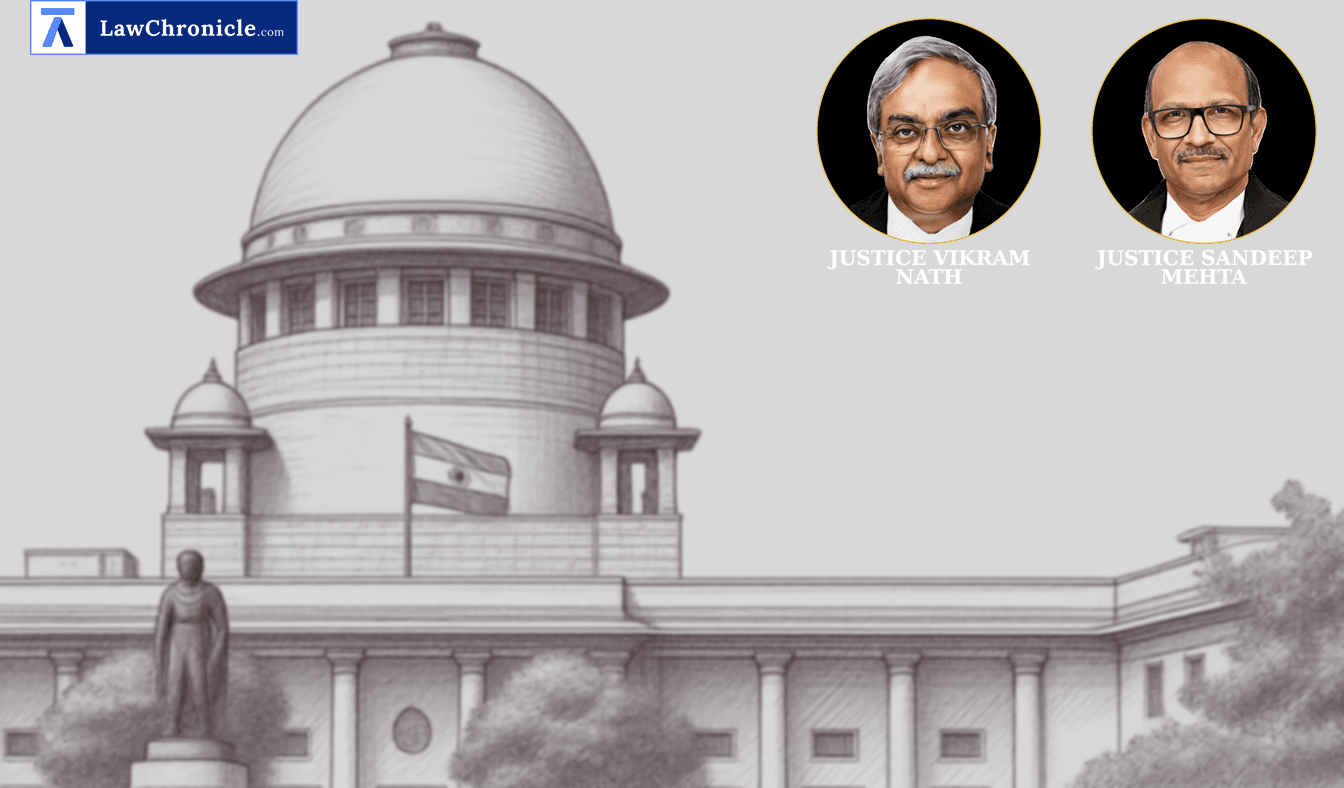
The Supreme Court set aside the conviction of a man sentenced to 10 years of rigorous imprisonment under Section 6 of the Protection of Children from Sexual Offences Act, 2012, holding that an acquittal in POCSO case must follow when key prosecution witnesses fail to identify the accused in court and material witnesses are withheld.
A Division Bench comprising Justice Vikram Nath and Justice Sandeep Mehta heard the appeal challenging the judgment of the High Court of Meghalaya, which had previously affirmed the trial court's order of conviction.
Key Takeaways
- In-Court Identification Is Crucial: Failure of prosecution witnesses, including the victim, to identify the accused in court severely undermines the credibility of the prosecution.
- Consequence of Unexplained Delay: Omission of material circumstances in an FIR lodged after a significant delay renders subsequent trial improvements doubtful.
- Adverse Inference for Withholding Material Witnesses: Withholding a pivotal witness without explanation obliges the court to draw an adverse inference against the prosecution under Section 114 of the Indian Evidence Act, 1872.
- Inapplicability of Section 106 Presumption: The 'last seen together' theory cannot shift the burden of proof to the accused under Section 106 of the Indian Evidence Act, 1872 unless exclusive presence with the victim is conclusively established.
Court Observations and Directions
The Supreme Court thoroughly re-examined the evidence of the prosecution witnesses and highlighted multiple fatal flaws in the case. The Bench noted that the victim and her cousin failed to identify the accused in the dock, admitting that his name was provided to them by the victim's mother. Furthermore, the Supreme Court noted the prosecution's failure to examine the school teacher, who had initially reported the disclosure made by the child. The Bench observed that "Where a material witness, capable of throwing light on the genesis of the occurrence is withheld without any plausible explanation, the Court would be justified in drawing adverse inference against the prosecution, particularly when such witness occupies a pivotal position in the chain of events."
Referring to precedents such as Amar Nath Jha v. Nand Kishore Singh and Ram Kumar Pandey v. State of M.P. ( "AIR 1975 SC 1026": 1975 CaseBase(SC) 23), the Apex Court reiterated that material omissions in an FIR lodged after considerable delay cast a cloud of doubt on the veracity of the prosecution's narrative. Reaffirming Takhaji Hiraji v. Thakore Kubersing Chamansing ( "(2001) 6 SCC 145": 2001 CaseBase(SC) 1061), the Bench held that non-examination of a witness who unfolds the genesis of an incident creates a serious deficiency in the case.
Ratio
When prosecution witnesses fail to identify the perpetrator in court, key material witnesses are withheld without explanation, and significant delay in lodging the FIR remains unclarified, the accused is entitled to the benefit of doubt, making the conviction unsustainable in law.
Background
The case arose from an FIR registered in June 2015 at Police Station Khliehriat, East Jaintia Hills District, alleging that the appellant had committed aggravated penetrative sexual assault on his minor niece suffering from 40% intellectual disability. Although the incident allegedly occurred on May 28, 2015, the FIR was lodged 10 days later, after the victim reportedly disclosed the matter to her school teacher.
The Special Judge (POCSO), East Jaintia Hills District, convicted the appellant under Section 6 of the Protection of Children from Sexual Offences Act, 2012 and sentenced him to 10 years of rigorous imprisonment with a fine of Rs. 1 Lakh. The High Court of Meghalaya dismissed his appeal on March 29, 2022.
On appeal, the Supreme Court noted that the medical witnesses were not effectively subjected to cross-examination by the defence counsel. Re-evaluating the testimony, the Court observed significant discrepancies regarding the appellant's relationship with the family, the failure to conduct a Test Identification Parade, and credible evidence led by the defence in support of a plea of alibi. Finding that the prosecution failed to prove the guilt beyond reasonable doubt, the Supreme Court allowed the appeal and acquitted the appellant.
Case Details:
Case No.: Criminal Appeal No(s). OF 2026 (Arising out of SLP(Crl.) No(s).11881 of 2022)
Neutral Citation: 2026 INSC 1102
Case Title: Charming Rupon v. State of Meghalaya
Appearances:
For the Petitioner(s): Shri Gaurav Agrawal, Senior Advocate
For the Respondent(s): Shri Amit Kumar, Advocate General
Source: 2026 CaseBase(SC) 8253
Similar Articles


 Breaking News


