


Suspicion Cannot Replace Proof In Circumstantial Evidence Cases: Karnataka HC
 Copy Link
 Share
 Save
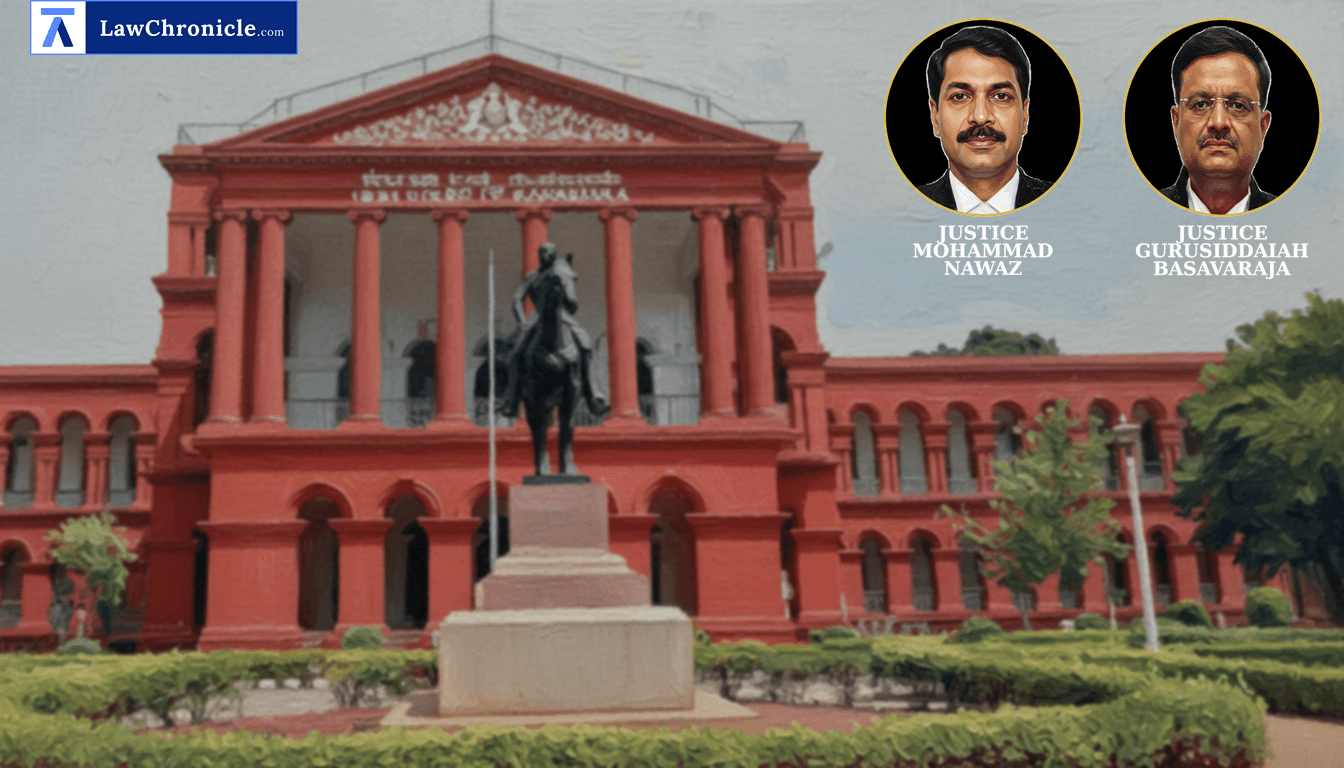
The Karnataka High Court has overturned the murder conviction of an accused, ruling that a failure by the prosecution to establish the foundational circumstances of motive and 'last seen together' snaps the chain of evidence completely. Clarifying the strict evidentiary threshold in cases based purely on circumstantial evidence, the Court highlighted that Section 106 of the Indian Evidence Act, 1872 cannot be used by the prosecution to shift its primary burden of proof onto the accused.
A Division Bench comprising Justice Mohammad Nawaz and Justice G Basavaraja was hearing an appeal against the judgment of conviction passed by the IV Additional District and Sessions Judge, Doddaballapura. The trial court had convicted Accused No. 1 under Section 302 and Section 201 of the Indian Penal Code while acquitting Accused No. 2 of all charges. Challenging these findings, Accused No. 1 filed an appeal against his conviction, while the State filed a cross-appeal challenging the acquittal of Accused No. 2.
Key Takeaways
Motive is Critical in Circumstantial Cases: Failure to prove motive significantly weakens the prosecution's case when no direct eyewitnesses exist.
Strict Proof for 'Last Seen' Theory: The 'last seen together' circumstance cannot be inferred from hearsay or unproved witness statements.
Section 106 Burden Explained: The statutory exception under Section 106 cannot be invoked to fill lacunae in the prosecution's initial burden of proof.
Rejection of Inconsistent Evidence Appreciation: Courts cannot convict one accused while acquitting another on the exact same uncorroborated set of evidence.
Court's Rationale on Circumstantial Evidence and Section 106
The High Court systematically evaluated the prosecution's reliance on circumstantial evidence, pointing out that key witnesses turned hostile and that testimony from relatives of the deceased was purely based on hearsay. It reiterated that suspicion, regardless of how grave, can never substitute legally admissible proof.
The Court has following directions:
"(i) Criminal Appeal No. 280 of 2019, filed by Accused No. 1, is allowed.
(ii) The judgment of conviction and order of sentence passed against Accused No. 1 for the offences punishable under Sections 302 and 201 of the Indian Penal Code, in SC No.10007 of 2017, is hereby set aside.
(iii) Accused No. 1 is acquitted of the said offences.
(iv) Accused No. 1 shall be released forthwith, if he is not required in any other case.
(v) The Registry is directed to communicate this judgment to the concerned Jail Authority forthwith.
(vi) Criminal Appeal No. 269 of 2019, filed by the State challenging the acquittal of Accused No. 2, is dismissed. The judgment of acquittal passed in favour of Accused No. 2 stands confirmed."
Evaluating the invocation of Indian Evidence Act, 1872, the Court, in its reasoning, observed:
"The provision does not cast upon the accused the initial burden of proving his innocence. The primary burden always remains upon the prosecution to establish the facts constituting the offence. Section 106 comes into operation only after the prosecution has established foundational facts from which a reasonable inference can be drawn that the particular fact was especially within the knowledge of the accused. In the absence of proof that the deceased was last seen alive in the company of the accused, the prosecution cannot invoke Section 106 to fill the lacuna in its own case."
Ratio
In a case resting entirely on circumstantial evidence, every link in the chain of circumstances must be conclusively established to exclude every reasonable hypothesis of innocence. The prosecution cannot shift the burden of proof onto the accused under Section 106 of the Indian Evidence Act, 1872 without first establishing foundational facts beyond a reasonable doubt.
Background
The case arose from the murder of Nagarajappa, whose body was found dumped in a culvert on December 9, 2016, near Mallohalli Colony. The complainant (PW1), nephew of the deceased, lodged a complaint alleging that the deceased had been staying with Accused No. 1. It was alleged that after an argument over dinner and alcohol consumption, Accused No. 1 killed the deceased by dropping a heavy stone on his head and, with the assistance of Accused No. 2, transported and dumped the body to destroy evidence under Section 201 of the Indian Penal Code.
During the trial, the prosecution examined 17 witnesses. However, key witnesses to the last-seen theory (PW8 and PW9) turned hostile and failed to support the case. Reappreciating the evidence in light of precedents such as Chandrappa v. State of Karnataka ( "(2007)4 SCC 415": 2007 CaseBase(SC) 278), Sanwat Singh v. State of Rajasthan ( "AIR 1961 SC 715": 1960 CaseBase(SC) 63), Sharad Birdhichand Sarda v. State of Maharashtra ( "(1984)4 SCC 116": 1984 CaseBase(SC) 194), Hanumant v. State of M.P. ( "AIR 1952 SC 343": 1949 CaseBase(RAJ) 19), Kali Ram v. State of H.P. ( "(1973)2 SCC 808": 1973 CaseBase(SC) 41), and NUSRAT PARWEEN v. STATE OF JHARKHAND ( "Criminal Appeal No.458 of 2012 decided on 10.12.2024": 2024 CaseBase(SC) 760), the High Court held that the prosecution failed to prove either motive or the last-seen circumstance. Citing Shambhu Nath Mehra v. State of Ajmer ( "AIR 1956 SC 404": 1956 CaseBase(SC) 77) and Nagendra Sah v. State of Bihar ( "(2021) 10 SCC 725": 2021 CaseBase(SC) 375) regarding Indian Evidence Act, 1872, alongside Sk. Yusuf v. State of West Bengal ( "(2011) 11 SCC 754": 2011 CaseBase(SC) 1109), the High Court held that the chain of circumstances was incomplete.
Consequently, the High Court allowed the appeal by Accused No. 1, setting aside his conviction and ordering his immediate release under Section 374(2) of the Code of Criminal Procedure, while dismissing the State's appeal under Section 378(1) of the Code of Criminal Procedure against the acquittal of Accused No. 2.
Case Details:
Case No.: Criminal Appeal No.280 of 2019 c/w Criminal Appeal No.269 of 2019
Case Title: Sri. Thirummallesha v. The State of Karnataka c/w State of Karnataka v. Thimmaiah
Appearances:
For the Petitioner(s): Sri Veeranna G. Tigadi, Adv. (for Accused No.1); Sri Vijay Kumar Majage, SPP-II (for State)
For the Respondent(s): Sri Vijay Kumar Majage, SPP-II (for State); Sri Abhishek M. K., Adv. (for Accused No.2)
Source: 2026 CaseBase(KAR) 16907
Similar Articles
 Breaking News


