


Suspicion Cannot Replace Proof In Circumstantial Evidence: Supreme Court
 Copy Link
 Share
 Save
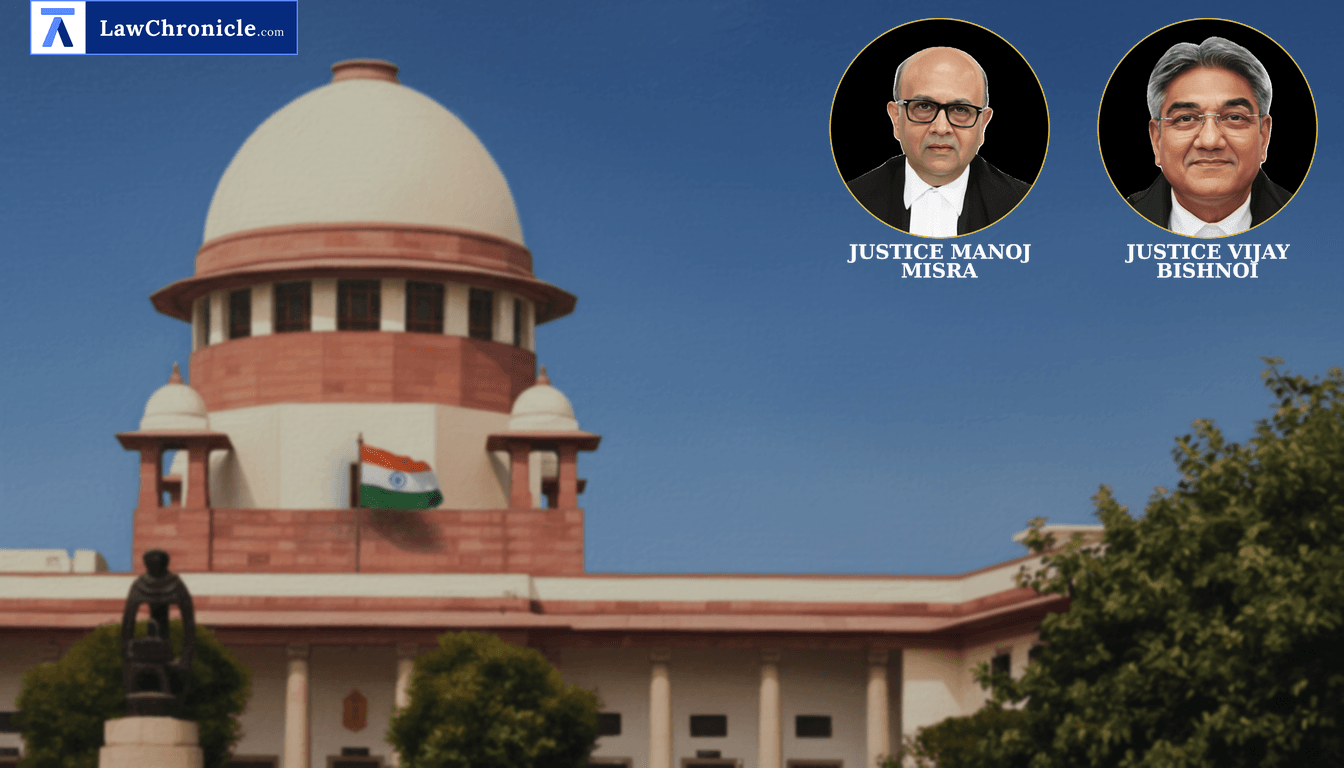
Uncorroborated electronic messages and inconclusive forensic recoveries cannot bridge the long mental distance between 'may be' and 'must be' guilty in a trial based purely on circumstantial evidence. Reversing the concurrent murder convictions passed by the lower courts, the Supreme Court ruled that an unverified WhatsApp message and unproved blood-stain recoveries fail to form an unbroken chain of guilt.
A two-judge bench comprising Justice Manoj Misra and Justice Vijay Bishnoi allowed the criminal appeal, setting aside the conviction of the appellant under Sections 302 and 201 of the Indian Penal Code, 1860. The Court scrutinized the reliance placed by the prosecution on electronic communications and unconfirmed forensic evidence in the absence of last-seen testimony or motive.
Key Takeaways
- Proof Beyond Suspicion Required: Evidentiary gaps cannot be filled by conjecture; circumstantial evidence must conclusively establish that the accused 'must be' guilty.
- Unauthenticated WhatsApp Texts Inadmissible: Electronic messages sent between third parties, where the author and source of knowledge remain unproven, carry no substantive evidentiary weight against an accused.
- Inconclusive FSL Reports Fatal: Failure to connect blood-stains or recovered weapons to the deceased via DNA profiling breaks the chain of circumstantial evidence.
- Impact of Investigation Lapses: In the modern era of forensic science, failure to perform DNA profiling of recovered blood-stains constitutes a serious flaw benefiting the accused.
Evidentiary Flaws in WhatsApp Messages and Forensic Recoveries
The Supreme Court analyzed the reliance on WhatsApp messages allegedly exchanged between third-party witnesses (PW-5 and PW-6) regarding a fight at the appellant's house. Observing that both witnesses turned hostile and denied personal knowledge or sending the text, the Court held that the author and source of the information remained unestablished. The Court observed that exchange of messages between third parties, at best, creates suspicion but does not prove the presence of the deceased with the accused or the assault.
Evaluating the recovery of an iron rod, screwdriver, and blood-stained soil under Section 27 of the Indian Evidence Act, 1872, the Court noted significant contradictions between seizure witnesses. Crucially, the Forensic Science Laboratory (FSL) report failed to match the blood group on the seized items with the deceased, and no DNA profiling was conducted.
The Court, in its reasoning, observed: "In the present case, what assumes importance is that there is no evidence on record of the deceased being last seen alive in the company of the accused. All prosecution witnesses set up by the prosecution to prove that the deceased was seen in the house of the accused on the fateful night have been declared hostile and they have not supported the prosecution case... In days of advancement of forensic science, lack of effort on the part of the investigating agency to get DNA profiles of the blood-stains match with DNA profile of the blood of the deceased is a serious investigational lapse and the benefit of such lapse must go to the accused, particularly when the entire prosecution case rests on circumstantial evidence."
Addressing the legal standard for circumstantial evidence, the Court cited Sharad Birdhichand Sarda v. State of Maharashtra ( "(1984) 4 SCC 116": 1984 CaseBase(SC) 194) and Shivaji Sahabrao Bobade and Anr. v. State of Maharashtra ( "(1973) 2 SCC 793": 1973 CaseBase(SC) 123) to emphasize that the mental distance between 'may be' and 'must be' divides vague conjectures from sure conclusions.
The Court issued the following directions:
"Accordingly, we allow the appeal and set aside the conviction of the appellant and acquit him of all the charges for which he had been tried. The judgment and order of the High Court and the Trial Court are set aside. The appellant is acquitted of the charges for which he had been tried. He shall be released forthwith unless wanted in any other case."
Ratio
In a case relying entirely on circumstantial evidence, the chain of circumstances must be fully established and unerringly point to the guilt of the accused, excluding every other reasonable hypothesis. Unverified electronic messages and recovered articles carrying decomposed or unmatched blood-stains without DNA confirmation cannot form the basis of conviction.
Background
The case arose from the discovery of a dead body alongside a motorcycle in an open field on February 9, 2019. The police registered an FIR against unknown persons and subsequently arrested the appellant based on WhatsApp messages extracted from mobile phones and alleged disclosure statements leading to the recovery of an iron rod, screwdriver, and blood-stained shirt.
The Trial Court convicted the appellant under Sections 302 and 201 of the Indian Penal Code, 1860, relying heavily on the electronic messages extracted under Section 65-B of the Indian Evidence Act, 1872, recoveries, and unexplained minor abrasions on the accused. The High Court of Chhattisgarh affirmed the conviction under Section 374 of the Code of Criminal Procedure, 1973.
On appeal, the Supreme Court noted that the autopsy doctor did not rule out injuries from a road accident, the deceased was prone to substance abuse, and all key witnesses had turned hostile. Holding that suspicion cannot substitute legal proof, the Supreme Court allowed the appeal and acquitted the appellant.
Case Details:
Case No.: Criminal Appeal No. 4894 of 2026
Neutral Citation: 2026 INSC 1148
Case Title: Kusumlal Sao v. State of Chhattisgarh
Appearances:
For the Petitioner(s): Mr. Yasharth Kant, Advocate
For the Respondent(s): Ms. Ankita Sharma, Advocate
Source: 2026 CaseBase(SC) 9492
Similar Articles



 Breaking News


