


Termination Order Against Assistant Professor Void If Not Under Statutory Penalties: Kerala HC
 Copy Link
 Share
 Save
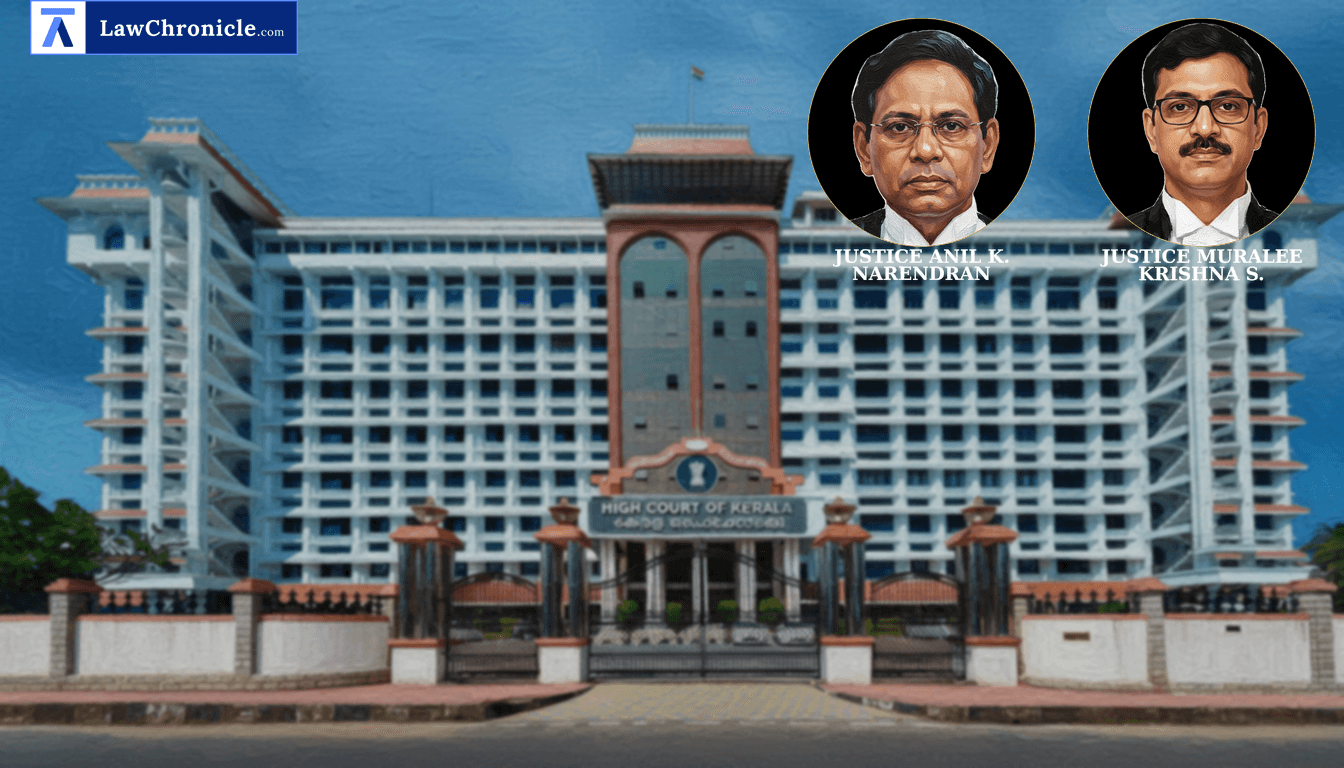
The Kerala High Court has reinforced the sanctity of statutory disciplinary procedures in educational institutions, ruling that a private college management cannot bypass mandatory requirements of framing specific charges or invent penalties not prescribed by law. Striking down the termination of an Assistant Professor, the Court declared that disciplinary actions initiated in 'utter violation' of governing statutes are liable to be quashed under writ jurisdiction, regardless of alternative appellate remedies.
A Division Bench of Justice Anil K. Narendran and Justice Muralee Krishna S. delivered this judgment while hearing an appeal filed by the Manager and Principal of Sacred Heart College (Autonomous), Thevara. The appellants challenged a Single Judge's order which had set aside the suspension and subsequent termination of an Assistant Professor from the Hindi department.
Vague Notice Cannot Substitute Formal Memo of Charges
The appellants contended that a notice of suspension issued to the teacher contained sufficient details of misconduct to satisfy the requirements of a charge memo. However, the Court rejected this argument, emphasizing that the Mahatma Gandhi University Statutes, 1997 and the Mahatma Gandhi University Act, 1985 (read with the Manual of Disciplinary Proceedings for State Government Servants) require definite charges and a statement of allegations.
The Court, in its reasoning, observed: "The purpose of issuance of a memo of charges accompanied with a statement of allegations containing definite particulars of the allegations is to understand the charges against the delinquent and provide her an opportunity to meet those allegations by appropriately explaining the same, even prior to the initiation of enquiry... In the instant case, Ext.P3 notice of suspension do not mention the date or time of the incidents forming the causation of that notice."
Penalties Must Align with Statutory Framework
A critical point of contention was the nature of the punishment. The management had issued an order of 'termination', which it argued was synonymous with 'removal' or 'dismissal'. The Bench found this legally untenable, noting that Statute 73 of the Mahatma Gandhi University Statutes, 1997 lists specific penalties, and 'termination' is not one of them.
The Court observed: "But while imposing a punishment, the disciplinary authority cannot take such a stand, since the impact of the punishments provided under Statutes 73(6) and 73(7) is different... In common parlance, termination of service is the severance of or separation of the employer and employee relationship. But that term cannot be used as a substitute for any of the punishments or penalties prescribed under Statute 73."
Writ Maintainability Despite Alternate Remedy
Addressing the challenge to the maintainability of the writ petition under Article 226 of the Constitution of India, 1950, the Court relied on John Kuriakose (Dr.) v. State of Kerala to hold that when service conditions are governed by statutory provisions, a writ is maintainable if those obligations are breached. The Bench reiterated the principle from Bhavnagar University v. Palitana Sugar Mill Pvt. Ltd. ( "(2003) 2 SCC 111": 2002 CaseBase(SC) 279) that a statutory authority must act within the "four corners" of its empowering statute.
Regarding the directions, the Court has following directions:
"In the result, this writ appeal stands dismissed; however, leaving open the right of the 1st appellant to proceed with the disciplinary proceedings against the 1st respondent from the stage of issuance of memo of charges, in accordance with law, if he is so advised."
Key Takeaways:
Strict Adherence to Procedural Norms
Educational agencies must frame precise, date-specific charges before initiating domestic enquiries; vague notices of suspension cannot bridge this gap.
No Arbitrary Nomenclature for Penalties
Disciplinary authorities are bound by the specific list of penalties provided in the University Statutes and cannot use generic terms like 'termination' if they are not listed.
Writ Jurisdiction Over Aided Colleges
High Courts will intervene under Article 226 despite statutory appeal options if the disciplinary process is found to be in 'utter violation' of law.
Employer Right to Correction
While setting aside flawed termination orders, the Court provides liberty to the employer to restart the process correctly from the stage where the error occurred.
Ratio Decidendi:
A disciplinary proceeding is vitiated if it bypasses the mandatory requirement of issuing a definite charge memo with a statement of allegations. Furthermore, a penalty imposed must strictly correspond to the nomenclature and legal consequences of the punishments expressly enumerated in the governing statutes; a Manager of an aided college cannot act outside the authority given by such statutes.
Background:
The dispute involved an Assistant Professor (Hindi) at Sacred Heart College, Thevara, who was suspended and later terminated following student complaints regarding her classroom behavior and combined classes. The teacher challenged these actions in W.P.(C) No. 25535 of 2025, alleging that she was never served a formal charge sheet. The Single Judge allowed the petition, directing her reinstatement. The Management appealed, citing Om Prakash Mann v. Director of Education (BASIC) and D. Anandakumar v. Indian Airlines to argue that the teacher had participated in the enquiry and was estopped from claiming the charges were vague. The High Court distinguished these precedents, noting the teacher had raised objections during the enquiry, and upheld the Single Judge's findings on procedural illegalities.
Case Details:
Case No.: WA NO. 5 OF 2026
NeutralCitation: 2026:KER:51973
Case Title: The Manager, Sacred Heart College (Autonomous) & Anr. V. Minipriya R & Ors.
Appearances:
For the Petitioner(s): Shri. Abel Tom Benny, Sri. D. Prem Kamath, Shri. Aaron Zacharias Benny, Shri. Mathew Angelo Davis, Sri. Thomas J. Anakkallunkal, Smt. Tessa Rose
For the Respondent(s): Sri. T. Sanjay, Sri. Rajesh. K. Raju, Shri. Sanil Kumar G., Smti. Afnan Dawood, Smt. Ashina Sakeer Hussain, Smt. Nisha Bose (Sr. GP), Sri. Surin George Ipe (SC)
Source: 2026 CaseBase(KER) 410
Similar Articles


 Breaking News


