


Thumb Impression Discrepancy Fatal to Claim of Heirship: Karnataka HC
 Copy Link
 Share
 Save
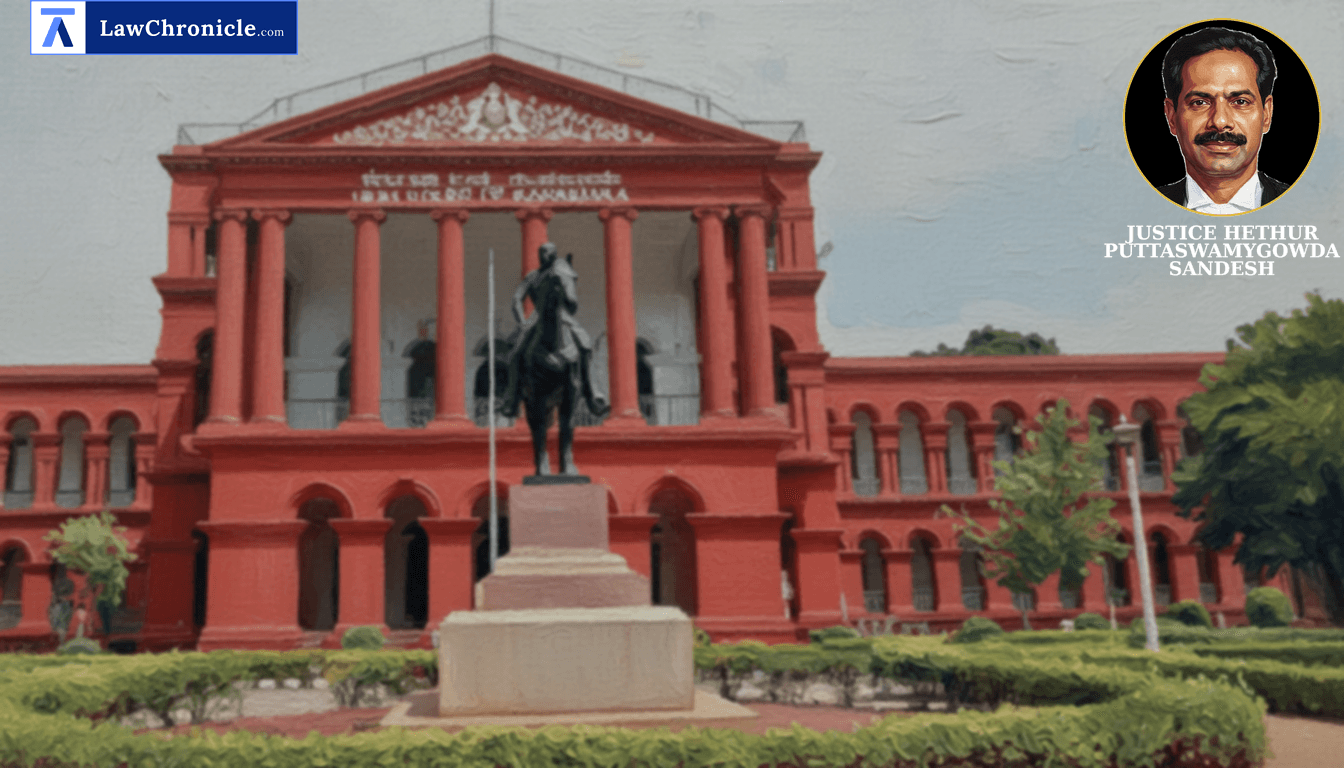
In a decisive blow to claims based on fabricated documentation, the Karnataka High Court has ruled that forensic evidence demonstrating non-identical thumb impressions is sufficient to dismantle assertions of legal heirship. The Court underscored that long-standing revenue entries and contemporaneous registered sale deeds executed by a widow prevail over contradictory voter lists and pension records created after the onset of a property dispute.
A single-judge bench of Justice H.P. Sandesh adjudicated upon the second appeal involving a complex dispute over the identity of one 'Poojari Lingappa' and the subsequent validity of a gift deed. The Court was tasked with determining whether the plaintiffs were the legitimate sons of the original property owner or if the first defendant was his sole surviving widow.
The Primacy of Forensic Expert Opinion
Central to the Court's analysis was the scientific comparison of thumb impressions between an undisputed sale deed of 1958 and a contested gift deed relied upon by the plaintiffs. The Court exercised its powers under Section 73 of the Indian Evidence Act, 1872 to evaluate the forensic reports. The Court, in its reasoning, observed: "Having considered and reassessed the evidence available on record in keeping the substantial question of law framed by this Court at the time of admission with regard to the scope of the appeal and the definite finding of fact under Order XLI Rule 1 of CPC as well as the additional substantial question of law framed by this Court with regard to the handwriting expert, whether the same can be believed. When this Court examined the expert evidence as well as compared the signatures by exercising the power under Section 73 of the Act, it is very clear that the person who had purchased the property in year 1958 under Ex.P1 is not the person who executed the gift deed at Ex.P2."
Judicial Prudence in Handwriting Comparison
While acknowledging that expert testimony is directory, the Bench relied on precedents established in Indian Overseas Bank v. Om Prakash Lal Srivasatava And State (Delhi Administration) v. Pali Ram to affirm the court’s authority to independently compare writings. The Court noted that even in the absence of an expert, the judiciary possesses the power to satisfy itself through observation, citing the ratio in Lalit Popli v. Canara Bank And Others. In this instance, the discrepancy in ridge characteristics between the admitted and questioned impressions was found to be conclusive.
Directions Issued by the High Court
The Court has the following directions:
"The second appeal is allowed. The impugned judgments of the Trial Court dated 19.04.2002 passed in O.S.No.64/1997 and the First Appellate Court dated 20.04.2006 passed in R.A.No.17/2002 are set aside. Consequently, the suit filed by the plaintiffs is dismissed."
Background:
The litigation originated when the plaintiffs sought a declaration of title and permanent injunction regarding a suit property purchased by Poojari Lingappa in 1958. They claimed to be his sons, whereas the first defendant claimed to be his widow. The plaintiffs relied on a gift deed and certain voter lists from 1983, 1988, and 1998 to establish their relationship. Conversely, the defendant produced a registered sale deed from 1956 identifying her as the wife of Poojari Lingappa.
The High Court found that the Trial Court and First Appellate Court had erroneously relied on inconsistent voter lists (where house numbers differed) and pension documents that were allegedly procured by misusing the defendant's illiteracy. The Court highlighted that the plaintiffs failed to produce standard documents like school certificates to prove their parentage. Crucially, the expert evidence confirmed that the thumb impression on the gift deed did not match the owner's impression on the 1958 sale deed.
Key Takeaways:
Forensic Superiority in Civil Proof
Where identity of an executant is in doubt, scientific evidence like fingerprint analysis carries higher probative value than secondary documents like voter lists.
Judicial Power under Evidence Law
Courts are empowered under Section 73 of the Indian Evidence Act, 1872 to independently compare disputed and admitted signatures/thumb impressions to reach a conclusion, regardless of expert presence.
Vulnerability of Revenue Records
Documents created pendente lite or post-dispute (like specific voter list entries) are viewed with suspicion if they contradict earlier registered deeds and long-standing occupation.
Ratio Decidendi:
A claim of title through succession cannot be sustained when forensic evidence proves that the supporting title documents (gift deeds) were executed by an individual other than the original owner. Registered documents identifying a spouse prior to any dispute carry significant evidentiary weight in determining legal heirship.
Case Details:
Case No.: RSA No. 2341 of 2006
Case Title: SMT. LAKKAMMA VS SRI. POOJARI LINGAPPA & OTHERS
Appearances:
For the Petitioner(s): SRI. C.R.GOPALASWAMY, SENIOR COUNSEL FOR SRI. G. BHARGAV, ADVOCATE FOR APPELLANT NO.1(a); SRI. D.R.RAJASHEKARAPPA, ADVOCATE FOR APPELLANT NO.2
For the Respondent(s): SRI. H.V. HARISH, ADVOCATE FOR R1, R2(a to d), R3 AND R4
Source: 2026 CaseBase(KAR) 229
Similar Articles


 Breaking News


