


Trial Records Not Mandatory for Summary Dismissal of State Appeals Against Acquittal: Allahabad HC
 Copy Link
 Share
 Save
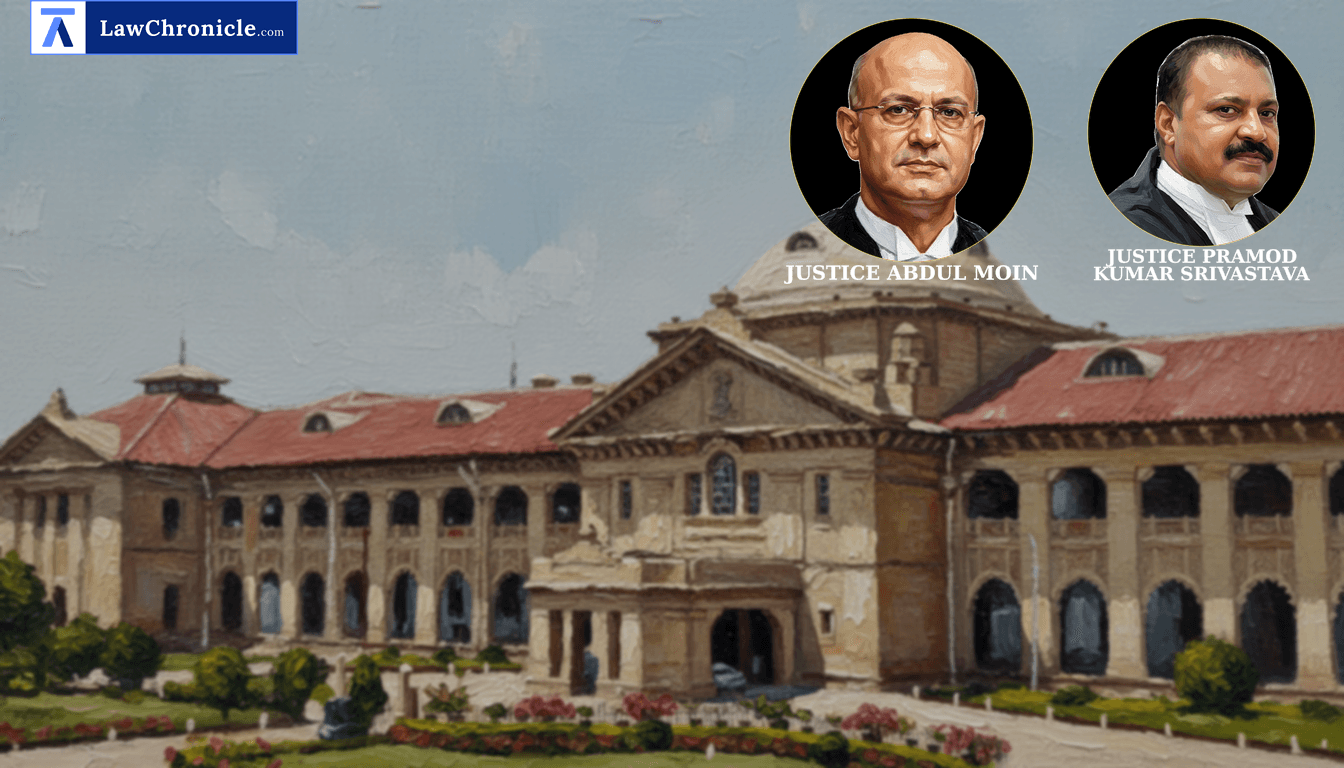
The Allahabad High Court has reinforced the discretionary power of appellate courts to summarily dismiss State-led appeals against acquittal without mandatorily summoning trial records, provided the judgment and petition reveal no arguable grounds for interference.
A Division Bench comprising Justice Abdul Moin and Justice Pramod Kumar Srivastava addressed a preliminary objection raised by the State, which contended that Section 385 of the Code of Criminal Procedure, 1973 made the summoning of records mandatory. The Allahabad High Court was hearing an appeal by the State of U.P. challenging the acquittal of an accused in a case involving charges under the Indian Penal Code, 1860 and the Protection of Children from Sexual Offences Act.
Key Takeaways
Procedural Autonomy in Summary Dismissal
Appellate courts retain the discretion to dismiss appeals at the threshold under Section 384 of the Code of Criminal Procedure, 1973 based solely on the petition and the impugned judgment.
Statutory Distinction Clarified
While Section 385 mandates summoning records for final hearings, Section 384 uses the permissive term "may," allowing for judicial efficiency in cases lacking merit.
Double Presumption of Innocence
An acquittal reinforces the initial presumption of innocence, and High Courts must exercise restraint unless the trial court’s view is found to be patently perverse or impossible.
Requirement of Reasoned Orders
Even in summary dismissals, courts must record brief reasons to enable higher judicial review, ensuring that the dismissal is not arbitrary.
Interpretation of Sections 384 and 385 of CrPC
The Allahabad High Court conducted a detailed analysis of the procedural landscape governing criminal appeals. It noted that while Section 385 of the Code of Criminal Procedure, 1973 (now Section 426 of the B.N.S.S) mandates sending for records when an appeal is admitted for a full hearing, Section 384 (now Section 425 of the B.N.S.S) provides an earlier exit ramp for meritless appeals. The Bench emphasized that the legislature intentionally used the word "may" in Section 384(2), contrasting it with the mandatory "shall" in Section 385(2).
The Allahabad High Court reasoned to observe that "The specification of the material to be relied upon in sub Section (1) of Section 384 Cr.P.C. for the purposes of considering the appeal for summary dismissal denotes the legislative intent then the only material which is required for consideration by the appellate court is the petition of appeal and the copy of the judgment. Sub Section (2) only enables the appellate court to call for the records of the case even before it proceeds to summarily dismiss the appeal and the Code has vested the discretion with the Appellate Court to summon the trial Court record before summarily dismissing the appeal..."
The Bench further relied on State of Maharashtra Vs. Sujay Mangesh Poyarekar ( "(2008) 9 SCC 475": 2008 CaseBase(SC) 763) to observe that “the appellate Court must consider the relevant material, sworn testimonies of prosecution witnesses and record reasons why leave sought by the State should not be granted... if arguable points have been raised, if the material on record discloses deeper scrutiny and re-appreciation, review or reconsideration of evidence, the appellate Court must grant leave as sought and decide the appeal on merits.”
Ratio
Granting leave to appeal under Section 378 of the Cr.P.C. does not automatically trigger a mandatory requirement to summon trial court records. An appellate court may summarily dismiss such an appeal under Section 384 of the Cr.P.C. if, upon examining the petition and the judgment, it finds no sufficient ground for interference. The power to call for records under Section 384(2) is an enabling, discretionary provision and not a mandatory obligation.
Background
The dispute originated from a 2021 FIR where the informant alleged that the accused had an affair with her daughter and later posted a viral photograph on Facebook falsely claiming marriage, leading to the daughter's distress. The accused was charged under Section 376 and 506 of the Indian Penal Code, 1860, Sections 3 and 4 of the Protection of Children from Sexual Offences Act, and Section 67 of the Information Technology Act.
The Special Judge (POCSO Act-I), Ayodhya, acquitted the accused on July 29, 2025. The trial court found that the victim was not a minor at the time of the incident, the FIR was lodged after a seven-year delay without explanation, and there was a pre-existing tenancy dispute between the families. Furthermore, no obscene photographs were recovered by the Cyber Cell.
Before the Allahabad High Court, the State argued that trial records must be summoned once leave to appeal is granted. The Bench, however, upheld the trial court's findings as a "possible view" and cited Surya Baksh Singh Vs. State of U.P and ors and Hanumat Das Vs. Vinay Kumar ( "AIR 1982 SC 1052": 1982 CaseBase(SC) 171) to highlight the limited scope of interference in acquittals. Paraphrasing the principles in Bannareddy and others vs. State of Karnataka and others ( "(2018) 5 SCC 790": 2018 CaseBase(SC) 1083) and Jayamma vs. State of Karnataka ( "2021 (6) SCC 213": 2021 CaseBase(SC) 1425), the Bench noted that while High Courts have the power to re-appreciate evidence, they should not set aside acquittals merely because a different view is probable, unless the trial court’s judgment is perverse. Finding no such perversity, the Allahabad High Court dismissed the State's appeal summarily.
Case Details:
Case No.: GOVERNMENT APPEAL No. - 92 of 2026
Neutral Citation: 2026:AHC-LKO:65951-DB
Case Title: State of U.P. Thru. Prin. Secy. Home, Lko. Versus Sharad Rastogi and 4 others
Appearances:
For the Petitioner(s): Shri Umesh Verma, learned AGA alongwith Shri Arunendra, Shri Badrul Hasan, Shri Anurag Verma, Shri S.N. Tilahri, Shri Pawan Kumar, and Ms. Meera Tripathi, learned AGAs
Source: 2026 CaseBase(ALL) 897
Similar Articles
 Breaking News


