


Tribunal May Grant Interim Relief Before Deciding 'Employer-Employee' Status: Gujarat HC
 Copy Link
 Share
 Save
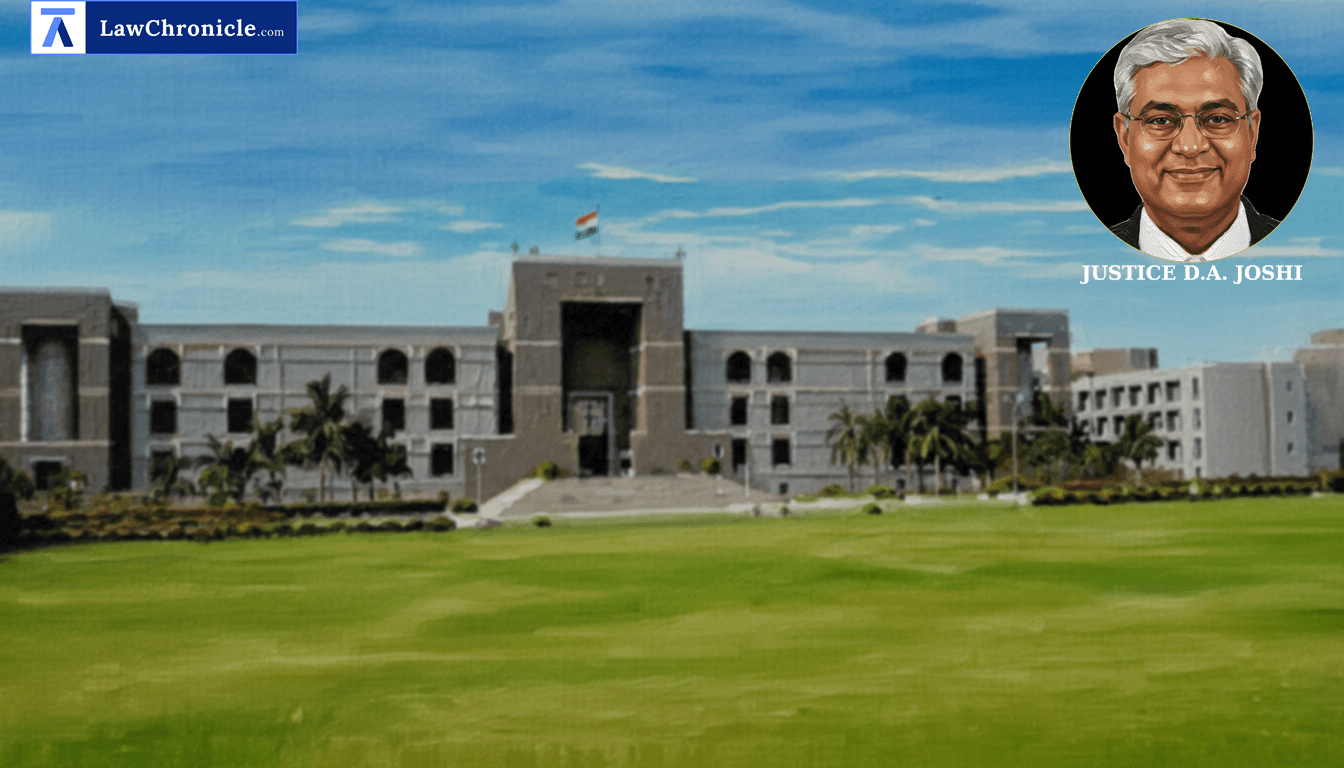
The High Court of Gujarat has affirmed the power of Industrial Tribunals to grant interim wage parity to contract workers even while the threshold issue of the 'sham' nature of the contract remains pending for final adjudication. In a significant decision, the court ruled that workers cannot be deprived of legitimate financial benefits during lengthy litigation, especially when clear salary disparities exist between similarly situated union members within the same establishment.
Justice Divyesh A. Joshi presided over the matter, hearing a challenge against an interim order passed by the Industrial Tribunal, Kalol. The petitioner company, Kalpataru Projects International Limited, contested the Tribunal's direction to pay interim benefits to members of the Gujarat Mazdoor Sabha at par with a settlement executed with a different union, arguing that the core issue of whether the contract system was a 'sham or bogus' had to be decided first as per previous judicial directions.
Key Takeaways
Interim Relief Not Barred by Threshold Issues
Industrial Tribunals possess the jurisdiction to grant interim financial relief under Section 10(4) of the Industrial Disputes Act, 1947 even if the fundamental 'employer-employee' relationship is under challenge.
Principle of Equal Pay for Equal Work
Where workers demonstrate functional parity and significant wage discrepancies compared to peers, the court may intervene to maintain industrial peace despite the pendency of a main reference.
Judicial Discretion vs. Procedural Delays
Courts must strike a balance between procedural requirements and the socio-economic reality of workers facing soaring price indices, preventing the exploitation of preliminary objections to delay justice.
Court's Rationale on Interim Parity
The court observed that the Industrial Tribunal had correctly identified a "vast difference" in the salaries of workmen performing the same tasks. By comparing pay slips, the Tribunal found that members of the respondent union were being paid significantly less than those who had signed a settlement affirmed under Section 2(p) of the Industrial Disputes Act, 1947. The High Court noted that since the petitioner company was a confirming party to the settlement with another union, it could not easily deny similar benefits to others based on technicalities during the pendency of the suit.
The Court, in its reasoning, observed: "A court is meant to do justice, no doubt, within the confines of law and principles which are settled from time to time. A court is intended to be an effective adjudicator of disputes. If the court is to be an effective adjudicator of disputes, it must inevitably be clothed with necessary power to deal with situations which may arise where the court must have power to strike off defence so that the people will continue to repose faith in the system and resort to lawful means which are provided by the courts."
The Court has following directions:
"Thus in view of the above observations and directions, the present petition is devoid of merits and is hereby rejected. Notice is discharged. Interim relief stands vacated. ... The implementation, execution and operation of this judgment may be stayed for a period of four weeks so as to enable them to approach higher forum."
Ratio
In industrial disputes, the principle of 'Equal Pay for Equal Work' can be applied at an interlocutory stage if the claimant establishes parity in duties and responsibilities. The existence of a 'jurisdictional fact' dispute such as the status of the employer-employee relationship does not automatically stifle the Tribunal's power to grant interim relief to prevent misery and preserve industrial peace, provided the order is well-reasoned and based on evidentiary parity.
Background
The dispute arose at Kalpataru Projects International Limited, where the Gujarat Mazdoor Sabha claimed that the contract system involving various contractors was a sham and paper arrangement designed to deny them regular benefits. The company, registered under the Companies Act, 1956, argued that the workers were employees of independent contractors licensed under the Contract Labour (Regulation And Abolition) Act, 1970.
Previously, in Special Civil Application No. 12023/2024, the High Court had directed the Tribunal to decide the 'sham contract' issue as a threshold matter. However, the Tribunal proceeded to hear Exh. 10, granting interim wages of Rs. 10,000 w.e.f. 01.04.2023. The petitioner alleged this amounted to judicial indiscipline. The High Court, relying on State Of Punjab & Ors. Vs. Jagjit Singh & Ors. ( "(2017) 1 SCC 148": 2016 CaseBase(SC) 490) and D.P. Maheshwari Vs. Delhi Administration & Ors., held that while preliminary issues are important, they should not be used to 'break the resistance of workmen' through prolonged litigation. The Court found the Tribunal's order to be a just exercise of discretion under Article 227 of the Constitution of India, 1950.
Case Details:
Case No.: R/SPECIAL CIVIL APPLICATION NO. 11206 of 2026
Neutral Citation: 2026:GUJHC:70666
Case Title: KALPATARU PROJECTS INTERNATIONAL LIMITED Versus GUJARAT MAZDOOR SABHA & ORS.
Appearances:
For the Petitioner(s): MR MIHIR JOSHI, Sr. Adv. with MR KEYUR GANDHI, MR NISARG DESAI and MS PRAVALIKHA BATTHINI
For the Respondent(s): MR AMRESH N PATEL with MR HARSH K RAVAL
Source: 2026 CaseBase(GUJ) 31985
Similar Articles

 Breaking News


