


Vehicle Retention Rules Clarified Under AP Minor Mineral Rules: Andhra Pradesh HC
 Copy Link
 Share
 Save
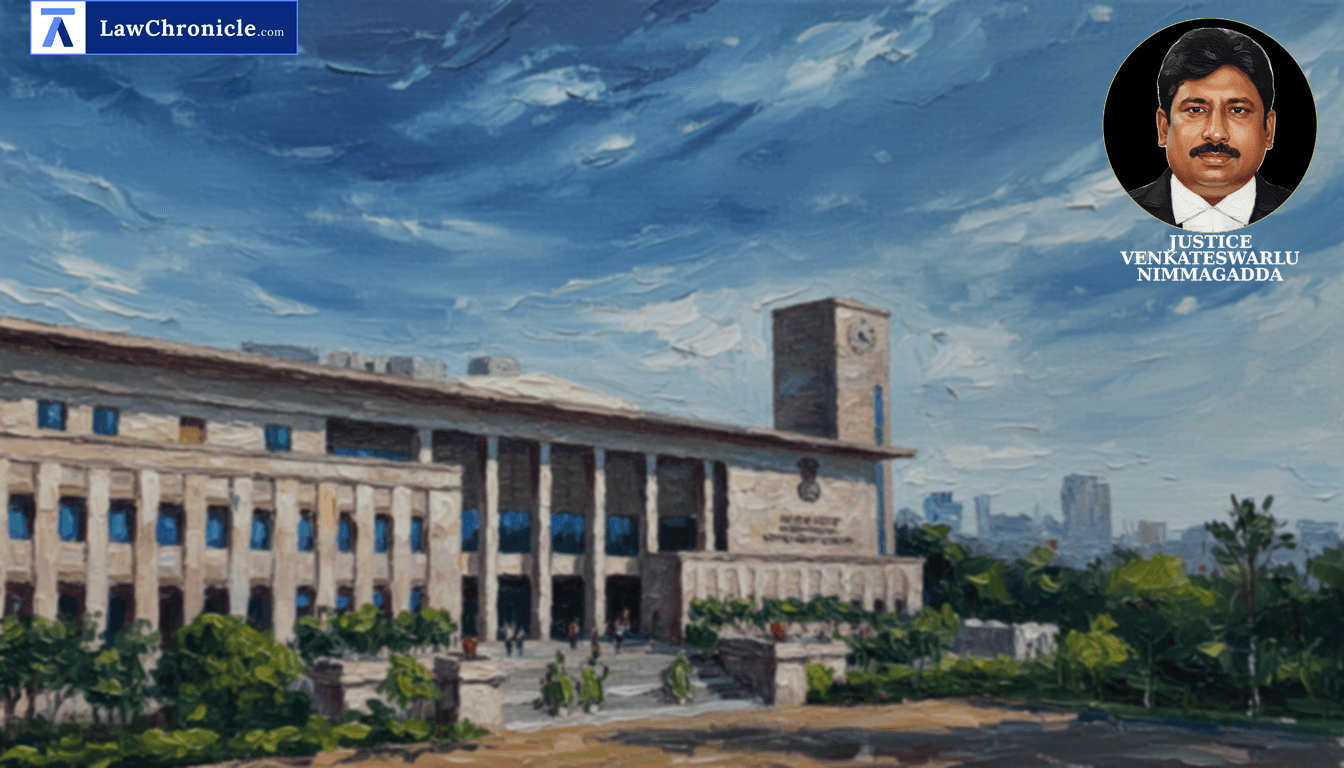
The Andhra Pradesh High Court has ruled that state authorities cannot indefinitely withhold seized vehicles under mineral concession rules without following statutory penalty mechanisms. Setting strict boundaries on executive seizures, the Court held that non-payment of penalties does not automatically justify the perpetual detention of transit vehicles.
In a writ petition challenging the unauthorized seizure of tipper lorries, a single-judge bench of Justice Venkateswarlu Nimmagadda addressed the scope of power exercised by mining and police officials regarding vehicle impoundment.
Key Takeaways
- Vehicle Release Mandate: Seized vehicles cannot be detained indefinitely if the statutory procedures for levying penalty and seigniorage fees are followed.
- Procedural Compliance Required: Authorities must act within the framework of Sub-Rule (3)(iii) of Rule 26 of the Andhra Pradesh Minor Mineral Concession Rules, 1966 rather than executing arbitrary impoundment.
- Precedent Alignment: Reaffirmation that retaining seized property without utility serves no legitimate administrative or judicial purpose.
Court Observations and Directions
Examining the regulatory framework under the Andhra Pradesh Minor Mineral Concession Rules, 1966, the High Court noted that the law penalizes unauthorized mineral transit through specific monetary levies rather than outright asset forfeiture.
The Court, in its reasoning, observed: "On a reading of the above Rule, there is nothing to indicate, the vehicle cannot be released, unless the penalty and 5 seigniorage fee is paid. All that the rule states is that the penalty equal to market value of the mineral seized along with seigniorage fee prevalent at that time can be ordered to be paid at the time of interception of the vehicle, if driver or person-incharge of the vehicle fails to produce a valid permit. But, nowhere the Rule postulates that the vehicle cannot be released, unless the same is paid."
Additionally, reliance was placed on Sunderbhai Ambalal Desai Vs. State of Gurajat to emphasize that keeping impounded vehicles idle indefinitely serves no fruitful purpose. The Court has the following directions:
"i) The 2nd respondent is directed to pass appropriate orders in terms of Sub-Rule (3)(iii) of Rule 26 of the Andhra Pradesh Minor Mineral Concession Rules, 1966 and collect the due seigniorage fee and penalty as per law;
ii) After levy of penalty and on payment of such penalty, the petitioner shall produce the receipt of such payment and ownership documents of the vehicles to the satisfaction of the 3rd respondent.
iii) In such an event, the 3rd respondent is hereby directed to release the seized vehicles of the petitioner i.e., Tipper Lorry bearing Nos. AP 39 UN 7000 and AP 16 TJ 5099."
Ratio
Sub-Rule (3)(iii) of Rule 26 of the Andhra Pradesh Minor Mineral Concession Rules, 1966 permits the levy of seigniorage fees and penalties for non-production of transit permits upon interception, but it does not empower state authorities to permanently detain seized vehicles once the prescribed statutory procedure for penalty levy and payment is complied with.
Background
The petitioner, Pasupuleti Brahmaiah, approached the High Court under Article 226 of the Constitution of India through Writ Petition No. 24761 of 2026. The petitioner sought a Writ of Mandamus declaring the action of the police and mining departments in seizing Tipper Lorries (bearing Nos. AP 39 UN 7000 and AP 16 TJ 5099) as illegal, arbitrary, and in violation of the Andhra Pradesh Minor Mineral Concession Rules, 1966, the Mines and Minerals (Development and Regulation) Act, 1957, and Constitutional rights under Articles 14, 19(1)(g), and 300-A of the Constitution of India.
The petitioner contended that the Station House Officer (Respondent No. 3) seized the vehicles without statutory authority and in breach of procedure. Relying on an earlier High Court decision in Naganath Vs. State of A.P., the petitioner argued that the authorities should be directed to pass appropriate orders for release. The Assistant Government Pleader for Mines and Geology conceded that the issue was covered by earlier judicial pronouncements.
The High Court, relying on the Division Bench judgment in Naganath Vs. State of A.P. and the principles laid down by the Supreme Court in Sunderbhai Ambalal Desai Vs. State of Gurajat, disposed of the writ petition at the admission stage with directions to release the vehicles upon payment of the assessed penalty and submission of ownership documents.
Case Details:
Case No.: WRIT PETITION NO: 24761 OF 2026
Neutral Citation: 2026:APHC:35716
Case Title: PASUPULETI BRAHMAIAH v. THE STATE OF ANDHRA PRADESH AND OTHERS
Appearances:
For the Petitioner(s): CHETAN PONNURU
For the Respondent(s): GP FOR HOME, GP FOR MINES AND GEOLOGY
Source: 2026 CaseBase(AP) 14577
Similar Articles
 Breaking News


