Why is Punjab Govt Opposing Justice Ashwani Kumar Mishra as Punjab and Haryana HC Chief Justice?
 Copy Link
 Share
Share Save
Save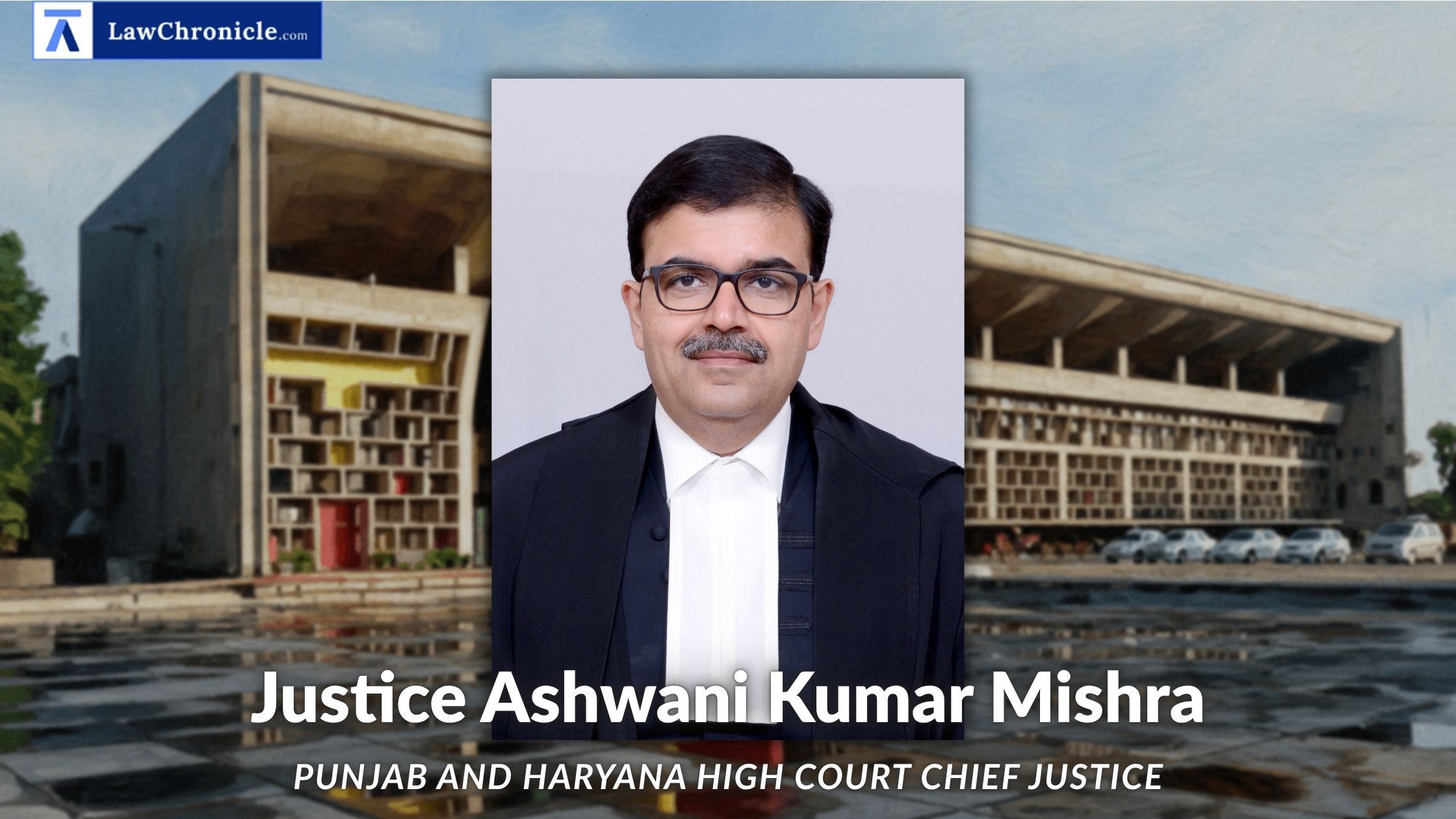
Justice Ashwani Kumar Mishra on Monday took oath as the Chief Justice of the Punjab and Haryana High Court. This happened despite the Punjab Government's objection to his elevation and its request that the appointment be kept on hold. However, why is the Punjab Government opposing Justice Ashwani Kumar Mishra as the Chief Justice of High Court in the first place?
The development has brought into focus questions concerning the procedure for appointment of High Court Chief Justices, the role of the State Government in that process, and the constitutional principle of judicial independence.
Justice Ashwani Kumar Mishra Appointed Chief Justice
The Union Government notified Justice Ashwani Kumar Mishra's appointment as Chief Justice of the Punjab and Haryana High Court on 5th September, 2026, following a recommendation by the Supreme Court Collegium.
The Collegium had recommended his elevation on 6th August, 2026. Justice Ashwani Kumar Mishra had already been functioning as the Acting Chief Justice of the High Court since June 2026, following the elevation of then Chief Justice Sheel Nagu to the Supreme Court. The elevation completed the transition from his tenure as Acting Chief Justice to that of the permanent Chief Justice.
About Justice Ashwani Kumar Mishra
Justice Mishra was appointed as an Additional Judge of the Allahabad High Court in February 2014 and became a permanent judge in February 2016. After serving at Allahabad for over a decade, he was transferred to the Punjab and Haryana High Court, where he joined in July 2025. He was subsequently appointed Acting Chief Justice in June 2026.
On 7th September, 2026, Punjab Governor Gulab Chand Kataria administered the oath of office to Justice Mishra. Haryana Chief Minister Nayab Singh Saini attended the ceremony, while Punjab Chief Minister Bhagwant Mann was absent.
Why Did the Punjab Government Oppose Chief Justice Appointment?
The Punjab Government's objection was not presented as an opposition to Justice Mishra's judicial credentials. Instead, the State Government challenged the manner and timing in which the appointment was notified. As per reports, the Punjab Cabinet, at an emergency meeting on Sunday, 6th September, passed a resolution stating that the Centre had notified Justice Mishra's appointment without awaiting the State Government's views on his suitability.
Punjab Govt. therefore requested that the appointment, as well as the administration of the oath, be kept on hold until its views were obtained and considered. Chief Minister Bhagwant Mann described the development as a violation of the prescribed procedure and constitutional norms, arguing that the State's role had not been adequately respected.
Memorandum of Procedure
The Punjab's objection rests upon the Memorandum of Procedure (MoP) for appointment and transfer of Chief Justices and Judges of High Courts. According to Punjab Government, after receiving the recommendation from the Chief Justice of India, the Union Law Minister is required to obtain the views of the concerned State Government. Those views are then to form part of the process through which the proposal is submitted to the Prime Minister and ultimately to the President.
Punjab claimed that its views had been sought by the Union Government on 12th August, but the appointment was notified before the State had responded. It argued that there was no prescribed deadline requiring the State to respond within a particular period in the case of appointment of a High Court Chief Justice. The State consequently maintained that the Union should have waited for its response instead of proceeding with the appointment.
Alleged 'Discrimination' in the Process
The Punjab Government also relied upon an earlier instance involving Justice Gurmeet Singh Sandhawalia. According to the State, Justice Sandhawalia, then a judge of the Punjab and Haryana High Court, had been recommended in 2024 for appointment as Chief Justice of the Madhya Pradesh High Court. Punjab claimed that the proposal was not notified for more than two months because the recommendation of the Madhya Pradesh Government had not been received.
The proposal was subsequently altered, and Justice Sandhawalia was appointed Chief Justice of the Himachal Pradesh High Court. Punjab Govt. cited this episode to argue that the Centre had previously waited for a State Government's views in a comparable situation but had not followed the same approach in Justice Mishra's case. It therefore alleged a perception of differential treatment towards Punjab.
Justice Ashwani Kumar Mishra Takes Oath as PHHC Chief Justice
Despite Punjab's resolution and request to the Governor, Justice Mishra's oath ceremony proceeded as scheduled. Justice Mishra formally assumed the office as Chief Justice on 7th September, 2026. The Punjab and Haryana High Court Bar Association criticized the State Government's intervention, describing Punjab Cabinet's decision to deliberate on the appointment as raising concerns of executive overreach into a matter governed by the constitutional mechanism for judicial appointments.
The Constitutional Question
The controversy raises an important distinction between consultation with a State Government and the requirement of its consent. Punjab's objection is founded on the argument that its views were required to be obtained and considered before the appointment was processed. However, the State's position has also been framed by the Chief Minister as requiring the Centre to obtain the State's "consent."
The distinction is significant because appointment of High Court judges and Chief Justices is constitutionally structured around the President's appointment, the Supreme Court Collegium's recommendation and the Union Government's role in processing the recommendation. The dispute, therefore, is less about whether a State Government can exercise a veto over a judicial appointment and more about whether the procedural requirement of obtaining and considering the State's views was complied with before the appointment was notified.
The Aftermath
With Justice Ashwani Kumar Mishra having taken oath, the immediate question of his assumption of office has been settled. However, concerns the interpretation and implementation of the Memorandum of Procedure governing consultation with State Governments in judicial appointments persist.
 Breaking News