


Winding Up Proceedings Cannot Extend Limitation For Filing Recovery Suit: Supreme Court
 Copy Link
 Share
 Save
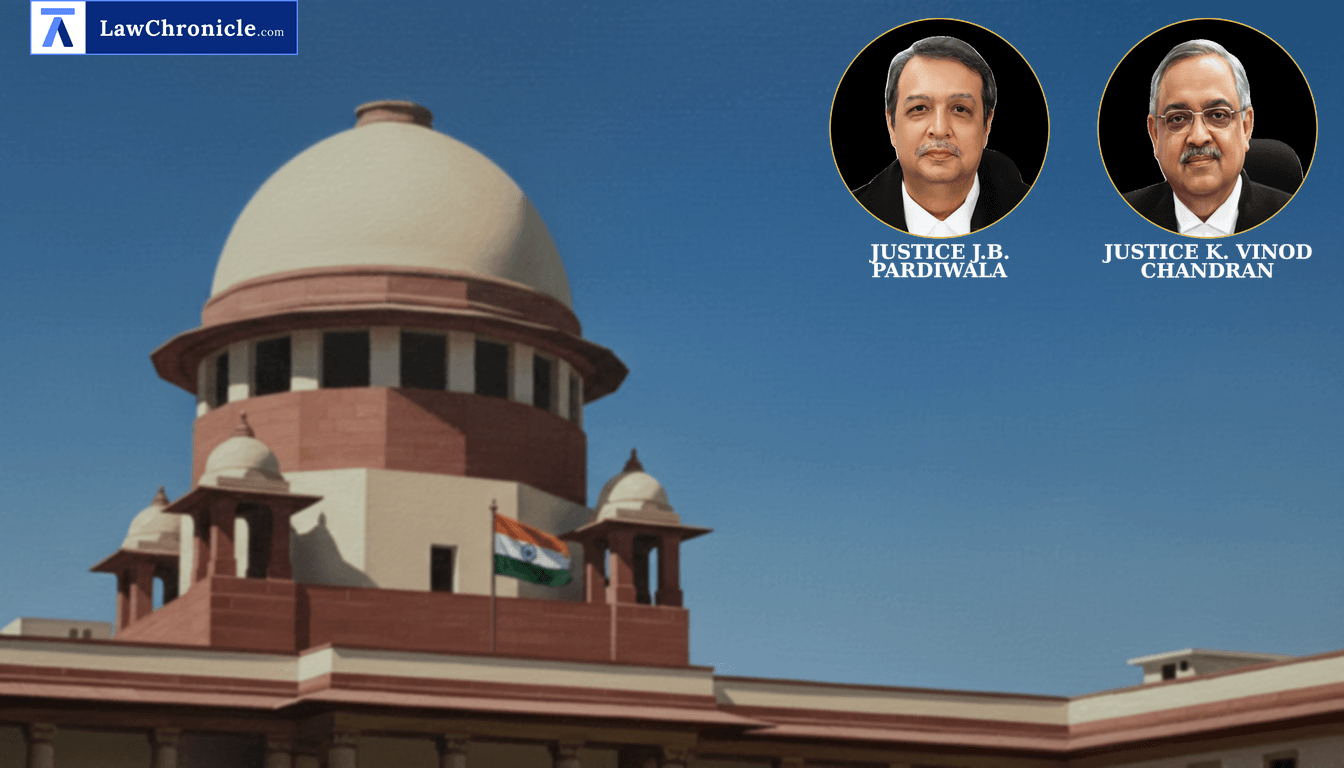
Initiating company winding-up proceedings before a court does not impact or extend the prescribed limitation period for filing an independent civil suit for recovery of money. Clarifying the distinct boundaries between insolvency remedies and monetary recovery suits, the Supreme Court held that time spent pursuing a winding-up petition cannot save a delayed suit from being barred by limitation.
A bench of Justice J.B. Pardiwala and Justice K. Vinod Chandran heard an appeal challenging a First Appellate Court decree that had reversed the dismissal of a money recovery suit.
Key Takeaways
Independent Civil Remedies: Insolvency or winding-up proceedings are distinct from money recovery suits and do not automatically toll the limitation period for filing civil suits.
Limits of Section 14: Benefit under Section 14 of the Limitation Act, 1963 cannot be claimed when the nature of relief sought in previous proceedings was fundamentally different from a civil decree.
Partnership Registration Proof: A Memorandum of Registration issued by the Registrar of Firms coupled with certified Form-VIII serves as valid proof under Section 69(2) of the Indian Partnership Act, 1932.
The Supreme Court affirmed that the respondent-firm was indeed registered under the Indian Partnership Act, 1932 based on Exhibit-8 and certified Form-VIII produced under Order XLI Rule 27(1) of the Code of Civil Procedure, 1908. However, turning to the crucial issue of limitation, the Court observed that the suit was grounded on individual unpaid invoices rather than a running account.
The Court noted that the respondent attempted to rely on proceedings before the Company Court and Section 14 of the Limitation Act, 1963 to surpass limitation. Disagreed with this approach, the Court relied on precedents to hold that winding-up proceedings and money suits operate on separate legal tracks.
The Court, in its reasoning, observed: "The filing of a suit for recovery based upon a cause of action, that is within limitation cannot in any manner impact the separate and independent remedy of a winding up proceeding. The converse position applies squarely to this case that the initiation of a winding up proceeding, which may or may not enable recovery, will not impact the limitation for the separate remedy of suit for recovery of money."
The Court has following directions:
"We find absolutely no reason to sustain the order of the High Court in the First Appeal and, hence, reverse the same to the extent of granting the relief of recovery, despite our finding that the suit was properly instituted by a partnership firm, whose registration has been proved in accordance with law. The claim for recovery is hit by limitation. The suit, hence, stands dismissed for that reason."
Ratio
The initiation of a winding-up proceeding before a Company Court does not extend or alter the period of limitation for instituting an independent civil suit for recovery of money based on the same underlying monetary liability.
Background
The dispute arose when the respondent-plaintiff filed a civil suit for the recovery of Rs. 24,36,105/- based on unpaid invoices raised against the appellant-defendant. The Trial Court initially dismissed the suit, holding that the plaintiff failed to prove its status as a registered partnership firm, rendering the suit barred under Section 69(2) of the Indian Partnership Act, 1932.
In appeal, the First Appellate Court reversed this finding, relying on a Memorandum of Registration (Exhibit-8) and additional evidence admitted under Order XLI Rule 27 of the Code of Civil Procedure, 1908, and decreed the suit with interest. The appellant challenged this decree before the Supreme Court, contending that the suit claim was hopelessly barred by limitation and that the respondent could not take refuge under the prior winding-up proceedings initiated before the Company Court.
Examining the legal framework and judicial precedents, the Supreme Court referred to Kalpraj Dharamshi and Anr. v. Kotak Investments Advisor Limited and Anr. ( "(2021) 10 SCC 401": 2021 CaseBase(SC) 781), Bhudan Singh v. Nabi Bux ( "(1969) 2 SCC 481": 1969 CaseBase(SC) 466), J. Kumaradasan Nair v. Iric Sohan ( "(2009) 12 SCC 175": 2009 CaseBase(SC) 463), and Consolidated Engg. Enterprises v. Irrigation Deptt. ( "(2008) 7 SCC 169": 2008 CaseBase(SC) 271) regarding Section 14 and Section 5 of the Limitation Act, 1963. However, applying the rulings in Yeswant Deorao Deshmukh v. Walchand Ramchand Kothari ( "1950 SCC 766": 1950 CaseBase(SC) 34) and Jignesh Shah and Anr. v. Union of India and Anr. ( "(2019) 10 SCC 750": 2019 CaseBase(SC) 1334), the Apex Court observed that insolvency and winding-up proceedings are not meant for obtaining the same relief as a money recovery suit. Consequently, the Supreme Court allowed the appeal and dismissed the suit as barred by limitation.
Case Details:
Case No.: Civil Appeal No.10658 of 2026
Neutral Citation: 2026 INSC 839
Case Title: Mageba Bridge Products Private Limited v. M/s. Trade Centre
Appearances:
For the Petitioner(s): Sri Nikhil Nayyar, Senior Counsel
For the Respondent(s): Sri Manish Goswami, Senior Counsel
Source: 2026 CaseBase(SC) 772
Similar Articles
 Breaking News


