


Witnesses 'Set Up' to Create Evidence: Supreme Court Acquits Murder Accused
 Copy Link
 Share
 Save
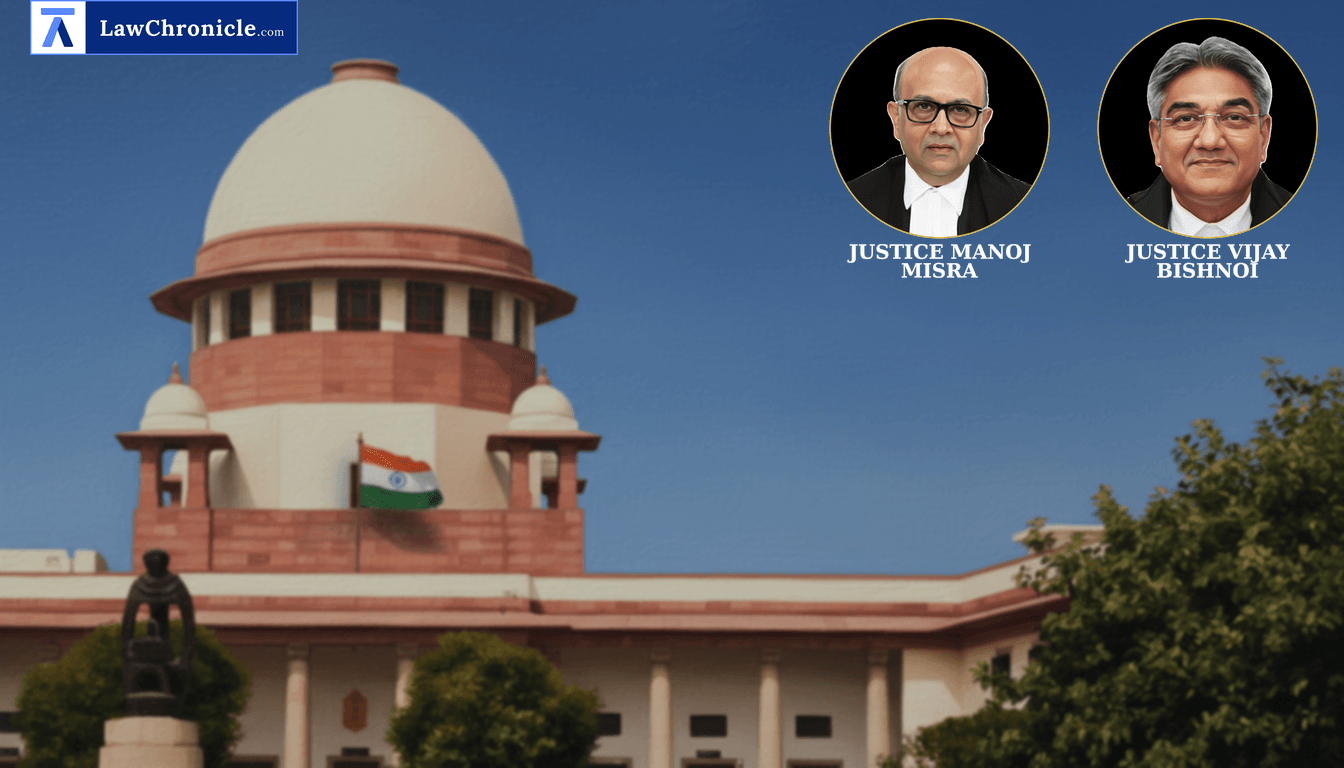
Exposing grave investigational lapses and a broken chain of circumstantial evidence, the Supreme Court has upheld the acquittal of a woman accused of murders of stepmother and stepbrother.
A Division Bench comprising Justice Manoj Misra and Justice Vijay Bishnoi dismissed the criminal appeal filed by the State of Himachal Pradesh against the judgment of the High Court of Himachal Pradesh, which had set aside the trial court's conviction under Section 302 of the Indian Penal Code, 1860.
Key Takeaways
- High Acquittal Interference Standard: Appellate courts must not disturb acquittals unless the findings are perverse, legally erroneous, or based on gross misappreciation of evidence.
- Investigational Lapses Fatal to Prosecution: Failure to procure mobile Call Detail Records (CDRs) with tower locations creates fatal gaps in proving proximity and timeline in circumstantial cases.
- DNA Matching Not Conclusive Proof: Matching DNA profiles from a shared domestic space does not automatically prove presence at the exact time of the crime, especially without corroborating physical evidence.
- Credibility of Set-Up Witnesses: Witnesses introduced without clear police rationale or documentation risk being treated as fabricated tools to bridge evidentiary gaps.
Court's Analysis on Interference with Acquittal
The Supreme Court thoroughly analyzed the legal parameters governing appeals against acquittals, emphasizing that an acquittal strengthens the presumption of innocence. The Bench observed that "...unless the judgment under appeal is contrary to the evidence or palpably erroneous or takes a view which could not have been taken by the court of competent jurisdiction, keeping in view the settled canons of criminal jurisprudence, this Court is reluctant to interfere with such judgment of acquittal."
Tracing established precedents including State of Rajasthan V. Shera Ram Alias Vishnu Dutta, State of M.P. versus Bacchudas alias Balram and others, and Rajesh Prasad v. State of Bihar and another, the Bench reiterated that if two reasonable views are possible on the evidence, the appellate court must adopt the view favorable to the accused unless compelling reasons justify interference.
Scrutiny of Circumstantial Evidence and Investigational Failures
Evaluating the five cardinal principles of circumstantial evidence laid down in Hanumant v. State of Madhya Pradesh and Sharad Birdhichand Sarda vs. State of Maharashtra ( "(1984) 4 SCC 116": 1984 CaseBase(SC) 194), the Bench found multiple missing links in the prosecution's case. The Supreme Court pointed out that the last-seen theory resting on the testimony of the deceased's father was filled with uncorroborated improvements. Corroborating testimony from a taxi driver and a hotel worker was discarded due to serious doubts about why and when their statements were recorded.
Highlighting the failure to collect tower locations for mobile phones, the Court criticized the investigating agency for suppressing vital location data. Additionally, while DNA extracted from a trunk matched the accused, the Court noted that since she frequented the house, past presence could not be ruled out, especially when no DNA was found on the murder weapons or victims' clothes.
Ratio
In an appeal against acquittal based on circumstantial evidence, the appellate court cannot set aside the judgment unless the lower court's reasoning is perverse or unsustainable. Where circumstances do not form an unbroken, conclusive chain excluding every hypothesis of innocence, the benefit of reasonable doubt must strictly accrue to the accused.
Background
The case originated on September 7, 2011, when police in Diur discovered the decomposed bodies of Mithilesh Kumari and her minor son Bhupinder Singh, both strangulated inside their locked house. The prosecution alleged that the accused, Anchla, daughter of Mithilesh's late husband from his first marriage, committed the double murder to grab property bequeathed to her stepbrother.
The Trial Court (Court of Session, Chamba) convicted the accused under Section 302 of the Indian Penal Code, 1860 on November 7, 2012, based on last-seen evidence, thumb injury treatment, recovery of house keys, and a matching DNA report. However, the High Court of Himachal Pradesh allowed her appeal on July 28, 2014, acquitting her of all charges after finding severe contradictions and lack of proof of motive. The Supreme Court affirmed the High Court's acquittal, dismissing the State's appeal.
Case Details:
Case No.: Criminal Appeal No. 166 of 2019
Neutral Citation: 2026 INSC 1074
Case Title: The State of Himachal Pradesh v. Anchla @ Chanchla
Source: 2026 CaseBase(SC) 8232
Similar Articles




 Breaking News


