


Writ Courts cannot limit Jurisdiction of Arbitral Tribunal under Section 16: Supreme Court
 Copy Link
 Share
 Save
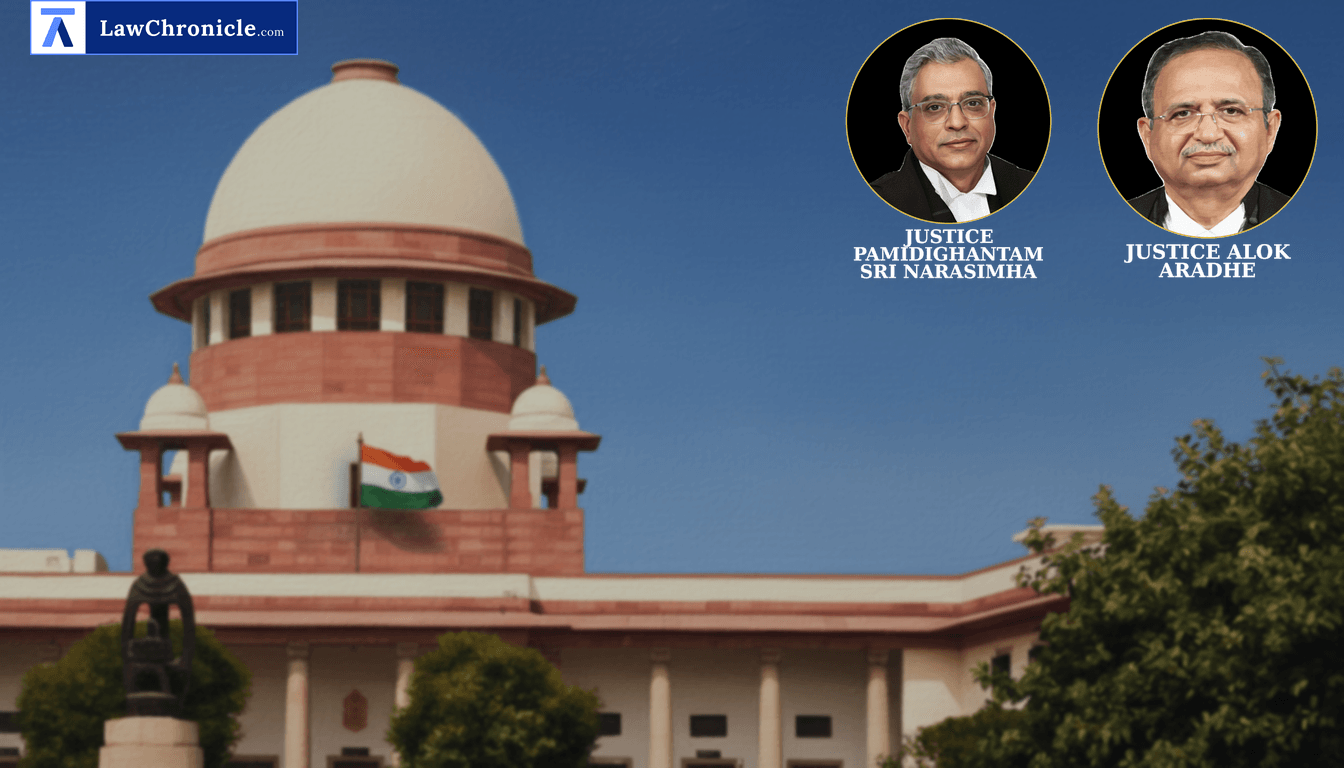
Affirming Jurisdiction of Arbitral Tribunal under Section 16, the Supreme Court ruled that High Courts exercising judicial review under Article 226 cannot circumscribe an Arbitral Tribunal's authority under Section 16 of the Arbitration and Conciliation Act, 1996 to determine its own jurisdiction over 'excepted matters' or contract termination disputes.
A Bench comprising Justice Pamidighantam Sri Narasimha and Justice Alok Aradhe modified a High Court order that had directed a sole arbitrator to decide contract claims 'strictly in accordance with the terms of the contract'. The Bench clarified that such judicial observations must not fetter the tribunal's statutory competence.
Key Takeaways
Kompetenz-Kompetenz Upheld: The decision reasserts that whether a claim falls within an 'excepted matter' clause is strictly for the Arbitral Tribunal to rule upon under Section 16 of the Arbitration and Conciliation Act, 1996.
Writ Restraint in Arbitration: High Courts exercising constitutional writ jurisdiction under Article 226 of the Constitution of India cannot pre-determine or constrain the scope of arbitral enquiries.
Evolution of Judicial Scrutiny: Reaffirms the narrow 'eye of the needle' standard governing referral courts and judicial authorities prior to arbitral adjudication.
Jurisdiction of Arbitral Tribunal (Section 16)
The Supreme Court emphasized the statutory mandate of non-intervention enshrined under Section 5 and Section 16 of the Arbitration and Conciliation Act, 1996, reiterating that the principle of kompetenz-kompetenz allows the arbitral tribunal to rule on its own jurisdiction.
The Court reasoned that "If a court exercising the power of appointment under Section 11(6A) has no jurisdiction to enter upon, still less to pre-determine, the touchstone by reference to which the Arbitral Tribunal is to adjudicate a claim said to fall within an 'excepted matters' clause, a writ appellate court, whose task was confined to testing the correctness of the learned Single Judge’s disposal of a writ petition impugning a termination notice, had, by parity of reasoning and a fortiori, no such jurisdiction."
Ratio
Whether a specific claim falls outside an arbitration clause as an 'excepted matter' is a question squarely within the competence of the Arbitral Tribunal under Section 16 of the Arbitration and Conciliation Act, 1996. A court exercising judicial review under Article 226 of the Constitution of India lacks jurisdiction to prescribe in advance the manner of or place constraints upon that adjudication.
Background
The dispute originated from a contract awarded by South Central Railway to a private construction firm for track doubling work. The contract was subsequently terminated under Clause 62 of the Indian Railways Standard General Conditions of Contract (GCC), leading to the forfeiture of the firm's performance guarantee.
The contractor challenged the termination before the High Court for the State of Telangana under Article 226 of the Constitution of India. A Single Judge dismissed the writ petition, holding that factual disputes were not amenable to writ jurisdiction and noting that arbitration had been invoked. On appeal, a Division Bench set aside the Single Judge's findings on the validity of the termination but directed the appointed Sole Arbitrator to decide claims strictly according to contractual terms.
Before the Supreme Court, the contractor argued that the direction restricted the arbitrator from deciding the validity of the contract termination, which was intrinsically linked to all other arbitral claims. Conversely, the Union of India relied on Clause 63 and Clause 64 of the GCC to contend that contract termination fell under 'excepted matters' excluded from arbitration, citing precedent like General Manager, Northern Railway and Another v. Sarvesh Chopra ( "(2002) 4 SCC 45": 2002 CaseBase(SC) 17) and Harsha Constructions v. Union of India and Others.
Analyzing the legislative trajectory from Konkan Railway Corpn. Ltd. & Ors. v. Mehul Construction Co., SBP & Co. v. Patel Engineering. Ltd. and Another, and National Insurance Co. Ltd. v. Boghara Polyfab (P) Ltd. ( "(2009) 1 SCC 267": 2008 CaseBase(SC) 242) to the amended framework under Section 11(6A) as interpreted in Duro Felguera, S.A. v. Gangavaram Port Ltd. ( "(2017) 9 SCC 729": 2017 CaseBase(SC) 145), Mayavati Trading (P) Ltd. v. Pradyuat Deb Burman ( "(2019) 8 SCC 714": 2019 CaseBase(SC) 3310), Vidya Drolia and Others v. Durga Trading Corporation ( "(2021) 2 SCC 1": 2019 CaseBase(SC) 2468), In Re: Interplay Between Arbitration Agreements and the Indian Stamp Act, 1899, and SBI General Insurance Company Ltd. v. Krish Spinning ( "(2024) 12 SCC 1": 2024 CaseBase(SC) 562), the Supreme Court noted that judicial intervention at the pre-arbitral stage is strictly limited. It distinguished the decision in ABS Marine Services v. Andaman and Nicobar Administration, noting that Clause 63 of the GCC does not oust court jurisdiction entirely but merely excludes excepted matters from arbitration. The Supreme Court accordingly disposed of the appeal by clarifying the High Court's direction.
Case Details:
Case No.: Civil Appeal No. of 2026 (@ Special Leave Petition (Civil) No. 7338 of 2026)
Neutral Citation: 2026 INSC 976
Case Title: M/s. GVV Constructions Private Limited v. The Union of India & Ors.
Appearances:
For the Petitioner(s): Mr. Gaurav Agarwal, Senior Advocate
For the Respondent(s): Mr. Vikramjit Banerjee, Additional Solicitor General
Source: 2026 CaseBase(SC) 6698
Similar Articles

 Breaking News


