


Absence Of Written Grounds Of Arrest No Automatic Basis For Bail: Supreme Court
 Copy Link
 Share
 Save
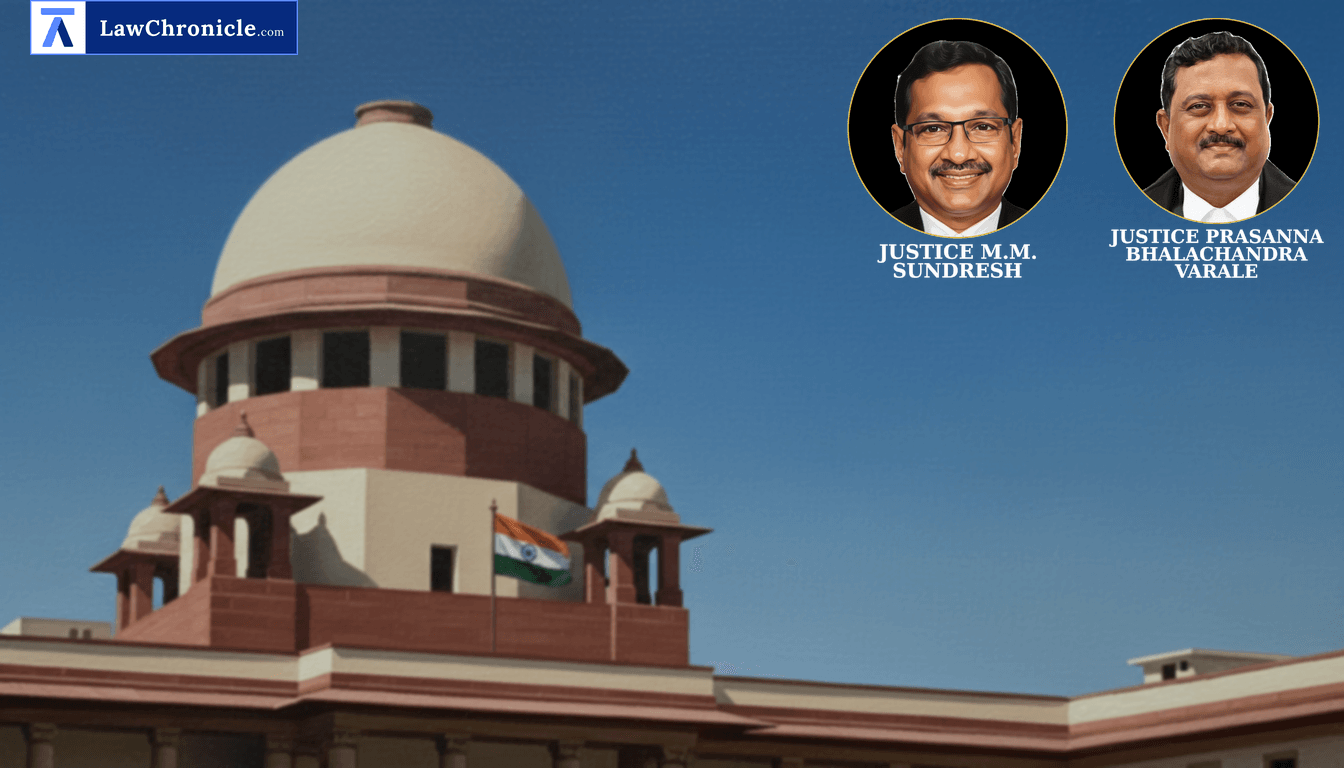
The Supreme Court has clarified that procedural lapses in serving written grounds of arrest cannot act as a self-executing key to unlock regular bail in grave offences affecting national security, unless demonstrable prejudice is proven. Overturning a High Court order that granted bail to an espionage suspect, the Apex Court ruled that procedural compliance must be evaluated using a prejudice-oriented test.
A bench comprising Justice M.M. Sundresh and Justice Prasanna B. Varale set aside the order of the Rajasthan High Court, which had enlarged an accused facing espionage charges under Section 3 and Section 9 of the Official Secrets Act, 1923, alongside Section 152 and Section 238(b) of the Bharatiya Nyaya Sanhita, 2023. The High Court had granted regular bail under Section 483 of the Bharatiya Nagarik Suraksha Sanhita, 2023 solely because written grounds of arrest were not separately served upon the arrestee at the time of remand.
Key Takeaways
Prejudice-Oriented Test Applies: Mere lack of written arrest grounds does not invalidate custody without proof of prejudice.
Hyper-Technicality Defeated: Procedural defects cannot bypass core bail parameters like gravity of offences and national security implications.
Substantial Compliance Validated: Communication recorded in arrest memos and oral intimation to legal counsel satisfies constitutional mandates.
Supreme Court on Written Grounds of Arrest
The Apex Court scrutinized the procedure followed by the investigating agency and noted that there was substantial compliance with the constitutional safeguard under Article 22(1) of the Constitution of India, 1950 and Section 47 of the Bharatiya Nagarik Suraksha Sanhita, 2023. The Supreme Court, in its reasoning, suggested that "A hyper-technical objection regarding the form or mode of communicating grounds of arrest cannot be treated as a self-executing, blanket key to unlock regular bail, bypassing the core parameters governing bail jurisprudence."
Ratio
Procedural lapses or the mere absence of written grounds of arrest do not ipso facto render detention illegal or entitle an accused to regular bail under Article 22(1) of the Constitution or statutory provisions, unless it leads to demonstrable prejudice or deprives the accused of a fair opportunity to defend.
Background
The dispute originated from intelligence reports alleging that the respondent was actively transmitting sensitive military information and strategic troop movement details from Pokhran and Jaisalmer to foreign handlers in exchange for money. Statutory notices under Section 8(1) of the Official Secrets Act, 1923 were issued prior to his formal arrest. Upon arrest, details of the allegations were recorded in an Arrest Memo signed by the accused, and telephonic information was provided to his brother under an Arrest Information Memo.
When produced before the Magistrate, the respondent was represented by counsel who contested remand on merits without raising any grievance regarding non-receipt of written grounds of arrest. The Sessions Judge subsequently rejected his regular bail application. However, the High Court allowed bail by relying on Mihir Rajesh Shah v. State of Maharashtra ( "(2026) 1 SCC 500": 2025 CaseBase(SC) 2876) and holding that oral intimation does not satisfy Section 47 of the Bharatiya Nagarik Suraksha Sanhita, 2023.
On appeal, the State relied upon Kasireddy Upender Reddy v. State of Andhra Pradesh ( "(2026) 8 SCC 275": 2025 CaseBase(SC) 1468) and State of Karnataka v. Sri Darshan to argue that substantial compliance suffices. Contrarily, the respondent relied on Pankaj Bansal v. Union of India ( "(2024) 7 SCC 576": 2023 CaseBase(SC) 603), Prabir Purkayastha v. State (NCT of Delhi) ( "(2024) 8 SCC 254": 2024 CaseBase(SC) 73), and Mihir Rajesh Shah v. State of Maharashtra ( "(2026) 1 SCC 500": 2025 CaseBase(SC) 2876) to contend that written service is mandatory. Adopting the reasoning in State of Karnataka v. Sri Darshan, the Supreme Court held that decisions like Pankaj Bansal v. Union of India ( "(2024) 7 SCC 576": 2023 CaseBase(SC) 603) and Prabir Purkayastha v. State (NCT of Delhi) ( "(2024) 8 SCC 254": 2024 CaseBase(SC) 73) turned on different contexts and allowed the State's appeal, cancelling the respondent's bail.
Case Details:
Case No.: Criminal Appeal No. OF 2026 (@ Special Leave Petition (Crl.) No. 13374 OF 2026)
Neutral Citation: 2026 INSC 1169
Case Title: State of Rajasthan v. Jhabra Ram
Appearances:
For the Petitioner(s): Mr. Rajkumar Bhaskar, learned A.S.G
Source: 2026 CaseBase(SC) 9509
Similar Articles
 Breaking News


