


Administrative Lethargy No Ground For 1220-Day Delay Condonation: Madras HC
 Copy Link
 Share
 Save
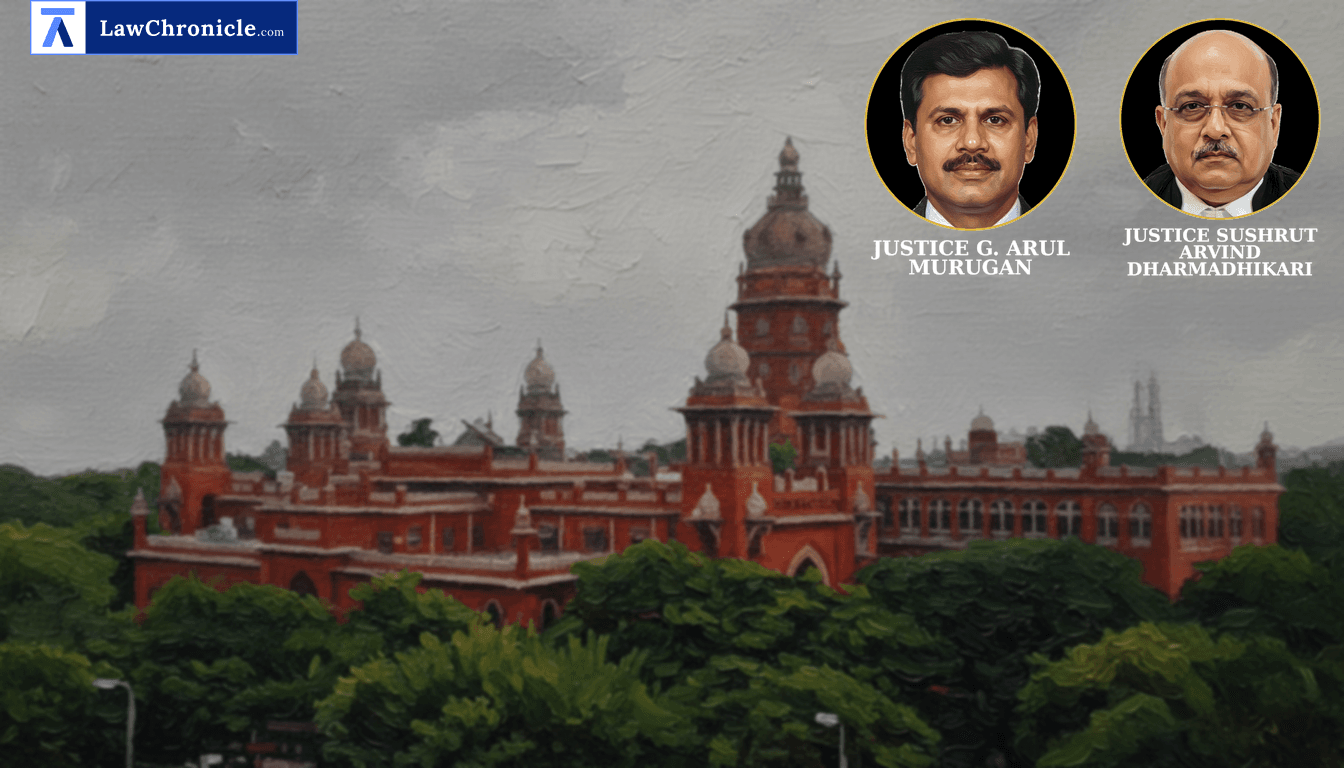
The Madras High Court has dealt a significant blow to bureaucratic delays, ruling that the State cannot seek condonation of inordinate delays on the mere grounds of 'administrative reasons' or 'procedural red-tape.' A division bench comprising Chief Justice Sushrut Arvind Dharmadhikari and Justice G. Arul Murugan refused to condone a staggering delay of 1220 days in an appeal filed by the Urban Land Tax authorities, emphasizing that the law of limitation binds the Government and private litigants equally.
Court Rejects 'Pure Administrative Reasons' for Delay
The appellants had sought to condone a delay of over three years, attributing it to the time taken for obtaining legal opinions and approvals across various hierarchical levels. However, the Court found the explanation to be woefully inadequate, noting that the officials involved appeared 'completely indolent' and sat over the files without action. The Bench highlighted that the State does not stand on an 'exalted position' regarding limitation periods.
The Court, in its reasoning, observed: "Administrative lethargy and laxity can never stand as a sufficient ground for condonation of delay... constitutional courts, ought not to obviate the procedure for a litigating State agency, who also equally suffer the bars of limitation from pursuing litigations due to its own lackadaisical attitude."
Strict Adherence to Limitation Law and Precedents
Drawing support from established precedents, the Court referred to State of Madhya Pradesh & Ors. V. Bherulal ( "(2020) 10 SCC 654": 2020 CaseBase(SC) 644), where the Supreme Court noted that while some leeway is given for government inefficiencies, modern technology renders 'bureaucratic methodology' an unacceptable excuse for delay. The Bench also cited State of Maharashtra v. Borse Brothers Engineers and Contractors Pvt. Ltd, where a delay of 75 days was deemed insufficient for condonation despite being filed by a public entity.
Furthermore, the Court relied on the recent apex court ruling in Shivamma v. Karnataka Housing Board ( "2025 INSC 1104": 2025 CaseBase(SC) 650), which cautioned High Courts against becoming 'surrogates for State laxity.' The Court reiterated that reopening matters with inordinate delay without sufficient cause only adds 'insult to injury' for private litigants who have secured favorable orders.
Directions Issued to Statutory Authorities
Concluding that the averments in the affidavit did not constitute 'sufficient cause' under Section 5 of the Limitation Act, the Court dismissed the application. The Court has the following directions:
"It is open for the appellants to take appropriate disciplinary action against those officials, whose inaction and whimsical negligence, was the reason for the appeal being filed beyond the period of limitation."
Background:
The matter arose from a delay of 1220 days in filing a Writ Appeal against an order dated 04.08.2022 passed by a Single Judge in W.P.No.28988 of 2017. The petitioners, including the Principal Secretary/Commissioner of Urban Land Ceilings and Land Tax, claimed the delay was neither willful nor wanton but necessitated by administrative processes. The respondents, led by K. Arumugam, were the successful parties in the original writ petition. The High Court, however, found the State's explanation to be frivolous and superficial, leading to the rejection of the appeal at the SR stage.
Case Details:
Case No.: C.M.P.No.10906 of 2026 and W.A.SR No.7210 of 2026
Case Title: The Principal Secretary/Commissioner, Urban Land Ceilings Land Tax and Others Vs K.Arumugam and Others
Appearances:
For the Petitioner(s): Mr.K.Kumaran, Government Pleader
Source: 2026 CaseBase(MAD) 272
Similar Articles
 Breaking News


