


Admissions In Evidence Are Substantive Proof Without Prior Confrontation: Himachal Pradesh HC
 Copy Link
 Share
 Save
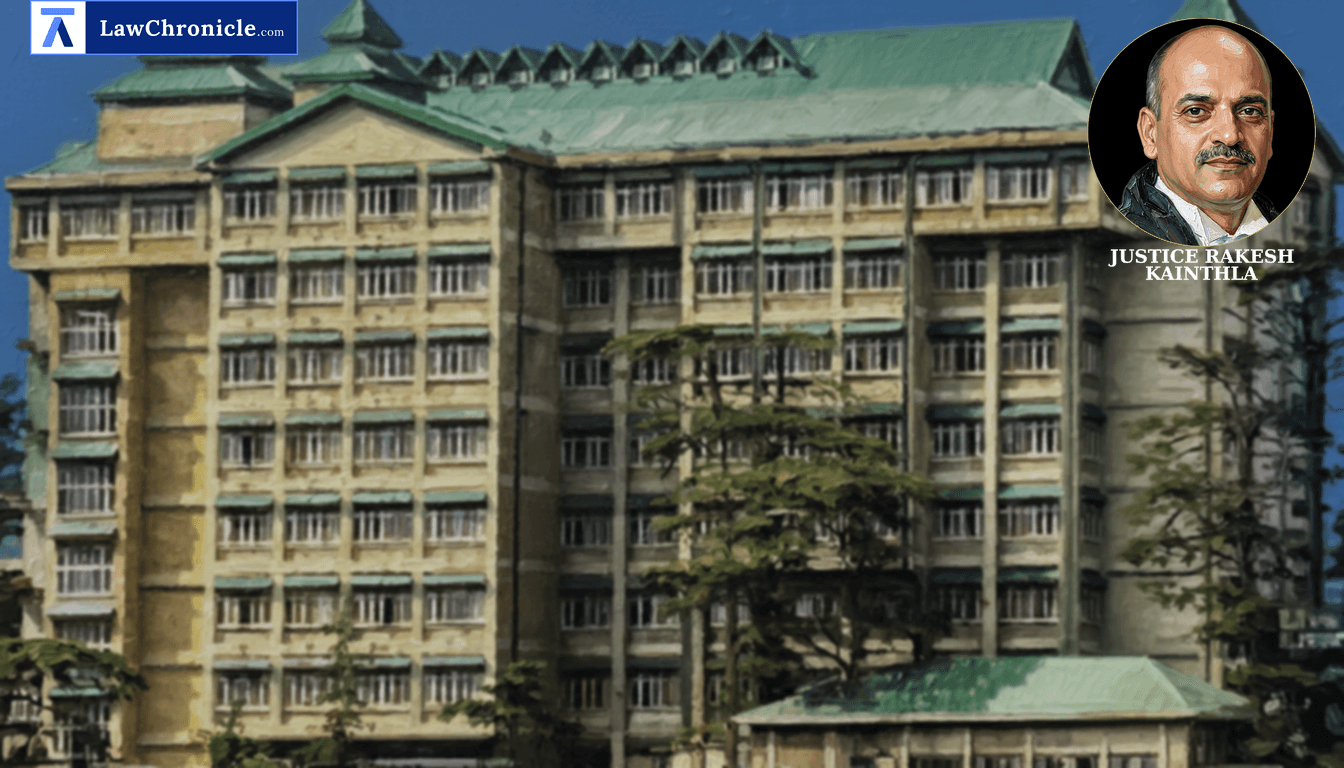
The Himachal Pradesh High Court has overturned concurrent findings of lower courts, ruling that a party's admission in a document or previous statement constitutes substantive evidence and does not require prior confrontation under the evidence law. This significant clarification ensures that documented admissions cannot be brushed aside merely on procedural technicalities like belated production or lack of cross-examination during trial.
Justice Rakesh Kainthla, sitting as a single-judge bench, heard the second appeals arising from a long-standing property dispute. The Court was tasked with determining whether the lower courts had perversely ignored material evidence in the form of written agreements and prior judicial statements that acknowledged the appellants' tenancy.
Key Takeaways
Admissions as Substantive Evidence
Documented admissions by a party are substantive evidence 'proprio vigore' and remain admissible even if the party was not confronted with them during cross-examination.
Exemption from Procedural Bars
Provisions under the Code of Civil Procedure, 1908 regarding the timeline for document production do not apply to documents used specifically for the cross-examination of witnesses.
Correction of Judicial Perversity
High Courts exercising jurisdiction under Section 100 of the Code of Civil Procedure, 1908 are duty-bound to interfere if lower courts exclude relevant admissible evidence, as such exclusion constitutes legal perversity.
Court's Rationale on Section 145 and Admissions
The Court observed that the lower courts erred by applying the rules of witness impeachment to the admissions of a party. It clarified that while Section 145 of the Indian Evidence Act, 1872 requires confronting a witness with prior contradictory statements to discredit them, an admission by a party-opponent is governed by Sections 17 and 21 of the Indian Evidence Act, 1872 and serves as primary evidence of the facts admitted.
The Court, in its reasoning, observed: "There is a cardinal distinction between a party who is the author of a prior statement and a witness who is examined and is sought to be discredited by use of his prior statement. In the former case, an admission by a party is substantive evidence if it fulfils the requirements of Section 21 of the Evidence Act; in the latter case, a prior statement is used to discredit the credibility of the witness and does not become substantive evidence."
Furthermore, the Court emphasized that once an admission is proved, the onus shifts entirely to the party who made it to explain it away. In the absence of a satisfactory explanation, the admission must be presumed true. By ignoring the agreements (Ext.DW4/A and Ext.DW4/B) and prior statements (Ext.PB), the lower courts had reached findings that were "contrary to the weight of evidence."
The Court has the following directions:
"In view of the above, the learned Courts below had excluded the relevant evidence; hence, the judgments and decrees passed by the learned Courts below are ordered to be set aside, and the suit filed by the plaintiffs is ordered to be decreed. The decree sheet be prepared accordingly."
Ratio
An admission made by a party in a document or a prior judicial proceeding is substantive evidence under the Indian Evidence Act, 1872 and is admissible irrespective of whether the party appeared in the witness box or was confronted with the statement. The procedural requirement of Section 145 of the Indian Evidence Act, 1872 applies only to the impeachment of witnesses, not to the substantive admissions of parties.
Background
The dispute began when the plaintiffs (appellants) filed a suit seeking a declaration of ownership and possession of land, claiming they were tenants inducted by the original owner, Het Ram, in 1965. They alternatively claimed ownership by adverse possession. The defendants contested this, asserting that the plaintiffs were merely licensees whose license had been terminated, and filed a counterclaim for possession.
The Trial Court and First Appellate Court dismissed the plaintiffs' suit, holding that they failed to prove tenancy. These courts discarded documents where the defendants had reportedly acknowledged the plaintiffs' tenancy, citing that the documents were produced late and not put to the defendant during her cross-examination.
In the second appeal, the High Court relied on Rekha Karol and Ors vs. Lachhmi Devi and Ors ( "2026 NCHHC 23642": 2026 CaseBase(HP) 5500) and Geeta Bhawan Vs. Balbir Singh & Ors. to hold that the lower courts' approach was legally flawed. It also referenced Bishwanath Prasad v. Dwarka Prasad and Vathsala Manickavasagam v. N. Ganesan ( "(2013) 9 SCC 152: 2013 SCC OnLine SC 550": 2013 CaseBase(SC) 349) to establish the scope of interference in second appeals when evidence is misread. Citing Union of India v. Moksh Builders and Financiers Ltd. ( "(1977) 1 SCC 60: 1976 SCC OnLine SC 377": 1976 CaseBase(SC) 504) and Inderjit Singh v. Omkar Singh, the Court concluded that the documented admissions (Ext.DW4/A and Ext.DW4/B) clearly proved the tenancy, necessitating the setting aside of the lower courts' decrees.
Case Details:
Case No.: RSA Nos. 364 and 365 of 2007
Neutral Citation: 2026:HHC:48782
Case Title: Diwan Singh (since deceased) through LRs v. Dashodha (since deceased) through LRs
Appearances:
For the Petitioner(s): Mr Bhupinder Gupta, Senior Advocate, with Mr Harshit Sharma, Advocate
For the Respondent(s): Mr Mohinder Verma, Advocate
Source: 2026 CaseBase(HP) 11178
Similar Articles
 Breaking News


