


After 40 Years of Litigation, Allahabad HC upholds Conviction Under Section 307 IPC; Reduces Sentence
 Copy Link
 Share
 Save
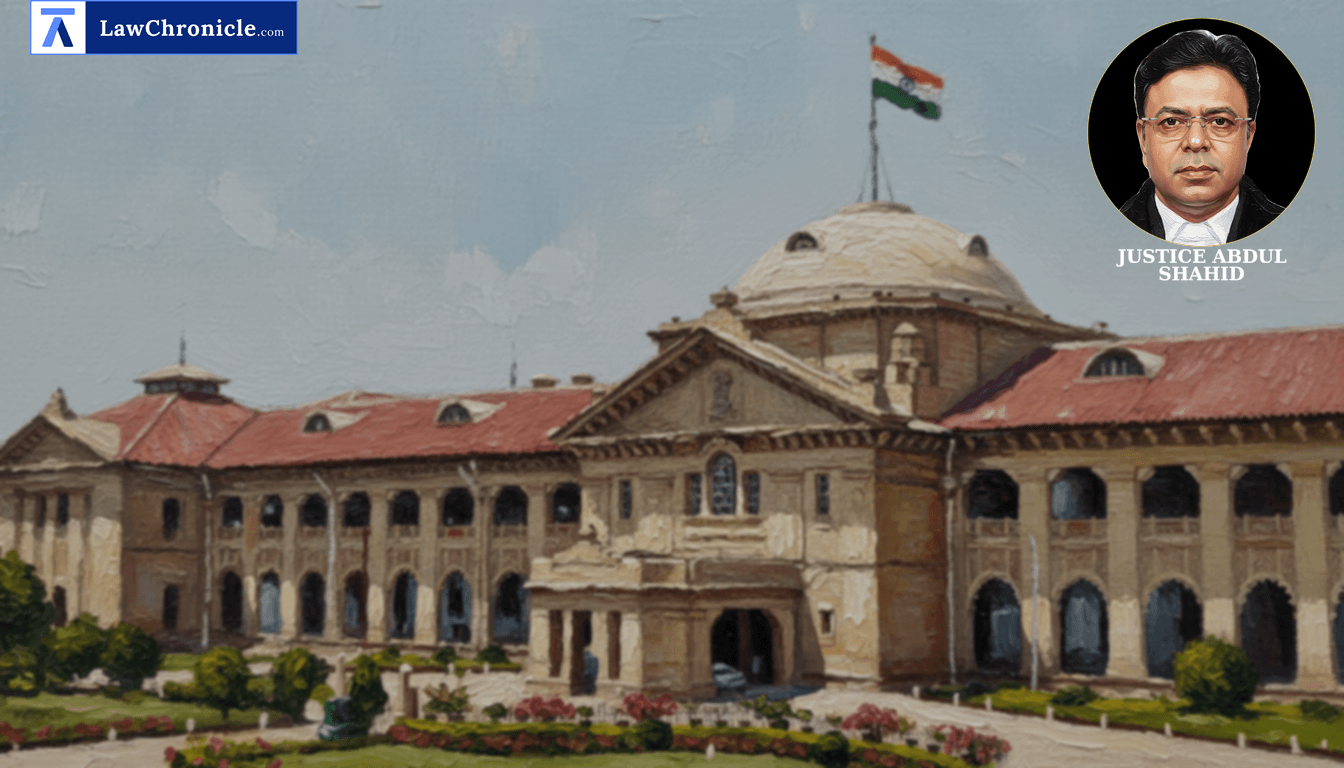
The Allahabad High Court has fortified the 'sterling' status of injured witnesses in criminal trials, ruling that their testimony carries a built-in guarantee of truthfulness that cannot be easily displaced by minor discrepancies. In a significant balancing act between retributive justice and the passage 40 years in litigation, the Bench upheld a 1986 conviction for attempted murder while slashing the prison term due to a four-decade-long litigation period.
Justice Abdul Shahid presided over the appeal challenging a trial court's verdict that found the appellant guilty of stabbing a man over a gambling dispute and a failed extortion attempt. The Allahabad High Court scrutinized the interplay between oral testimony and medical evidence in cases involving vital organ injuries.
Key Takeaways
Primacy of Injured Witnesses
Reaffirms that an injured person is the best witness as they are unlikely to spare the actual assailant to falsely implicate others.
Medical vs. Ocular Evidence
Establishes that direct ocular testimony from a reliable witness prevails over probabilistic medical opinions or minor discrepancies.
Mitigation for Trial Delay
Recognizes that litigation spanning over 40 years constitutes a valid ground for taking a 'lenient view' regarding the quantum of sentence.
Explanation of FIR Delay
Clarifies that a delay of a few hours in lodging an FIR is acceptable if the complainant prioritized providing medical aid to the victim.
In its analysis of the prosecution's case, the Allahabad High Court highlighted the reliability of P.W.-1, who sustained a life-threatening stab wound to the abdomen. The Bench noted that the promptness of the FIR and the corroboration by blood-stained clothing and medical reports left no room for doubt regarding the appellant's guilt.
Court Observations and Directions
The Allahabad High Court focused on the high evidentiary value of a 'sterling witness' and the necessity of ignoring minor contradictions that do not affect the core of the prosecution's case. The Bench observed that “It is settled law that an injured witness is the best witness. An injured person is not expected to falsely implicate an innocent person while letting the real culprit go scot-free. ... In the present case, the injured witness is within the category of ‘sterling witness’.” Hence, the Allahabad High Court reduced the sentence from 7 to 4 years of rigorous imprisonment.
Ratio
The testimony of an injured witness is inherently reliable and possesses a 'built-in-guarantee' of presence at the scene, requiring convincing evidence to discredit. Furthermore, while the prosecution must prove its case beyond reasonable doubt, this does not necessitate proof beyond a 'shadow of doubt', and long-term litigation delays (exceeding 30-40 years) warrant a reduction in the quantum of sentence to meet the ends of justice.
Background
The incident dates back to May 12, 1985, when the appellant allegedly stopped the victim, Ganga Charan, and demanded Rs. 500/- after he refused to join a gambling session. Upon refusal, the appellant stabbed Charan in the abdomen with a knife and threatened him with a country-made pistol. The victim was rushed to the hospital by his brother, Tara Chandra, where he underwent emergency surgery.
The trial court convicted the appellant under Section 307 of the Indian Penal Code, 1860, sentencing him to seven years of rigorous imprisonment. The appellant challenged this before the Allahabad High Court, arguing that independent witnesses were not examined and that defense witnesses supported a theory of false implication due to prior monetary disputes.
In dismissing these arguments, the High Court relied on Anna Reddy Sambasiva Reddy & Ors vs State of Andhra Pradesh ( "2010 (1) SCC (CRI) 630": 2009 CaseBase(SC) 36) and Balraje v. State of Maharashtra to emphasize that injured witnesses are unlikely to let the real culprit go free. Referring to Rai Sandeep @ Deepu vs State of NCT of Delhi ( "2012 (8) SCC 21": 2012 CaseBase(SC) 82), the Court classified the victim as a 'sterling witness'. Although the appellant cited Krishna Kumar Kedia Versus Union of India ( "2025 INSC 608": 2025 CaseBase(SC) 703) to argue for leniency, the Allahabad High Court maintained the conviction while reducing the sentence, noting the incident was 40 years old. The Allahabad High Court also applied principles from Haalesh @ Haleshi @ Kurubara Haleshi v. State of Karnataka ( "(2024) 3 SCC 475": 2024 CaseBase(SC) 495) regarding ocular evidence and Yogesh Singh vs Mahabeer Singh & Ors ( "2017 (11) SCC 195": 2016 CaseBase(SC) 385), Prabhu Dayal vs The State Of Rajasthan ( "2018 (8) SCC 127": 2018 CaseBase(SC) 743), and Iqbal Moosa Patel vs State Of Gujarat ( "(2011) 2 ALLCRIR 1897": 2011 CaseBase(SC) 189) regarding minor discrepancies.
Case Details:
Case No.: CRIMINAL APPEAL No. - 1418 of 1986
Case Title: Satya Prakash @ Satte Pandit Versus State of U.P.
Appearances:
For the Petitioner(s): D. Swaroop, Nitya Nand Pandey, Rajesh Pratap Singh, Santosh Kumar Pandey
For the Respondent(s): A.G.A., Manvendra Nath Singh
Source: 2026 CaseBase(ALL) 1190
Similar Articles
 Breaking News


