


Allahabad HC Refuses to Unsettle Two-Decade-Old Delimitation Orders
 Copy Link
 Share
 Save
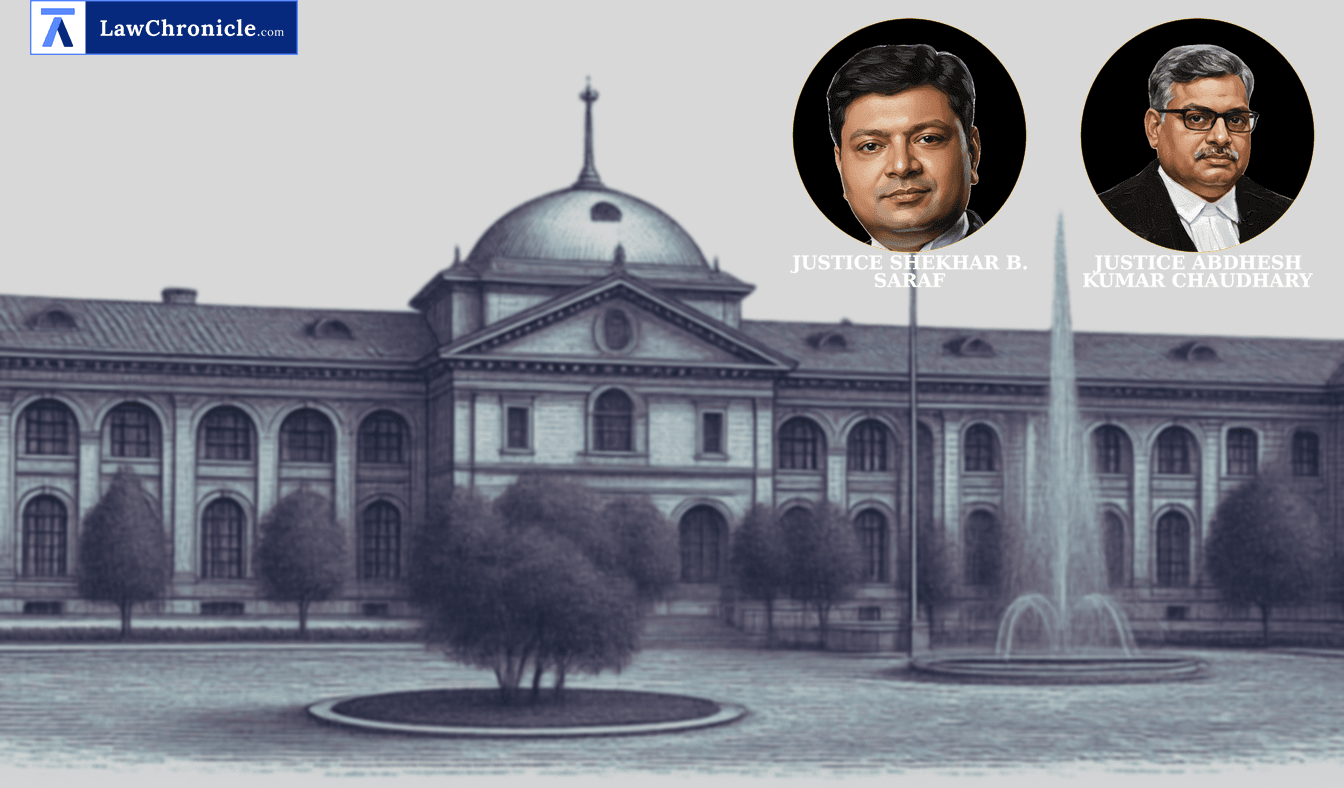
The Allahabad High Court restricted belated challenges to electoral delimitation, ruling that judicial intervention into constituency boundaries is strictly confined to narrow constitutional grounds and cannot be invoked after decades of electoral finality. The Bench underscored that allowing individual voters to disrupt established electoral maps through arithmetical re-computations would risk holding the democratic process hostage to indefinite litigation.
A division bench comprising Justice Shekhar B. Saraf and Justice Abdhesh Kumar Chaudhary heard the petition filed by a resident of Ambedkar Nagar District. The petitioner appeared in person to challenge the delimitation and reservation status of assembly constituencies, specifically questioning the population ratios and the reservation of the Alapur seat for Scheduled Castes.
Key Takeaways
Finality of Delimitation Orders
Orders passed by the Delimitation Commission, once published in the Gazette, acquire the force of law and cannot be casually disturbed by courts.
Narrow Scope of Judicial Review
Court intervention in delimitation matters is restricted only to cases involving a lack of legislative competence or violation of fundamental rights.
Doctrine of Laches in Electoral Matters
Challenges to electoral boundaries filed after a lapse of nearly twenty years and multiple election cycles are barred by the principle of delay and laches.
Administrative Latitude in Population Ratios
Constitutional mandates for population-to-seat ratios are subject to practical considerations like geographical contiguity and administrative boundaries.
Limited Scope for Judicial Scrutiny
The Allahabad High Court observed that under Section 10(2) of the Delimitation Act, 2002, orders of the Commission are final. The Bench noted that judicial scrutiny is confined to two narrow grounds: want of legislative competence and violation of Constitution of India, 1950. The Bench stated that the petitioner failed to demonstrate either, relying instead on demographic re-computations which fall within the technical domain of the Commission. The Allahabad High Court observed that "...such an exercise, howsoever meticulously undertaken, is essentially a matter of methodology and technical determination falling squarely within the domain of the Delimitation Commission, and does not, by itself, disclose any violation of a fundamental right or any other Constitutional provision."
Regarding the 10% deviation guideline, the Bench clarified that these are internal methodologies and not strict statutory mandates. The Allahabad High Court further noted that comparative population percentages for reservation are matters for Parliament to decide, not the judiciary.
Ratio
An order of the Delimitation Commission, being in the nature of law and not an administrative order, is not amenable to a writ of mandamus or certiorari except on the grounds of lack of legislative competence or violation of fundamental rights. Furthermore, the doctrine of laches applies to electoral delimitation challenges where the passage of time and intervening elections have crystallized the rights of the electorate.
Background
The petitioner challenged the final delimitation order dated December 5, 2006, issued under the Delimitation Act, 2002. He argued that the population ratio among constituencies in Ambedkar Nagar District violated Article 170(2) of the Constitution of India, 1950. Specifically, he contended that the Alapur constituency was improperly reserved for Scheduled Castes while Jalalpur remained a General seat, based on his own population analysis.
The respondents, represented by the Election Commission, argued that the petition was filed after a 20-year delay and that the delimitation was based on the 2001 Census. They relied on Jagdish Singh vs. Election Commission of India and Chandra Mani Prasad v. Union of India to argue that such orders have the force of law. The Allahabad High Court agreed, citing Kishorchandra Chhanganlal Rathod v. Union of India ( "(2024) 13 SCC 237": 2024 CaseBase(SC) 231) and Meghraj Kothari v. Delimitation Commission ( "1966 SCC OnLine SC 12": 1966 CaseBase(SC) 199), noting that judicial intervention at this late stage would be inequitable, especially as the 2026 Census approaches. The Bench distinguished Kishorchandra Chhanganlal Rathod v. Union of India ( "(2024) 13 SCC 237": 2024 CaseBase(SC) 231), clarifying that while judicial review exists, it must be exercised at an appropriate stage and within a limited sphere.
Case Details:
Case No.: WRIT - C No. - 2022 of 2026
Case Title: Dileep Kumar Versus Union of India, Thru. Secy. Ministry of Law and Justice New Delhi and 3 others
Appearances:
For the Petitioner(s): Shri Dileep Kumar (In Person)
For the Respondent(s): Shri O.P. Srivastava (Senior Advocate), Ms. Anupriya Srivastava (Counsel)
Source: 2026 CaseBase(ALL) 1211
Similar Articles
 Breaking News


