


Allahabad HC Upholds Delimitation Act Provision on Reserved Seats Without Rotation
 Copy Link
 Share
 Save
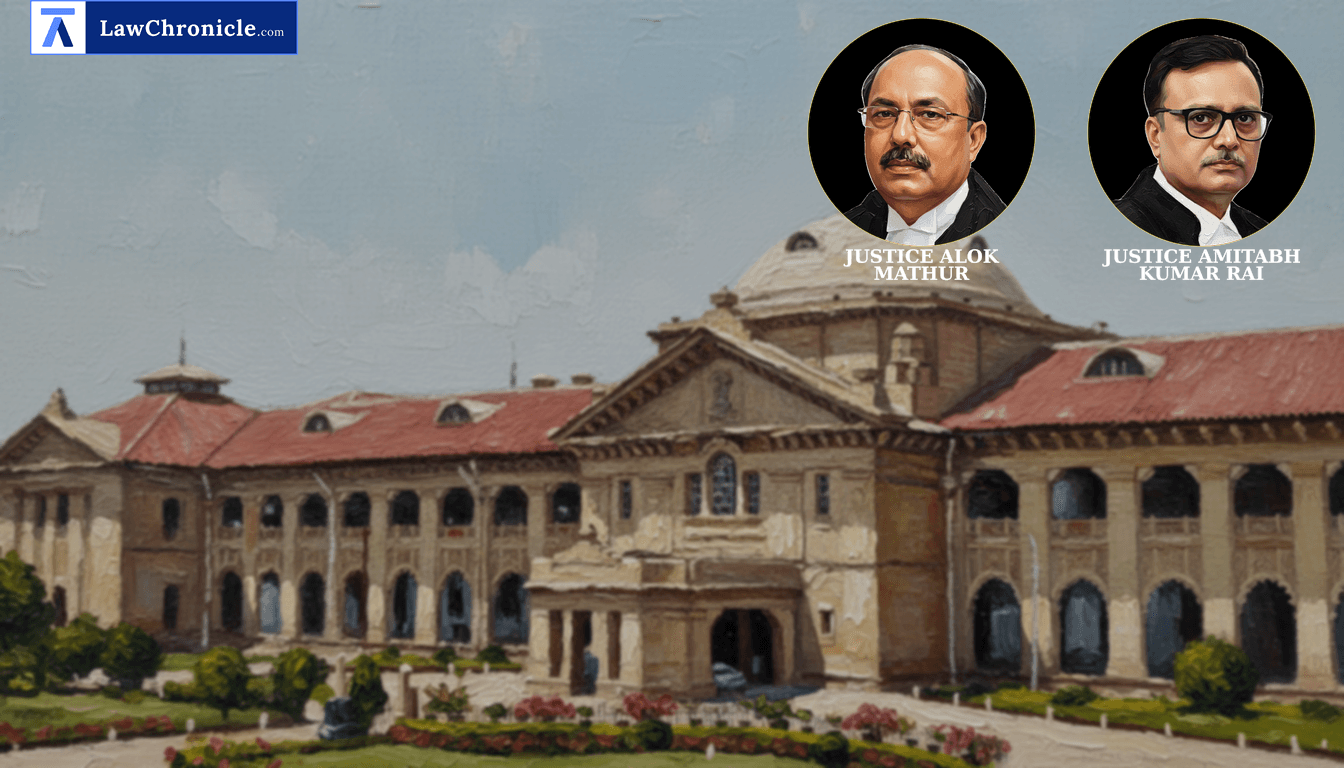
The Allahabad High Court upheld Section 9(1)(c) of the Delimitation Act, 2002, holding that the absence of a rotation system for reserved seats in Parliamentary and State Assembly elections does not infringe fundamental rights. A division bench comprising Justice Alok Mathur and Justice Amitabh Kumar Rai heard the challenge against the stagnation of reservation in the Kadipur Assembly Constituency, which had remained reserved for the Scheduled Caste (SC) category for nearly six decades.
While addressing the preliminary objection regarding the bar on judicial review in electoral matters under Article 329 of the Constitution of India, 1950, the Court relied on Kishorchandra Chhanganlal Rathod vs. Union of India and Ors. ( "Civil Appeal No.7930 of 2024 decided on 23.07.2024": 2024 CaseBase(SC) 231) to hold that judicial intervention is permissible if an order is manifestly arbitrary or requires constitutional interpretation. However, on merits, the bench found no constitutional mandate for rotation in Assembly or Parliamentary elections, unlike the specific provisions for Panchayats and Municipalities.
Court Rejects Challenge to 'Population-Based' Reservation Allocation
The Court, in its reasoning, observed: "Articles 330 and 332 of the Constitution of India do not contain any prohibition against the provisions contained in Section 9 (1) (c) of the Act, 2002, which provide for reservation of seats for SC/ST candidates in those areas where the SC/ST population is comparatively large. Hence, it cannot be said that such a provision is violative of any constitutional provision. In fact, Parliament, in its wisdom, enacted such a provision in the Act, 2002 in exercise of the powers conferred under Article 327 of the Constitution, which neither forbids nor infringes any constitutional provision."
Legislative Competence and the Principle of Separation of Powers
The Court emphasized that it cannot step into the shoes of the legislature to mandate a rotation policy. It cited Union of India vs. Deoki Nandan Aggarwal ( "1992 Supp (1) SCC 323": 1991 CaseBase(SC) 96) and State of U.P. vs. Mahindra and Mahindra Ltd. ( "(2011) 13 SCC 77": 2011 CaseBase(SC) 268) to underscore that the power to legislate lies exclusively with Parliament. The bench noted that while the goals of social and political justice might be furthered by rotation, it remains a policy decision for Parliament to 'ponder on the issue'.
Background:
The petitioner, a resident of Sultanpur, challenged the notification dated 18.12.2006, which notified the Kadipur Assembly Constituency (191) for the Scheduled Caste. He argued that the continuous reservation for sixty years prevented general category voters from choosing candidates of their choice, effectively creating a "caste-bonded vote" system. This, he claimed, violated Articles 14, 15, and 19 of the Constitution of India, 1950.
The petitioner further contended that the Delimitation Act, 2002 was being misinterpreted, as the framers of the Constitution never intended for seats to remain reserved indefinitely in areas with the largest SC/ST populations. Reference was made to the Representation of the People Act, 1951 and the Representation of the People Act, 1950 to show that rotation is followed in local body elections.
The Court, however, followed Rajbala and others vs. State of Haryana and Others ( "(2016) 2 SCC 445": 2015 CaseBase(SC) 367) to hold that the right to vote and contest are constitutional rights subject to legal restrictions. It also applied the ratio from K.S. Puttaswamy (Retired) and another (AADHAAR) vs. Union of India and Another ( "(2019) 1 SCC 1": 2017 CaseBase(SC) 892) and Rajbala and others vs. State of Haryana and Others ( "(2016) 2 SCC 445": 2015 CaseBase(SC) 367) to conclude that a statute cannot be struck down merely on the grounds of being 'arbitrary' unless it violates specific constitutional provisions or lacks legislative competence. Consequently, the challenge to Section 9(1)(c) of the Delimitation Act, 2002 failed as the provision was found to be within the legislative domain of Parliament under Entry 72 of List I of the Seventh Schedule.
Case Details:
Case No.: WRIT - C No. - 6153 of 2011
Case Title: Jagdish Singh v. Election Commission of India Through Chief Election Commission
Appearances:
For the Petitioner(s): Ajay Pratap Singh, Surya Bhan Singh, Advocates
For the Respondent(s): O.P. Srivastava, Senior Advocate; Akhilesh Srivastava, Standing Counsel; S B Pandey, Raj Kumar Singh, Advocates
Source: 2026 CaseBase(ALL) 223
Similar Articles

 Breaking News


