


Andhra Pradesh HC Refuses to Interfere in CISF Constable's Removal for Eve-Teasing
 Copy Link
 Share
 Save
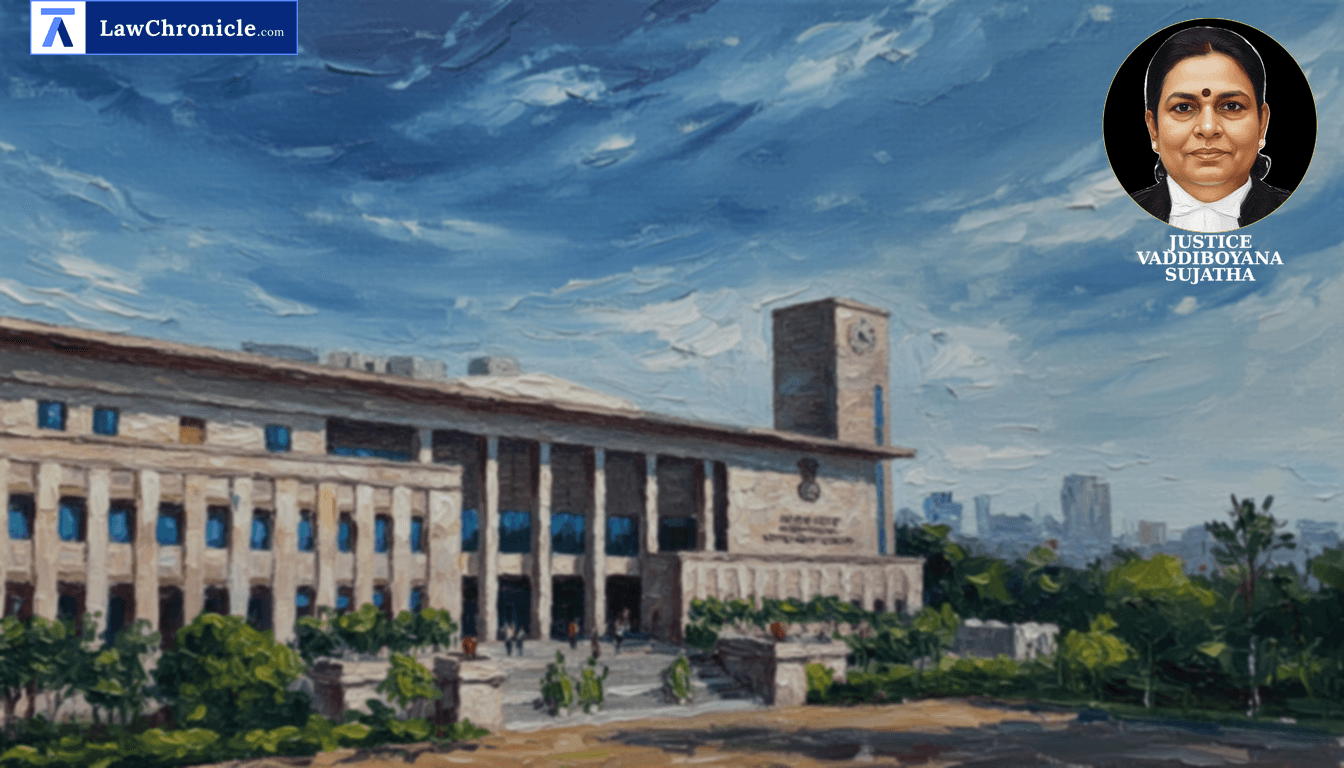
The Andhra Pradesh High Court has reinforced the stringent conduct standards expected from members of disciplined forces, ruling that judicial review cannot be used to re-appreciate evidence in disciplinary proceedings where procedural fairness has been maintained. In a stern reminder of public accountability, the court upheld the removal of a CISF constable who indulged in misconduct at a public market, emphasizing that the image of the organization is inextricably linked to the personal conduct of its personnel.
A Single Judge bench of Justice V. Sujatha presided over the matter, hearing a writ petition filed under Constitution of India. The petitioner, a former Constable/GD with the Central Industrial Security Force (CISF), challenged his removal from service following a departmental enquiry into allegations of eve-teasing at a vegetable market in Ukkunagaram.
Key Takeaways
Integrity of Disciplined Forces
Public servants in uniformed forces are held to higher standards of decorum both on and off duty; any breach of public propriety reflects poorly on the institution.
Limitations of Judicial Review
Under Constitution of India, the High Court’s role is confined to evaluating the decision-making process for procedural lapses or natural justice violations, rather than reassessing the merits of the evidence.
Circumstantial Evidence Sufficiency
In disciplinary proceedings, the non-examination of a primary victim (such as a complainant in eve-teasing) does not vitiate the enquiry if other circumstantial evidence and witness testimonies sufficiently prove the charge.
Doctrine of Proportionality
Punishment for misconduct in disciplined forces will not be deemed disproportionate unless it is vindictive, irrational, or shocks the judicial conscience, especially in matters of moral turpitude.
Court Rejects Challenge to Fact-Finding Process
The petitioner argued that the finding of misconduct was unsustainable because the girl allegedly gestured at was never examined during the departmental enquiry. However, the Court observed that the Enquiry Officer's findings were supported by the testimony of departmental witnesses and the petitioner's own statement recorded during the preliminary enquiry.
The Court, in its reasoning, observed: "Judicial review is not an appeal from a decision but a review of the manner in which the decision is made. Power of judicial review is meant to ensure that the individual receives fair treatment and not to ensure that the conclusion which the authority reaches is necessarily correct in the eye of the court. When an inquiry is conducted on charges of misconduct by a public servant, the Court/Tribunal concerned is to determine whether the inquiry was held by a competent officer or whether rules of natural justice are complied with."
Regarding the non-examination of the victim, the Court noted that the incident was proven through circumstantial witnesses, including Home Guard personnel who intervened immediately after the petitioner was confronted by a crowd.
Observations on Disciplined Conduct
Justice V. Sujatha highlighted that a government servant, particularly in a disciplined force, must maintain a high standard of propriety. The Court noted: "A government servant, particularly one belonging to a disciplined force, is expected to conduct himself with restraint, dignity and good manners in public, as his conduct outside the workplace may also reflect upon the image and reputation of the organization to which he belongs."
Ratio
In proceedings under Constitution of India, the High Court will not act as an appellate authority to re-appreciate evidence or judge the adequacy of proof in disciplinary matters. As long as the enquiry followed the prescribed procedure and principles of natural justice, the findings of the disciplinary authority are final. The lack of direct testimony from a victim does not render an enquiry defective if the charge is otherwise established by reliable circumstantial evidence and departmental witnesses.
Background
The dispute originated from an incident on November 14, 2013, when the petitioner, while off-duty at a vegetable market, allegedly made inappropriate gestures toward a girl. Following a confrontation with the public, he was handed over to the CISF authorities. A departmental enquiry conducted under Rule 36 of the CISF Rules, 2001, found the charges proven, leading to his removal from service in January 2014.
The petitioner’s subsequent appeals and revisions were dismissed. He also attempted to seek relief from courts in Punjab and Haryana, which were dismissed for lack of territorial jurisdiction. The Andhra Pradesh High Court, after reviewing the records, found that the petitioner was afforded adequate opportunity to defend himself, including the right to cross-examine witnesses. The Court relied on principles established in B. C. Chaturvedi v. Union of India ( "(1995) 6 SCC 749": 1995 CaseBase(SC) 611), Union of India Vs. H.C. Goel ( "1963 SCC OnLine SC 16": 1963 CaseBase(SC) 11), and Ranjit Thakur Vs. Union of India and Ors. ( "(1987) 4 SCC 611": 1987 CaseBase(SC) 59) to conclude that there was no patent error of law or perversity in the disciplinary action.
The Court has the following directions:
"In view of the foregoing discussion, this writ petition is dismissed. There shall be no order as to costs. Consequently, Miscellaneous Petitions, if any, pending in this Petition shall stand closed."
Case Details:
Case No.: WRIT PETITION NO: 10930/2018
Neutral Citation: 2026:APHC:37462
Case Title: Rishi Kapoor V. Union Of India And Others
Appearances:
For the Petitioner(s): Sai Sundeep Manchikalapudi
For the Respondent(s): Y V ANIL KUMAR (Central Government Counsel)
Source: 2026 CaseBase(AP) 15664
Similar Articles


 Breaking News


