


Appellate Courts Cannot Revert Trial Court Decrees Without Reasoned Judgments: SC
 Copy Link
 Share
 Save
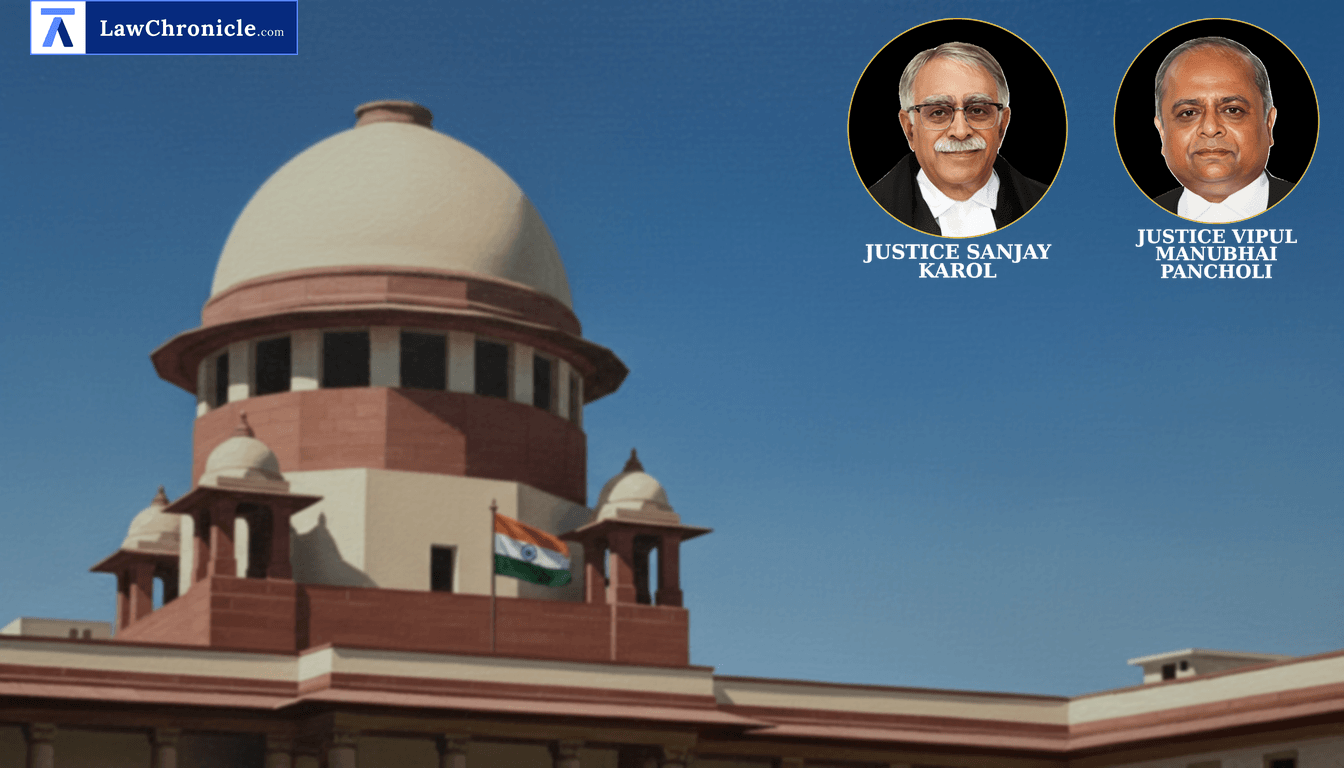
The Supreme Court has delivered a scathing rebuke to appellate shortcuts, ruling that a High Court cannot overturn a Trial Court's findings through cryptic orders that lack points for determination or independent reasoning. Emphasizing that reasons are the 'lifeblood of law,' the apex court held that judicial supervision does not permit the summary dismissal of lower court judgments without a rigorous re-evaluation of both facts and law.
In a verdict delivered by a bench comprising Justice Sanjay Karol and Justice Vipul M. Pancholi, the Court set aside a Kerala High Court judgment that had reversed a partition decree in a matter involving a disputed Will. The Supreme Court expressed grave concern over the High Court’s brief, two-paragraph order which not only lacked legal depth but also directed the Trial Court judge to undergo training for alleged incompetence.
The Mandate of Section 96 and Order 41 Rule 31
While examining the scope of first appeals under Section 96 of the Code of Civil Procedure, 1908, the bench observed that the First Appellate Court is the final court of fact. The Court stressed that Code of Civil Procedure, 1908 Order 41 Rule 31 mandates that a judgment must state points for determination, the decision thereon, and the reasons for such decision.
The Court, in its reasoning, observed: "If orders such as these are permitted to stand, it sends a wrong message of the judgments of the Civil Courts/Trial Courts being able to be set aside without due effort and application of mind. That, needless to say, would be a grave error. The least that could have been expected of the Court was to discuss, what it termed as 'extraneous consideration', after referring to the evidence as adduced by the parties."
Guidelines for Proving Genuineness of Wills
Recognizing the dispute centered on a Will under the Indian Succession Act, 1925, the Court reiterated the high standards required for proving testamentary documents. It noted that the High Court failed to apply the principles of Section 67 and 68 of the Evidence Act 1872 or Sections 59 and 63 of Indian Succession Act, 1925.
The Court referred to the foundational principles laid down in H. Venkatachala Iyengar v. B.N. Thimmajamma ( "1958 SCC OnLine SC 31": 1958 CaseBase(SC) 175) and Meena Pradhan v. Kamla Pradhan ( "(2023) 9 SCC 734": 2023 CaseBase(SC) 1053) regarding the satisfaction of a 'prudent mind' in establishing that a testator understood the nature and effect of the dispositions.
Judicial Restraint and Adverse Remarks Against Subordinate Judges
One of the most significant aspects of the judgment was the Supreme Court's decision to expunge the Kerala High Court's remarks against the Principal Sub Judge of Thrissur. The High Court had directed the officer to be sent for training, a move the Supreme Court found to be an excessive exercise of superior authority.
Referring to State of U.P. v. Mohd. Naim and State of Punjab v. Shikha Trading Co., the bench emphasized that the independence of the judiciary depends on judges being allowed to perform their functions without fear of disparaging remarks. The Court noted that judicial pronouncements must maintain sobriety and moderation.
The Court has the following directions:
"The impugned judgment and order dated 30.11.2022 in RFA No.298 of 2019 on the whole, and the direction against the learned Principal Sub Judge of the Principal Sub Court, Thrissur, are set aside. The first appeal is restored to the file of the High Court of Kerala, to be heard afresh leaving all contentions open for the parties to agitate."
Key Takeaways:
Reasoning is Mandatory for Reversals
Appellate courts must provide detailed independent reasoning when overturning lower court decrees; general agreement is only permissible for concurrences.
Procedural Compliance under CPC
Failure to frame points for determination as required by Order 41 Rule 31 of the Code of Civil Procedure, 1908 can vitiate an appellate judgment if not supported by other recorded reasons.
Protecting Judicial Independence
High Courts should act as 'friends and philosophers' to the subordinate judiciary rather than using disparaging remarks or disciplinary directions as a primary tool for correction.
Strict Proof for Testamentary Documents
Proving a Will requires meeting the specific criteria of the Indian Succession Act, 1925 and Evidence Act 1872, including evidence of the testator's sound mind and valid attestation.
Ratio Decidendi:
A First Appellate Court, being the final court of fact and law (subject to second appeal), is legally bound under Order 41 Rule 31 of the Code of Civil Procedure, 1908, to record a reasoned judgment that reflects an independent application of mind to all issues and evidence. Any reversal of a lower court's decision without providing a cogent legal rationale or following the mandatory requirements of the CPC is unsustainable in law.
Background:
The litigation arose when the appellant filed a suit for partition of her deceased mother’s property. The respondents contested this by producing a registered Will dated 22nd March 1999. The Trial Court (Principal Sub Court, Thrissur) found that the Will was not proved in accordance with Section 63 of the Indian Succession Act, 1925 and granted a preliminary decree for partition.
On appeal, the Kerala High Court set aside the partition decree in a brief order, calling the Trial Court's reasoning 'extraneous' and directing the judge to undergo training. The Supreme Court found that the High Court had failed to engage with the evidence or the precedents cited, such as Santosh Hazari v. Purushottam Tiwari and B.V. Nagesh v. H.V. Sreenivasa Murthy ( "(2010) 13 SCC 530": 2010 CaseBase(SC) 1386). Consequently, the apex court allowed the appeal, restored the matter to the High Court for a fresh hearing, and deleted the adverse remarks against the Trial Judge.
Case Details:
Case No.: Civil Appeal No. of 2026 (@ SLP (C) No. 9510 of 2023)
NeutralCitation: 2026 INSC 709
Case Title: Lakshmi v. Gopi & Ors.
Source: 2026 CaseBase(SC) 659
Similar Articles

 Breaking News


