


Disinheriting Natural Heirs Not A Ground To Vitiate Registered Wills: Allahabad High Court
 Copy Link
 Share
 Save
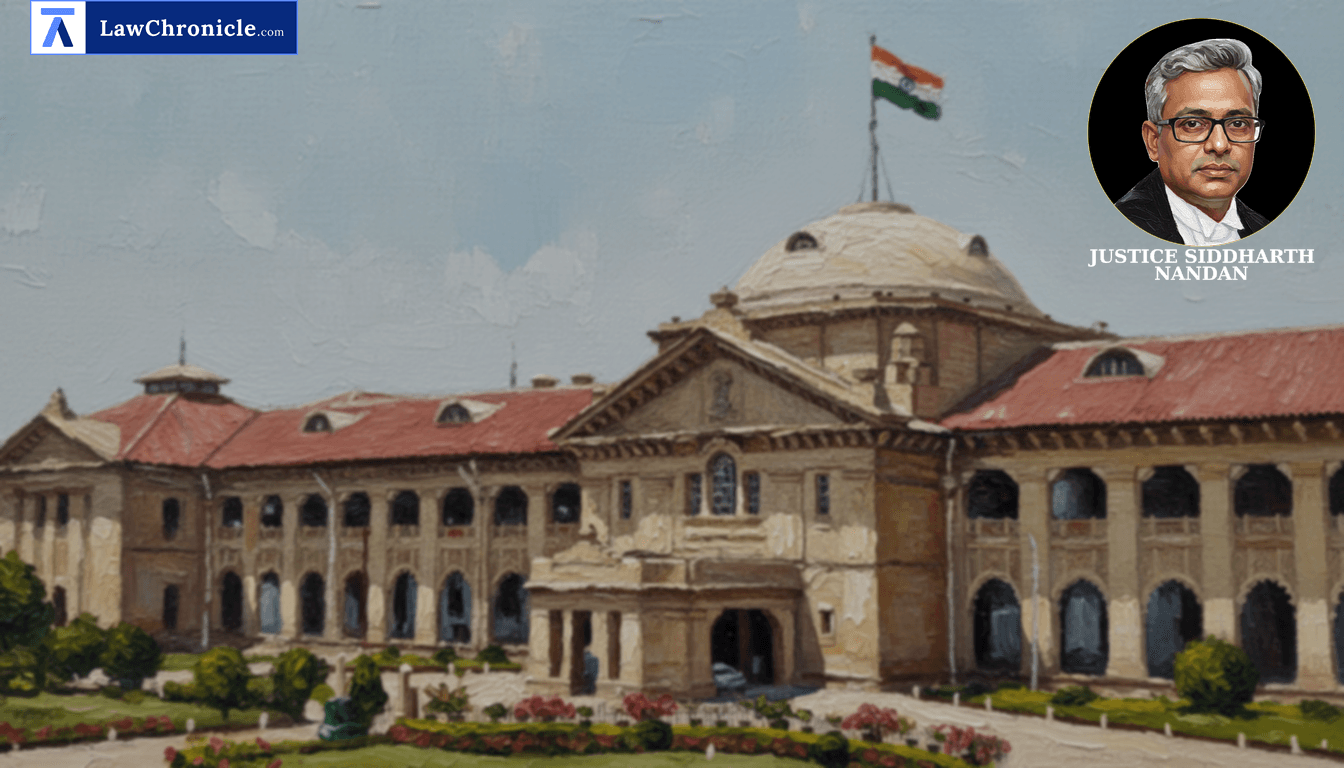
The Allahabad High Court has fortified the principle of testamentary freedom, ruling that the exclusion of natural heirs from a registered Will does not inherently constitute a suspicious circumstance, especially when the bequest favors offspring who provided care to the testator in their old age. In a definitive stance against judicial overreach into family equity, the High Court held that judges cannot apply standards of fairness to redistribute property if the due execution and mental capacity of the testator are legally established.
Justice Siddharth Nandan presided over the second appeal challenging a lower appellate court's decision that had upheld a Will disinheriting a grandson in favor of the testator’s son. The Bench examined whether the mere fact of a fiduciary relationship between a father and son, or the advanced age of the testator, could nullify a registered document on grounds of undue influence.
Key Takeaways
Testamentary Freedom Over Family Equity
Courts are restricted to verifying due execution and testamentary capacity rather than evaluating whether a Will’s distribution is fair or equitable among all children.
Suspicion vs. Natural Exclusion
Disinheriting a natural heir is not a 'suspicious circumstance' per se; a Will is fundamentally executed to alter the natural mode of succession.
Burden of Proof on Undue Influence
Broad allegations of undue influence based on a fiduciary relationship (like son-father) are insufficient; the party alleging coercion must provide specific evidence of its exercise.
Scribe as Competent Witness
A scribe who signs in the column of an attesting witness is a competent witness under Section 63 of the Indian Succession Act, 1925 if they witnessed the testator's signature.
Legal Validity of Disinheritance
The Court observed that the primary purpose of a Will is to depart from the normal line of succession. Relying on Savithri and others Vs. Karthyayani Amma and others ( "2008 AIR (SC) 300": 2007 CaseBase(SC) 82), the Court noted that a person of ordinary prudence would naturally favor an offspring who stayed back to care for them over an ungrateful child or a well-settled relative living elsewhere. The Court emphasized that a fiduciary relationship, such as a son caring for an elderly father, does not automatically lead to a presumption of undue influence.
While dismissing the second appeal, the Allahabad High Court observed that "The law relating to suspicious circumstances surrounding the execution of a Will is already well-settled... In the matter of appreciating the genuineness of execution of a Will, there is no place for the Court to see whether the distribution made by the testator was fair and equitable to all of his children. The Court does not apply Article 14 to dispositions under a Will."
Ratio
Under the Indian Succession Act, 1925, once the propounder proves the due execution of a Will through an attesting witness and establishes the testator's sound disposing mind, the burden shifts to the caveator to prove fraud or undue influence. The exclusion of a natural heir or the advanced age of a testator are not independent grounds to presume suspicious circumstances if the testator’s mental alertness is otherwise demonstrated by their conduct, such as contemporary correspondence.
Background
The dispute arose regarding a registered Will dated December 6, 1971, executed by a person who disinherited his grandson (a government servant) and bequeathed his property to his son, citing that the son cared for him and his agricultural land while the grandson lived away. The Trial Court had cancelled the Will, finding it suspicious that no village witnesses were present and assuming 'undue influence' due to the testator's age (81 years) and the son’s fiduciary position.
However, the First Appellate Court reversed this, noting that the grandson failed to provide medical evidence of the testator’s mental incapacity. The Allahabad High Court, while dismissing the second appeal, upheld this reversal, citing Makhan Lal Bangal v. Manas Bhunia & Ors ( "(2001) 2 SCC 652": 2001 CaseBase(SC) 695) and H. Venkatachala Iyengar Vs. B.N. Thimmajamma and others ( "1959 AIR (SC) 443": 1958 CaseBase(SC) 175) to emphasize that procedural irregularities like non-framing of specific issues under Code of Civil Procedure, 1908 do not vitiate a judgment if the parties were aware of the controversy and led evidence accordingly. The Allahabad High Court also applied Seth Beni Chand Vs. Kamla Kunwar to validate the testimony of the scribe who acted as an attesting witness.
Case Details:
Case No.: SECOND APPEAL No. - 2785 of 1980
Case Title: Bhanu Datta Pathak v. Hardutta Pathak and others
Appearances:
For the Petitioner(s): Bipin Lal Srivastava, Pankaj Agarwal, Rahul Mishra, S.k. Verma, Santosh Kumar Singh, Sharad Kumar Pandey, Vinayak Varma, Advocates
For the Respondent(s): Anand Kr Srivastava, Avadhesh Singh, J.a. Azmi, J.p.mishra, M.p. Singh, Rahul Mishra, Advocates
Source: 2026 CaseBase(ALL) 887
Similar Articles
 Breaking News


