


Court Finds Will Valid, Sets Aside High Court and Trial Decrees; Plaintiff Excluded from Estate Has No Partible Share
 Copy Link
 Share
 Save
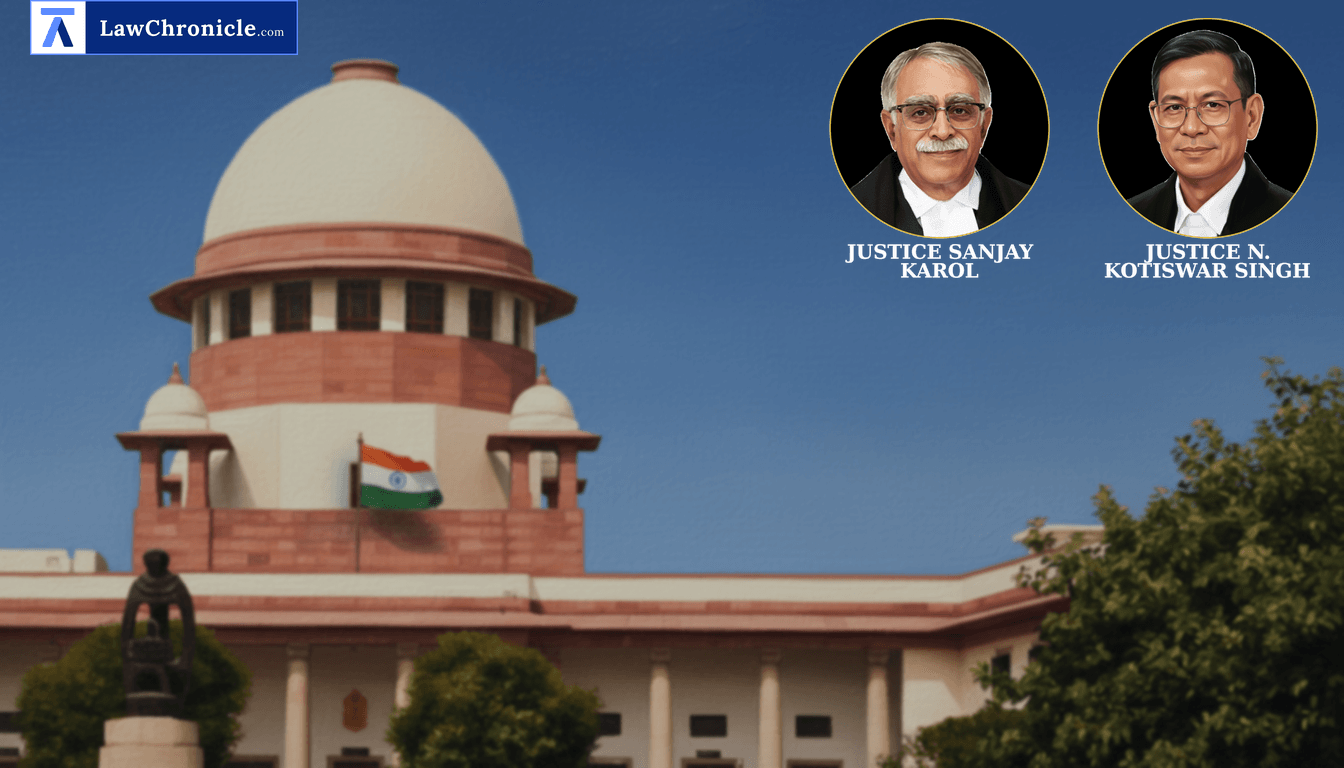
A bench of Justices Ahsanuddin Amanullah and K. Vinod Chandran heard appeals by two defendants challenging concurrent findings disbelieving a registered will that excluded one of nine children and holding the testator's estate to be partible. The appeals arose from a suit for partition filed in 2011 by the excluded child (plaintiff), who had been left out of a will executed and registered in March 1988 by her father, N.S. Sreedharan.
The Supreme Court allowed the appeals, held that the will was proved satisfactorily and set aside the judgments of the trial court and the High Court which had rejected the propounded will. The Court observed that the attesting witness (DW-2) had identified the testator’s signature, had deposed to his own attestation and, on cross-examination, affirmed that “we put our signatures on it” in relation to the other attesting witness. The Court concluded that “the will stands proved unequivocally” and that “the last will and testament of the testator cannot be digressed from or frustrated.” The Court, in its reasoning, observed: “It is obvious that for deciding material questions of fact which arise in applications for probate or in actions on wills, no hard and fast or inflexible rules can be laid down for the appreciation of the evidence. It may, however, be stated generally that a propounder of the will has to prove the due and valid execution of the will and that if there are any suspicious circumstances surrounding the execution of the will the propounder must remove the said suspicions from the mind of the court by cogent and satisfactory evidence...the judicial mind must always be open though vigilant, cautious and circumspect.”
Background The testator executed Exhibit B2, a will dated 26.03.1988 and registered on 27.03.1988. The will bequeathed the properties to eight of his nine children, excluding the present plaintiff who had married out of the community. In 1990, a defendant had filed an injunction suit producing a copy of the will; the plaintiff did not contest that suit and an ex parte decree was entered. In 2011 the plaintiff filed a suit for partition. The defendants relied on the registered will; two attesting witnesses were named but one had died before trial and the other was examined as DW-2.
The trial court and the High Court found the will unproved, citing deficiencies in the attestation evidence and highlighting anomalies in DW-2’s deposition about dates of visits and presence of the Sub-Registrar. The appellants contended that Section 63 of the Indian Succession Act and Section 68 of the Evidence Act were satisfied by DW-2’s evidence and that the plaintiff was estopped from challenging the will. The respondent relied on precedents emphasising the need to call available attesting witnesses and on cases where suspicious circumstances warranted disbelief.
The Supreme Court reviewed authorities including H. Venkatachala Iyengar v. B.N. Thimmajamma and Rani Purnima Debi, reiterated that proof of a will remained a question of fact and that suspicious circumstances required removal by cogent evidence. The Court examined the chief- and cross-examination of DW-2, accepted his identification of the testator’s signature and his affirmation that both attesting witnesses had signed, and rejected the High Court’s view that a leading suggestion in cross-examination lacked probative value. Finding no legitimate doubt as to testamentary capacity or execution, the Court set aside the lower courts’ judgments, allowed the appeals and dismissed the partition suit. No interim directions were necessary.
Case No.: 2025 INSC 1451 Case Title: K. S. Dinachandran v. Shyla Joseph & Ors. Appearances: For the Petitioner(s): Mr. V. Chitambaresh, Senior Counsel; Mr. A. Hariprasad, Senior Counsel For the Respondent(s): Mr. P. B. Krishnan, Senior Counsel
Similar Articles
 Breaking News


