


Article 22 Violation | Supreme Court Mandates Magistrate's Nod for Re-Arrest After Illegal Arrest
 Copy Link
 Share
 Save
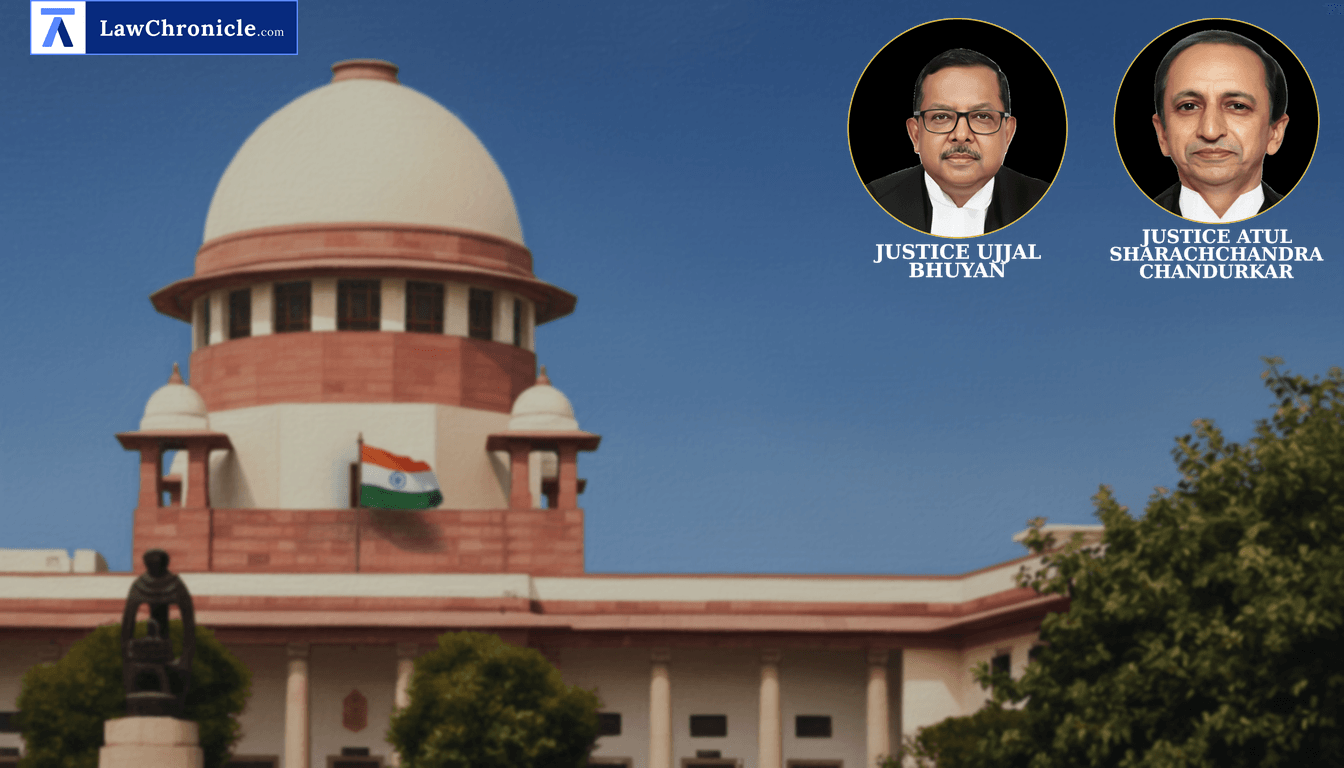
The Supreme Court has ruled that an accused released due to procedural violations of Article 22 of the Constitution of India, 1950 cannot be automatically re-arrested by the executive without prior judicial authorization. The Apex Court made Magistrate's permit necessary for rearrest after illegal arrest.
A Bench of Justice Ujjal Bhuyan and Justice Atul S. Chandurkar heard the appeal challenging an order of the Punjab and Haryana High Court. The High Court had held that the police could re-arrest an accused despite a previous release order passed due to the non-furnishing of written grounds of arrest. While the Bench declared that any subsequent attempt to take an accused into custody following a breach of constitutional safeguards must be subject to judicial scrutiny and superior administrative oversight.
Key Takeaways
- Mandatory Judicial Sanction for Re-Arrest: Re-arresting an individual after release for constitutional violations under Article 22 requires explicit permission from a Magistrate.
- Administrative Superior Endorsement: Applications seeking re-arrest must carry the endorsement of an immediate superior officer to ensure accountability for initial procedural lapses.
- Automatic Transfer of Investigation: Superior authorities must transfer the case investigation to a new officer and initiate departmental inquiries against erring personnel upon such lapses.
- Equal Application Across Statutes: Fundamental guarantees under Article 22 apply uniformly regardless of the gravity of the alleged offense or special statutory provisions.
Violation of Article 22 Safeguards
The Supreme Court emphasized that fundamental constitutional rights under Article 22(1) and Article 22(2) of the Constitution of India, 1950 cannot be treated as mere procedural technicalities. The Bench noted that an arrest made in violation of these safeguards is unconstitutional, rendering subsequent detention illegal.
Magistrate's Role on Re-Arrest after Illegal Arrest
The Supreme Court while setting aside the High Court order observed that “What is sought to be highlighted is that once there is a breach of Article 22(1) of the Constitution, the power to re-arrest the accused must not be left to the discretion of the very same authority who had violated the said provision of the Constitution. It must have the judicial imprimatur. It is only when the Magistrate is satisfied that for bona fide reasons the grounds of arrest could not be furnished to the arrestee at the first instance but furnished subsequent to his release and on further satisfaction that the accused needs to be re-arrested, he may pass an order permitting the investigating agency to re-arrest.”
Ratio
When an accused is released from custody owing to a violation of the constitutional mandates under Article 22(1) or Article 22(2) of the Constitution of India, 1950, the investigating agency cannot automatically exercise executive powers to re-arrest the individual for the same offense. Any subsequent arrest or custody request requires prior written application detailing reasons and prior non-compliance explanations, endorsement by a superior officer, and explicit judicial approval by the jurisdictional Magistrate after hearing the accused.
Background
The case arose from an FIR registered under Sections 64, 65(1), and 351 of the Bharatiya Nyaya Sanhita, 2023 read with Section 6 of the Protection Of Children From Sexual Offences Act, 2012. The appellant was arrested on May 17, 2026, but was not supplied with written grounds of arrest. Producing him before the Duty Magistrate the following day, the police sought remand. The Magistrate found the arrest illegal for non-compliance with Section 50(1) of the Code Of Criminal Procedure, 1973 (corresponding to Section 47 of the Bharatiya Nagarik Suraksha Sanhita, 2023) and Article 22(1) of the Constitution of India, 1950, relying on Mihir Rajesh Shah Vs. State of Maharashtra ( "(2026) 1 SCC 500": 2025 CaseBase(SC) 2876). The Magistrate ordered his immediate release while observing that the police could move a fresh application after supplying written grounds.
Subsequent applications by the police for custody were turned down by the Additional Chief Judicial Magistrate because grounds had still not been supplied prior to seeking custody. The appellant then approached the High Court seeking to restrain the police from re-arresting him or obtaining arrest warrants. The High Court dismissed the petition, ruling that procedural release did not grant blanket immunity from future arrest in grave offenses.
Reviewing relevant precedents including Khatri Vs. State of Bihar ( "(1981) 1 SCC 627": 1980 CaseBase(SC) 209), Manoj Vs. State of Madhya Pradesh ( "(1999) 3 SCC 715": 1999 CaseBase(SC) 1120), Directorate of Enforcement Vs. Subhash Sharma ( "2025 SCC OnLine SC 240": 2025 CaseBase(SC) 92), Bhim Singh Vs. State of Jammu & Kashmir ( "(1985) 4 SCC 677": 1985 CaseBase(SC) 52), Pankaj Bansal Vs. Union of India ( "(2024) 7 SCC 576": 2023 CaseBase(SC) 603), Prabir Purkayastha Vs. State (NCT of Delhi) ( "(2024) 8 SCC 254": 2024 CaseBase(SC) 73), Vihaan Kumar Vs. State of Haryana ( "(2025) 5 SCC 799": 2025 CaseBase(SC) 206), Kamal Dutta Vs. Union of India, Rudul Sah Vs. State of Bihar ( "(1983) 4 SCC 141": 1983 CaseBase(SC) 166), Nilabati Behera @ Lalita Behera Vs. State of Orissa, and Prabhu Dayal Deorah Vs. District Magistrate, Kamrup, the Supreme Court clarified that release resulting from constitutional violations is distinct from regular bail or default bail. It allowed the appeal, quashing the High Court's order and laying down mandatory safeguards for any future re-arrest.
Case Details:
Case No.: Criminal Appeal No. 4234 of 2026
Neutral Citation: 2026 INSC 1022
Case Title: Jaskaran Jeet Singh Deol Vs. State of Punjab
Source: 2026 CaseBase(SC) 7015
Similar Articles




 Breaking News


