


Attempt To Murder Charges depend upon Intent, not Injury Site: Supreme Court reiterates
 Copy Link
 Share
 Save
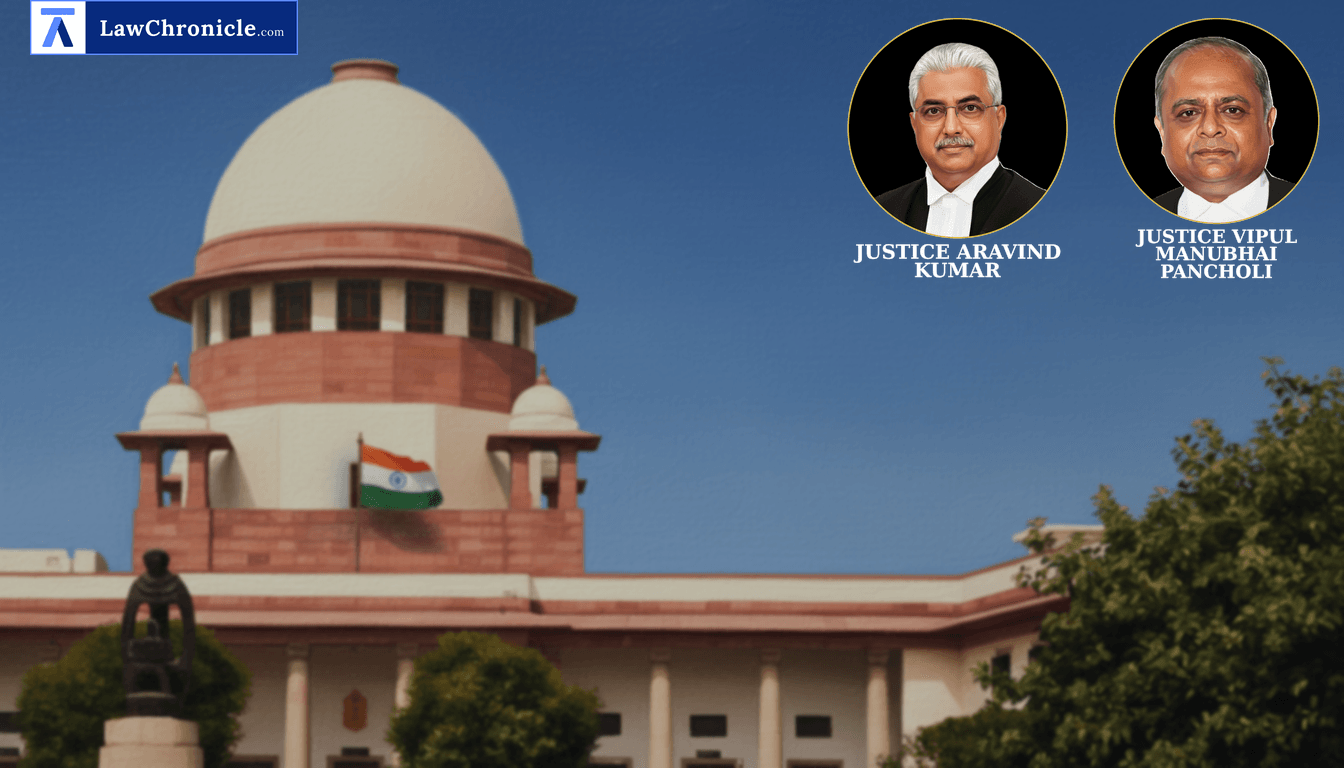
In a decisive blow to technical interpretations of violent crimes, the Supreme Court ruled that a charge of attempt to murder cannot be diluted merely because the resulting bodily injuries landed on non-vital parts of the victim's body. Overturning a High Court order that downgraded a Section 307 charge to Section 308, the Apex Court affirmed that intent and knowledge derived from the totality of circumstances, not the medical result alone, are the true touchstones of culpability.
A bench comprising Justice Aravind Kumar and Justice Vipul M. Pancholi heard the appeal challenging a Rajasthan High Court judgment that had partly quashed charges framed by a Sessions Court against an accused who allegedly rammed a tractor into victims and inflicted axe wounds.
Key Takeaways
Intent Over Injury Site
Courts cannot discharge or alter Section 307 IPC charges simply because injuries were inflicted on non-vital body parts, especially when defensive actions shield vital organs.
No Mini-Trials At Charge Framing
At the stage of framing charges under Section 227 and Section 228 of the CrPC, trial courts are not required to weigh evidentiary material as if conducting a full-fledged trial.
Statutory Flexibility Maintained
Trial courts retain the power under Section 216 CrPC to alter charges prior to judgment if full trial evidence fails to establish Section 307 IPC ingredients.
Bodily Injury and Attempt to Murder Charge
Reiterating settled criminal jurisprudence, the Supreme Court highlighted that bodily injury capable of causing death is not an absolute prerequisite to attract Section 307 of the Indian Penal Code, 1860. Relying on its precedents in State of Maharashtra v. Balram Bama Patil ( "(1983) 2 SCC 28": 1983 CaseBase(SC) 324), State of Madhya Pradesh v. Saleem alias Chamaru, Jage Ram v. State of Haryana ( "(2015) 11 SCC 366": 2015 CaseBase(SC) 299), and Surender Kumar v. State of Haryana ( "2026 SCC OnLine SC 1912": 2026 CaseBase(SC) 6026), the Court reiterated that intention or knowledge must be deduced from the nature of weapons deployed, the persistence of the assault, and prior animosity.
The Bench observed that “To justify a conviction under Section 307 of the IPC, it is not essential that a fatal or life-threatening bodily injury must actually be sustained and the nature, gravity and site of the wound may assist in determining the intention of the accused, intention or knowledge can and must be deduced from the totality of circumstances...”
Ratio
To establish an offence under Section 307 of the IPC, the decisive criterion is whether the overt act was committed with the requisite intention or knowledge under circumstances that would cause death, irrespective of the medical severity or the specific site of the resulting injury.
Background
The case arose from an incident on November 26, 2020, where the accused allegedly drove a tractor at high speed into the agricultural field of the appellant, striking his mother and subsequently assaulting family members with axes. The victim and his father sustained deep bone-deep and muscle-deep incised wounds on their arms and wrist while defending their heads from axe strikes.
Following investigation, police filed a charge-sheet under Sections 447, 323, 324, 326 read with 34, and Section 307 of the Indian Penal Code, 1860. Recoveries of weapons were made pursuant to Section 27 of the Indian Evidence Act, 1872. The Additional Sessions Judge, Merta framed charges including Section 307 IPC. However, the High Court of Judicature for Rajasthan at Jodhpur, exercising revision jurisdiction under the Code Of Criminal Procedure, 1973, altered the charge against the primary accused to Section 308 IPC, holding that the injuries were on non-vital body parts.
Allowing the appeal filed by the complainant, the Supreme Court held that the High Court committed a grave error in conducting a mini-trial and technical assessment of injuries at the threshold stage, ignoring defensive arm positions and statutory provisions under Section 216 of the Code Of Criminal Procedure, 1973.
Case Details:
Case No.: Criminal Appeal No. 4767 of 2026
Neutral Citation: 2026 INSC 1093
Case Title: Abhishek v. State of Rajasthan & Ors.
Appearances:
For the Petitioner(s): Mr. Nishant Bishnoi, Advocate
For the Respondent(s): Mr. S. Udaya Kumar Sagar, Advocate (for State)
Source: 2026 CaseBase(SC) 8246
Similar Articles

 Breaking News


