


Fatal Injury not a pre-requisite to attract charges of Attempt to Murder: Supreme Court
 Copy Link
 Share
 Save
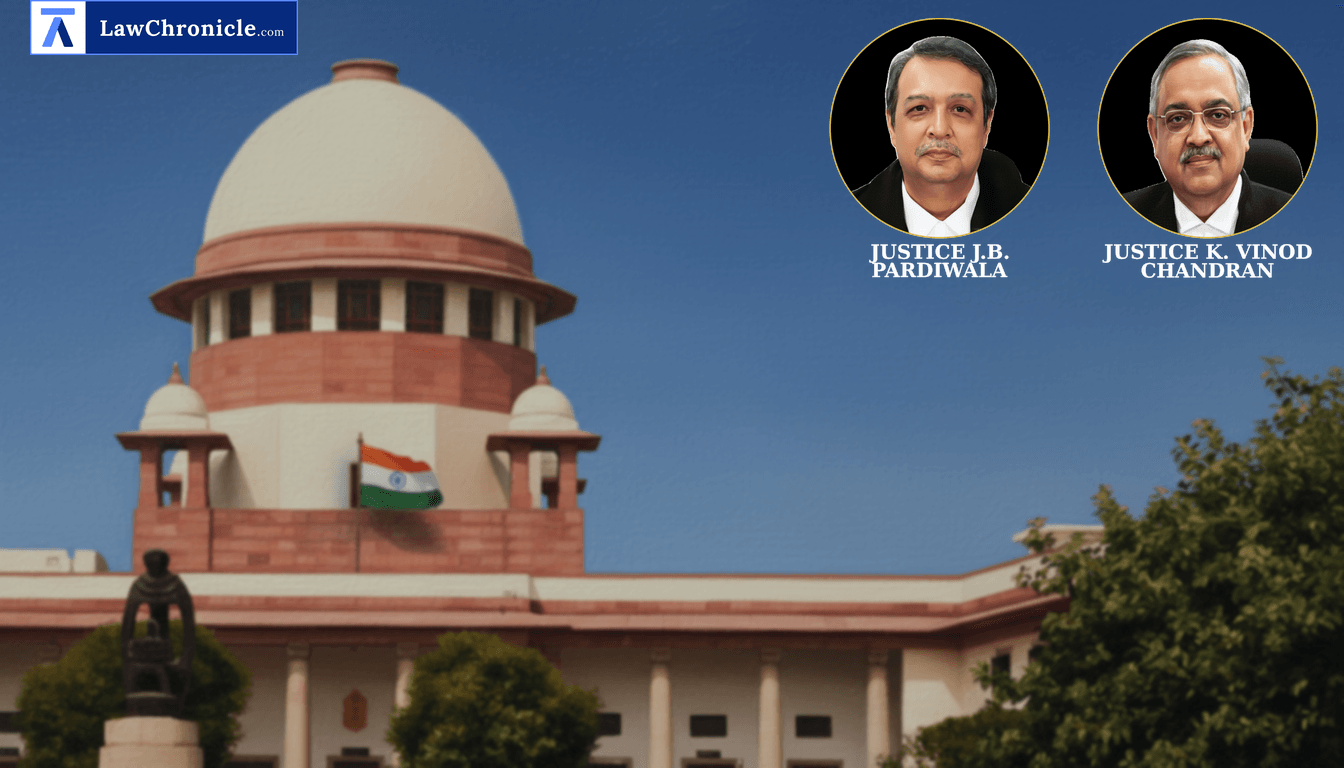
The Supreme Court has ruled that the extent or severity of physical injury is not a mandatory prerequisite to attract attempt to murder charges, as culpability hinges primarily on the accused's intent or knowledge behind the act. The Apex Court has clarified that while injury gravity does not solely dictate an attempt to murder prosecution, courts can reject late-stage attempts to alter charges if basic allegations of intent were missing from the initial proceedings.
In a matter considering an appeal against a High Court order affirming the rejection of an application to add attempt to murder charges, a bench of Justice J.B. Pardiwala and Justice K. Vinod Chandran examined the scope of Section 307 under Indian Penal Code, 1860.
Key Takeaways
- Intent Prevails Over Injury: Culpability under Section 307 requires proof of intention or knowledge, not necessarily a life-threatening bodily injury.
- Two-Tiered Punishment Structure: Section 307 prescribes up to ten years imprisonment for the act alone, which extends to life imprisonment if hurt is actually caused.
- Timelines Matter for Charge Alteration: Belated applications to add severe charges can be rejected if the foundational facts were known but omitted at the FIR and cognizance stages.
- Court's Continuous Prerogative: Trial courts retain full authority to alter charges at any juncture during trial if justified by evidence.
Analysis of Intent and Injury
Analyzing the statutory scheme, the Supreme Court stressed that the nature of injury alone cannot dictate whether an attempt to murder occurred. The Apex Court observed that "Hurt, grievous or simple, is not a precondition to attract Section 307, but, if there is a hurt, be it simple or grievous, and the act causing such hurt is with the intention or knowledge that such act could have caused death; making the perpetrator guilty of murder, then a graver punishment is provided."
Addressing the legal principles governing the provision, the Supreme Court noted that prior judgments in State of Madhya Pradesh v. Kashiram and Others ( "(2009) 4 SCC 26": 2009 CaseBase(SC) 121) and State of M.P. v. Saleem alias Chamaru and Another established that a bodily injury capable of causing death is not essential to sustain a conviction. The Court further referred to Chimanbhai Jagabhai Patel v. State of Gujarat and Another ( "(2009) 11 SCC 273": 2009 CaseBase(SC) 732), Pasupuleti Siva Ramakrishna Rao v. State of Andhra Pradesh and Others ( "(2014) 5 SCC 369": 2014 CaseBase(SC) 114), State of Madhya Pradesh v. Kanha alias Omprakash ( "(2019) 3 SCC 605": 2019 CaseBase(SC) 2767), and Jage Ram and Others v. State of Haryana ( "(2015) 11 SCC 366": 2015 CaseBase(SC) 299) to reiterate that while the absence of a fatal injury does not rule out Section 307, the surrounding circumstances, nature of weapons, and severity of hurt serve as evidentiary material to infer intent and knowledge.
Dismissing the Special Leave Petition due to the lack of timely allegations regarding intent, the Supreme Court issued no specific procedural directions, but clarified the ongoing powers of trial courts. The Bench further added a clarification with the words "However, we also make it clear that it is the Court’s prerogative to alter the charge at any time when the trial is continuing, provided there is sound and justifiable cause, as emanating from the evidence led before court."
Ratio
To establish an offense of attempt to murder under Section 307, the essential ingredient is the intention or knowledge that the act could cause death, rather than the actual occurrence or severity of a physical injury. Although trial courts retain the prerogative to alter charges at any stage based on emerging evidence, an application to add charges at a late stage may be declined if allegations of such intention or knowledge were absent at the initial stages of investigation and cognizance.
Background
The dispute originated from a conflict over waterlogging caused by draining rainwater, leading to an assault where the petitioner, his brother, and his uncle sustained multiple injuries. An FIR was registered under Sections 147, 148, 149, 323, 325, and 506 of Indian Penal Code, 1860 at Police Station Nissing, Karnal against six accused persons.
During trial, a private Neurosurgeon deposed as PW5 stating that the fracture sustained by the petitioner's brother could have been dangerous to life. However, a Medical Board formed during investigation, which included the Medical Officer (PW6), concluded that the injuries, though grievous, did not pose a danger to life. Based on the Medical Board report, Section 307 was omitted from the chargesheet.
At a advanced stage of the trial, the petitioner filed an application to alter the charge to Section 307 of Indian Penal Code, 1860. The Judicial Magistrate First Class, Karnal, rejected the plea holding that the Medical Board's opinion prevailed. Revision petitions before the Sessions Court and the High Court were subsequently dismissed, as no allegation of intent to kill was made at the initial stage and two of the accused persons had also sustained injuries. The Supreme Court affirmed the lower court decisions and dismissed the Special Leave Petition.
Case Details:
Case No.: Special Leave Petition (Crl.) No.14611 of 2026
Neutral Citation: 2026 INSC 1006
Case Title: Surender Kumar v. State of Haryana & Ors.
Source: 2026 CaseBase(SC) 8077
Similar Articles
 Breaking News


