


Civil Court Retains Jurisdiction Over Comprehensive Title Suits Despite Endowments Act: Telangana HC
 Copy Link
 Share
 Save
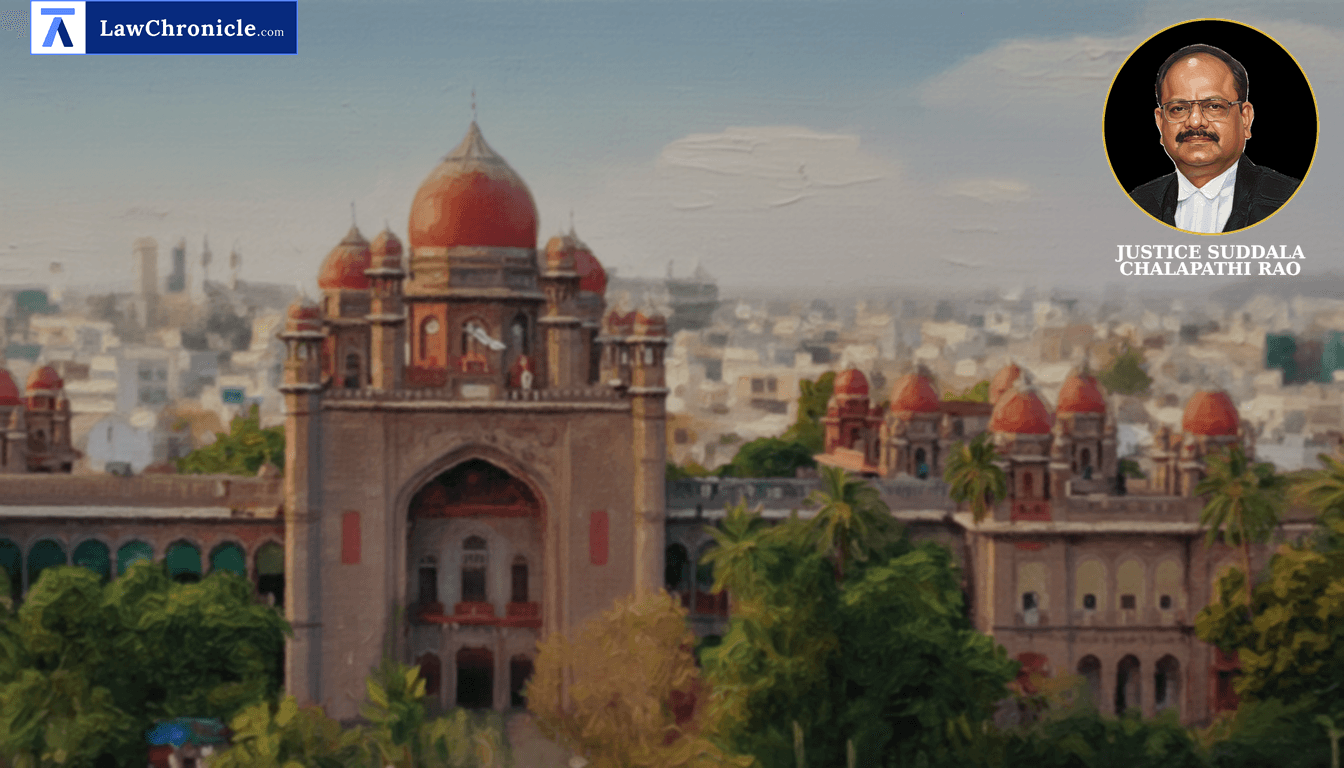
The Telangana High Court has ruled that a comprehensive civil suit for declaration of title and recovery of possession remains maintainable even when the property is claimed by a religious or charitable trust. The Bench affirmed that statutory bars under endowment legislations do not automatically strip civil courts of their power to adjudicate complex questions of ownership and testamentary validity that fall outside the specialized expertise of executive authorities.
A bench of Justice Suddala Chalapathi Rao presided over the appeal challenging a trial court's dismissal of a suit involving agricultural lands and commercial properties. The appellants, being the wife and adopted son of the deceased property owner, sought to set aside a registered Will that endowed their ancestral and self-acquired properties to a charitable trust.
Key Takeaways
Preservation of Civil Jurisdiction
Declaratory suits involving complex title disputes and the validity of Wills are maintainable in Civil Courts despite the presence of specialized tribunals under the Andhra Pradesh Charitable and Hindu Religious Institutions and Endowments Act, 1987.
Registration vs. Revocation
While a registered Will carries high evidentiary value, the law does not mandatorily require a subsequent revocation deed to be registered to be valid, though its execution must be proved with concrete evidence.
Burden of Proof in Title Suits
In suits for declaration of title, the plaintiff must succeed on the strength of their own case and cannot rely on the weaknesses of the defendant's claim.
Stridhana and Property Ownership
Mere inclusion of a spouse's name in municipal or bank records does not constitute conclusive proof of title if the underlying land acquisition cannot be traced to the spouse's independent funds.
Civil Court Jurisdiction Over Endowment Disputes
The Telangana High Court addressed the critical question of whether the suit was barred by Section 87 of the Andhra Pradesh Charitable and Hindu Religious Institutions and Endowments Act, 1987. The Court noted that the suit was instituted in 1990, long before the 2007 amendment which established the Endowments Tribunal. The Court held that "...a substantive suit of declaratory relief cannot be dealt by an authority particularly, the Deputy Commissioner, who has no expertise to deal with such comprehensive suits... the suit filed before the Civil Court seeking comprehensive reliefs, is maintainable."
Validation of the Registered Will and Charitable Trust
The dispute centered on a registered Will (Ex.X2) executed by the late property owner in 1989, which created the "Admala Laxma Reddy Trust" for educational and medical aid. The Telangana High Court found no evidence of coercion or fraud, despite the 7th defendant being a beneficiary. In its reasoning, the bench observed that "...normally a registered document carries some authenticity and the plaintiffs have to necessarily disprove the same by placing substantial evidence/concrete material to disprove the same or it was executed under threat, coercion, undue influence or fraud."
Regarding the alleged revocation deed (Ex.X1), the Telangana High Court emphasized that a handwriting expert's opinion alone is insufficient to prove revocation. it further added that “...proof of the signature alone does not necessarily establish, that the document was executed by the testator with knowledge of its contents and with the intention of revoking the earlier Will.”
Ratio
A Civil Court's jurisdiction to entertain a comprehensive suit for declaration of title and recovery of possession is not ousted by the Andhra Pradesh Charitable and Hindu Religious Institutions and Endowments Act, 1987 when the dispute involves the foundational validity of a Will or complex ownership claims that existed prior to the establishment of specialized Tribunals. Furthermore, the burden of proving a Revocation Deed against a registered Will requires more than a mere expert opinion on signatures; it requires proof of testamentary intention and the removal of all suspicious circumstances surrounding the document's execution.
Background
The litigation began when the wife (1st Plaintiff) and adopted son (2nd Plaintiff) of late Admala Laxma Reddy challenged the management of their properties by the Endowments Department. They claimed that the suit properties were either joint family properties or the self-acquired "Stridhana" property of the wife. They alleged that the deceased, who was suffering from cancer, was coerced into executing a Will in favor of a trust and the 7th defendant. They further produced an unregistered Revocation Deed, claiming the deceased had changed his mind before his death in 1990.
The trial court at Jagtial had dismissed the suit in 1999, validating the registered Will. The Telangana High Court, while noting that the original trial records were destroyed over time, relied on State of U.P. v. Abhai Raj Singh and Anr. to proceed with the available material. Referencing Union of India v. Vasavi Cooperative Society Ltd., the Telangana High Court reiterated that the plaintiffs failed to prove their exclusive title or the ancestral nature of the properties, leading to the dismissal of the appeal.
Case Details:
Case No.: A.S.No.620 of 1999
CNR No.: HBHC010030771999
Case Title: Admala Chandramma and others v. The Govt. of A.P., and others.
Appearances:
For the Petitioner(s): Sri V.Ravi Kiran Rao, Senior Counsel representing Sri V.Rohith
For the Respondent(s): Learned Government Pleader for Appeals
Source: 2026 CaseBase(TEL) 35405
Similar Articles
 Breaking News


