


Hospitalization Same Day Not Suspicious Circumstance To Invalidate Will: Karnataka HC
 Copy Link
 Share
 Save
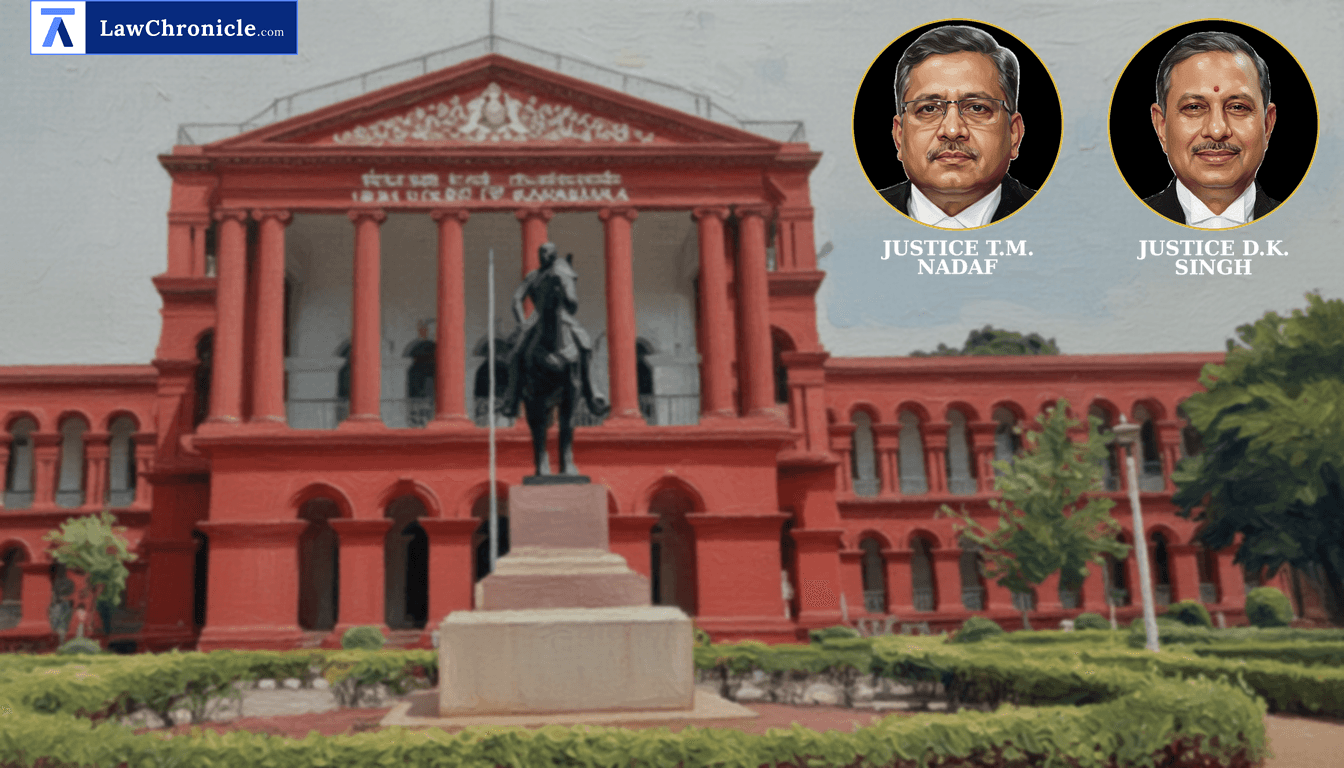
The High Court of Karnataka has ruled that mere hospitalization of a testator on the very day of executing a registered Will cannot be treated as a suspicious circumstance to invalidate the testamentary disposition, provided the attesting witnesses cogently prove sound mind and valid execution.
In a partition dispute involving family properties, a Division Bench comprising Justice D K Singh and Justice T. M. Nadaf set aside a city civil court's order that had discarded a mother's registered Will executed in favor of her son.
Key Takeaways
Burden of Proof on Ill-Health: Objectors alleging mental incapacity must examine treating medical professionals rather than relying solely on hospital admission records.
Proving Attested Documents: Compliance with Section 69 of Indian Evidence Act and affirmative attestation by surviving witnesses fully satisfies the statutory mandate under Indian Succession Act, 1925.
Judicial Presumptions Overruled: Trial judges cannot substitute personal inferences regarding shaky signatures over direct, unshaken testimony of attesting witnesses.
Court's Rationale on Will Execution and Evidence
The High Court observed that when an attesting witness unequivocally confirms the testator's sound state of mind and voluntary execution of a registered document, courts cannot invalidate the instrument based on speculative inferences.
The Court, in its reasoning, observed: "When the witness has clearly stated regarding sound state of mind and health of the Testator while executing the Will and his evidence neither shaken nor discredited in the cross-examination, it becomes very hard for us to accept the reasons assigned by the Trial Court... It is trite law that a Judge cannot prescribe his personal view on any issue involved in the lis, which is against the evidence led by the respective party in that respect."
The Court further emphasized: "Mere production of Medical certificates are not the only circumstances to discredit the proof of Will, when the same has been proved in accordance with law as per the provisions of Indian Succession Act R/w. Indian Evidence Act."
The Court has following directions:
"(i) The Regular First Appeal is allowed in part.
(ii) The declaration of the Trial Court holding that the Will dated 23.02.2006 in respect of 'A' schedule property is not valid, is set-aside. We declare that defendant No.2 has proved the Will dated 23.02.2006 in respect of 'A' schedule property bequeathed in his favor by Late Nanjamma under the Will, neither the plaintiff nor defendant No.1(a) have any right over the property supra to claim partition.
(iii) The Registry is directed to draw the modified decree accordingly."
Ratio
A registered Will executed in compliance with statutory attestation provisions cannot be invalidated as being surrounded by suspicious circumstances merely due to the testator's hospitalization on the date of execution, unless the challenging party adduces positive medical evidence proving cognitive incapacity at the time of execution.
Background
The dispute arose out of a partition suit in O.S.No.3555/2004 filed by Respondent No. 1 seeking a 1/6th share in suit schedule properties left behind by his parents. The family had previously entered into a compromise in an earlier partition suit (O.S.No.286/1988), allotting 'A', 'B', and 'C' schedule properties to the parents with full rights to alienate or bequeath them. Following the father's death, the mother, Nanjamma, executed a registered Will dated 23.02.2006 bequeathing the 'A' schedule Wilson Garden residential property to Appellant No. 1 (Defendant No. 2).
The trial court partly decreed the suit under Section 96 of CPC., 1908, declaring the Will invalid on the ground that Nanjamma was admitted to Mallige Hospital on the day of execution and lacked absolute title to dispose of the entire property. Challenging this judgment, the affected defendants preferred an appeal before the High Court.
During appellate proceedings, all claims pertaining to 'B', 'C', and 'D' schedule properties were amicably settled among the parties, restricting the appeal exclusively to the validity of the Will concerning the 'A' schedule property under Transfer of Property Act. Reversing the trial court's decision, the High Court held that Appellant No. 1 successfully proved the execution of the Will through attesting witnesses and ordered the decree to be modified accordingly.
Case Details:
Case No.: RFA No. 294 of 2014
Case Title: Sri. Ranganatha Reddy and another v. Sri R. Keshava Reddy and others
Appearances:
For the Petitioner(s): Sri. Ranganath Reddy S., Advocate for A1; Sri. Rahul S. Reddy, Advocate for A2
For the Respondent(s): Sri. Rajesh Mahale, Sr. Advocate a/w Sri. Bryeu Stain Berg & Sri. Jose Sebastian, Advocates for R1; Sri. H.S. Gaurav, Advocate for R2; Sri. B.R. Hari Krishna, Advocate for R3; Sri. Vishnu Hegde, Advocate for R4 and R5
Source: 2026 CaseBase(KAR) 13149
Similar Articles
 Breaking News


