


Civil Courts Can Reopen Suits Settled Via 'Hybrid Orders' In Lok Adalat: Karnataka HC
 Copy Link
 Share
 Save
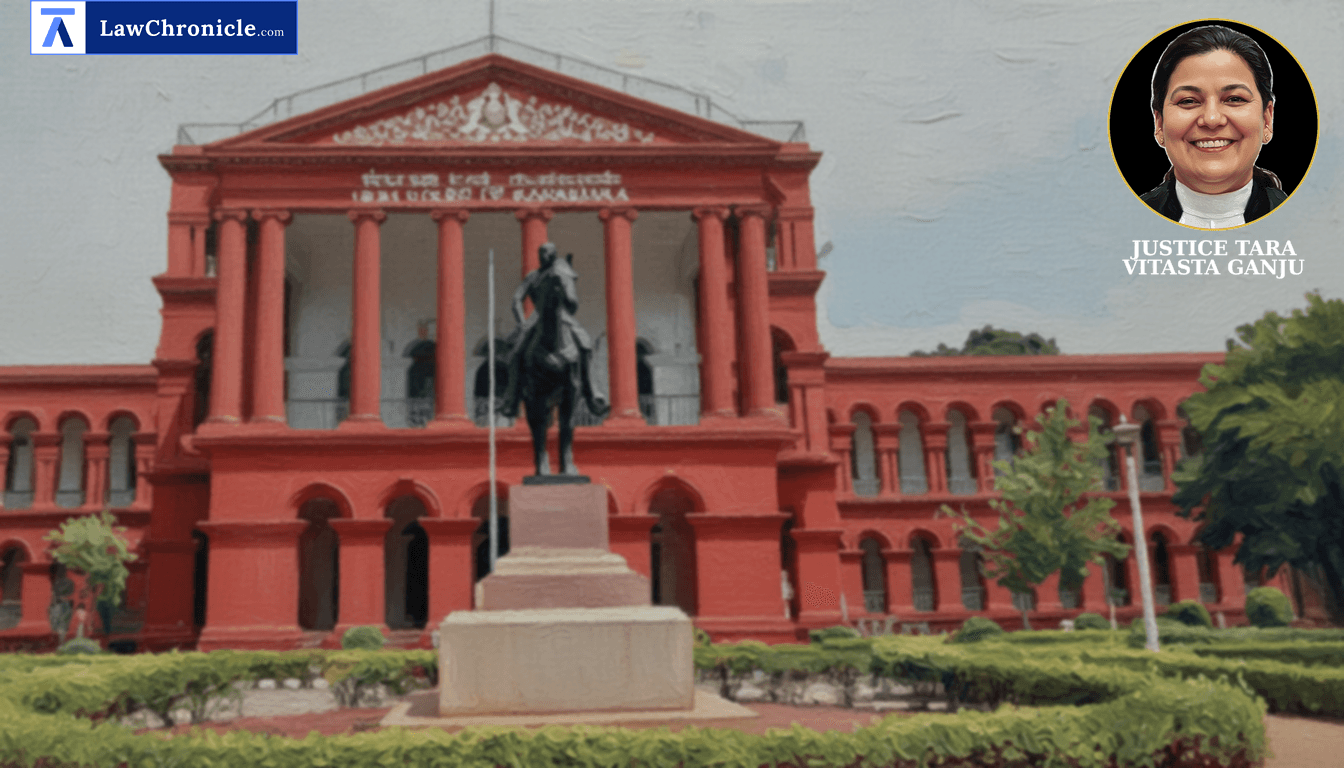
The High Court of Karnataka has ruled that trial courts retain the inherent power to recall orders dismissing suits as withdrawn in Lok Adalats, especially when such dismissals are based on unfulfilled settlement assurances rather than signed awards. In a definitive stance against procedural irregularities, the court clarified that a 'hybrid order' containing directions but lacking a bilateral settlement cannot divest a civil court of its jurisdiction to do substantial justice.
A single-judge bench of Justice Tara Vitasta Ganju presided over the matter, determining whether a civil court could re-examine an issue after a suit was disposed of as settled in a Lok Adalat following an application under Section 1 of Code of Civil Procedure, 1908. The court heard a batch of writ petitions filed by a club challenging the trial court’s decision to reopen cases where members had withdrawn their suits based on promises of membership regularization that ultimately did not fructify.
Key Takeaways
Curbing Lok Adalat Overreach
Lok Adalats cannot assume the adjudicatory powers of civil courts to pass 'hybrid' judicial orders; they are strictly limited to conciliation and the passing of awards based on mutual consent.
Inherent Power of Recall
Civil courts are not rendered functus officio by a Lok Adalat order if the settlement process was flawed or based on misrepresentations, allowing for the invocation of Section 151 of Code of Civil Procedure, 1908.
Validity of Lok Adalat Awards
An order passed by a Lok Adalat without a signed joint memo or a formal award executed by both parties does not attain statutory finality and is not equivalent to a decree.
Safeguarding Litigant Interests
When a suit is withdrawn based on a defendant's assurance that later fails, the court must act ex debito justitiae to prevent injustice rather than folding its hands due to procedural silence.
Invalidity of 'Hybrid' Lok Adalat Orders
The Court observed that the Lok Adalat assumed the powers of a Civil Court by passing an order instead of a formal award. Referring to the principles laid down in State of Punjab and Another Vs. Jalour Singh and Ors. ( "(2008) 2 SCC 660": 2008 CaseBase(SC) 455), the bench emphasized that Lok Adalats have no adjudicatory or judicial functions. The Court, in its reasoning, observed: "When a case is referred to the Lok Adalat for settlement, two courses are open to it: (a) if a compromise or a settlement is arrived at between the parties, to make an award, incorporating such compromise or settlement; or (b) if there is no compromise or settlement, to return the record with a failure report to the court. There can be no third 'hybrid order' by the Lok Adalat containing directions to the parties by way of final decision."
The Court noted that in the present case, no joint memo was executed and the defendant-club did not sign any settlement. The withdrawal was a unilateral act by the plaintiffs based on a representation that their grievances would be addressed in a future general body meeting. Since this was a "pre-cursor to a settlement" that did not fructify, the trial court was justified in reopening the suits.
Inherent Jurisdiction Under Section 151 CPC
Addressing the club's argument that the trial court became functus officio, the High Court relied on Jet Plywood and another Vs. Madhukar Nowlakha and Others to hold that a court is not powerless to set aside orders of dismissal if they resulted from mistake or misrepresentation. The bench further noted that Code of Civil Procedure, 1908 is not exhaustive, and where it is silent, the inherent powers under Section 151 may be invoked. The Court highlighted that the doctrine of finality, as discussed in Hari Singh Mann Vs. Harbhajan Singh Bajwa ( "(2001) 1 SCC 169": 2000 CaseBase(SC) 478), applies to valid awards, but the order in question did not qualify as a Lok Adalat award under Legal Services Authorities Act, 1987.
The Court has following directions:
"Accordingly, W.P. No. 4306 of 2026; W.P. No. 7083 of 2026; W.P. No. 7093 of 2026; W.P. No.7097 of 2026; W.P. No.7098 of 2026; W.P. No.7102 of 2026; W.P.No.7127 of 2026; W.P. No.7130 of 2026 and W.P. No.7160 of 2026 are dismissed. Pending applications, if any, stand closed. It is clarified that all rights and contentions of both parties are left open to be agitated before the learned Trial Court."
Ratio
A Lok Adalat order that records a withdrawal of a suit with liberty to reopen based on a future contingency, without a signed settlement or a formal award, is a 'hybrid order' lacking statutory finality. Consequently, the Civil Court does not become functus officio and retains the inherent jurisdiction under Section 151 of the Code of Civil Procedure, 1908, to recall such an order and restore the suit to its original file to ensure substantial justice and prevent prejudice caused by unfulfilled assurances.
Background
The dispute originated when members of the Bowring Institute filed multiple suits challenging a 2013 Enquiry Committee Report and a resolution demanding an additional payment of Rs. 9 lakhs for membership regularization. During the pendency of these suits, the matters were referred to a Lok Adalat in December 2023. At the Lok Adalat, the Secretary of the Club reportedly assured the plaintiffs that their grievances would be resolved in the Annual General Body Meeting of June 2024. Based on this, the plaintiffs filed applications to withdraw their suits under Order 23 Rule 1 of Code of Civil Procedure, 1908, with liberty to reopen if the result was unfavorable.
When the Club failed to provide a favorable resolution in the June meeting, the plaintiffs moved the Trial Court to reopen the cases. The Trial Court allowed these applications, leading the Club to approach the High Court. The Club argued that once settled in Lok Adalat, the only remedy was a writ petition, citing Bhargavi Constructions v. Kothakapu Muthyam Reddy ( "(2018) 13 SCC 480": 2017 CaseBase(SC) 617). However, the High Court distinguished these precedents, noting the absence of a signed settlement. The court relied on Manohar Lal Chopra vs. Seth Hiralal ( "1961 SCC OnLine SC 17": 1961 CaseBase(SC) 179) and Rameswar Sarkar Vs. State of West Bengal to emphasize that a court must aid litigants who have suffered due to procedural mistakes, affirming the Trial Court's decision to permit adjudication on merits.
Case Details:
Case No.: WP No. 4306 of 2026 C/W WP No. 7083 of 2026, WP No. 7093 of 2026 and others
Neutral Citation: 2026:KHC:49326
Case Title: Bowring Institute vs. J. Giridhar and others
Appearances:
For the Petitioner(s): Sri. K.B.S. Manian, Advocate
For the Respondent(s): Sri. B.S. Manjunath, Advocate for C/R
Source: 2026 CaseBase(KAR) 19191
Similar Articles


 Breaking News


