


Civil Courts Have Jurisdiction In Scheduled Areas For Non-Tribal Disputes: SC
 Copy Link
 Share
 Save
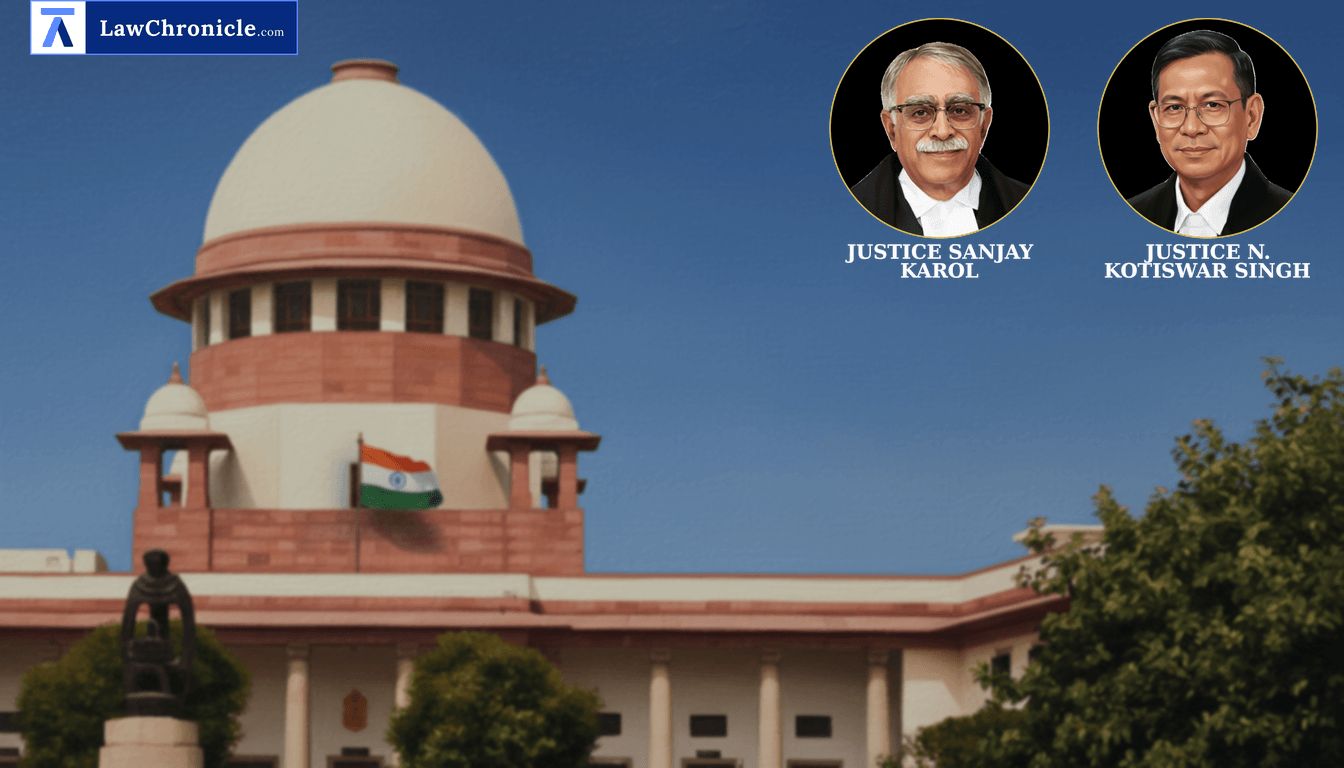
Civil courts have the complete jurisdiction to try civil disputes situated within Scheduled Areas provided all the contending parties are non-tribals, resolving decades of procedural uncertainty in tribal belts. Overturning an earlier high-power committee-driven decision, the apex court restored access to ordinary civil remedies where no indigenous rights or tribal land protections are compromised.
A Bench of Justice Sanjay Karol and Justice Nongmeikapam Kotiswar Singh allowed an appeal against a judgment of the High Court for the State of Telangana, which had held that Civil Courts lack jurisdiction over Scheduled Areas under the Andhra Pradesh Civil Courts Act, 1972.
Key Takeaways
- Civil Jurisdiction Restored: Civil courts can entertain partition and property suits in Scheduled Areas if all parties to the dispute are non-tribals.
- Inapplicability of Nagarjuna Ruling: The Court held that Nagarjuna Gramin Bank v. Medi Narayana did not lay down a binding precedent on judicial jurisdiction as it merely deferred to executive policy.
- Protection of Tribal Interests Maintained: If even a single party to the litigation is a tribal residing in Scheduled Areas, the Agency Courts will retain exclusive jurisdiction.
- Prospective Application: The ruling applies strictly to pending cases and future litigations to avoid disturbing settled property rights.
Interpretation of Precedents and Article 14 Nexus
Examining the constitutional mandate under the Fifth Schedule of the Constitution of India, 1950 alongside the Scheduled Districts Act, 1874, the Andhra Pradesh Agency Rules 1924, the Agency Tracts Interest and Land Transfer Act, 1917, and the Government of India Act, 1935, the Court stressed that special procedural exemptions in Scheduled Areas are meant exclusively to safeguard tribal communities from exploitation.
The Court, in its reasoning, observed: "When the object sought to be achieved by agency courts continuing in the Scheduled Areas is to protect the tribal people, the tribal property, their customs and practices, what is achieved by subjecting non-tribal people in that area to such special procedure? There is only one answer. Nothing. Admittedly, both the parties to this dispute are non-tribals. Then, what is the rational nexus of asking them to abide by procedures not intended for them? Rational nexus, as it is well known, is one of the grounds which is to be considered when looking at a particular dispute through the lens of Article 14 of the Constitution."
Analyzing the nature of precedent, the Court discussed decisions including Read and others v. The Bishop Of Lincoln Respondent, Abdul Kayoom v. CIT, V. Senthil Balaji v. State, State of Gujarat v. Utility Users’ Welfare Assn. ( "(2018) 6 SCC 21": 2018 CaseBase(SC) 1326), Career Institute Educational Society v. Om Shree Thakurji Educational Society, State of Madras v. V.G. Row, Chitra Ghosh v. Union of India, State of Punjab v. Davinder Singh ( "(2025) 1 SCC 1": 2024 CaseBase(SC) 371), and T.N. Medical Officers Assn. v. Union of India ( "(2021) 6 SCC 568": 2020 CaseBase(SC) 371), reaffirming the 'Inversion Test' to determine the binding ratio decidendi of a case.
The Court has following directions:
"The impugned judgment is set aside, and the second appeal is restored to the file of the High Court to be decided on the merits in a manner consistent with this judgment. Parties to appear before the High Court on 24.08.2026. Hearing expedited."
Ratio
The exclusion of Civil Courts' jurisdiction in Scheduled Areas does not extend to civil suits involving exclusively non-tribal parties where no tribal property, customary rights, or statutory protections are impacted. Extending procedural restrictions intended for indigenous protection to purely non-tribal disputes lacks rational nexus and violates Article 14 of the Constitution of India, 1950.
Background
The origin of the dispute traces back to a civil suit filed under Section 9 of the Code of Civil Procedure, 1908 for partition and separate possession among the non-tribal descendants of late Mukkera Muthaiah. The trial court dismissed the suit on grounds including limitation under Article 110 of the Limitation Act, 1963 and prior oral partition. The First Appellate Court under the Andhra Pradesh Civil Courts Act, 1972 reversed the trial court's decision, holding the suit properties to be joint family property.
In second appeal, the Telangana High Court set aside the First Appellate Court's decision solely on the premise that Civil Courts lacked jurisdiction in Scheduled Areas pursuant to Nagarjuna Gramin Bank v. Medi Narayana and executive notifications under the Andhra Pradesh Civil Courts Act, 1972. Relying on constitutional protections discussed in Samatha v. State of A.P., the Supreme Court clarified that geographic classification under the Fifth Schedule cannot strip non-tribal litigants of ordinary civil remedies where no tribal interest is involved.
Case Details:
Case No.: Civil Appeal No(s). OF 2026 (Arising out of SLP(C) No(s)…..@Diary No. 21610 of 2022)
Neutral Citation: 2026 INSC 810
Case Title: Mukkera Venkata Ratnam & Ors v. Vantasala China Venkateswarlu & Ors.
Source: 2026 CaseBase(SC) 753
Similar Articles

 Breaking News


