


Contractor Cannot Claim Damages for Foreclosed Works Without Evidence of Loss: Karnataka HC
 Copy Link
 Share
 Save
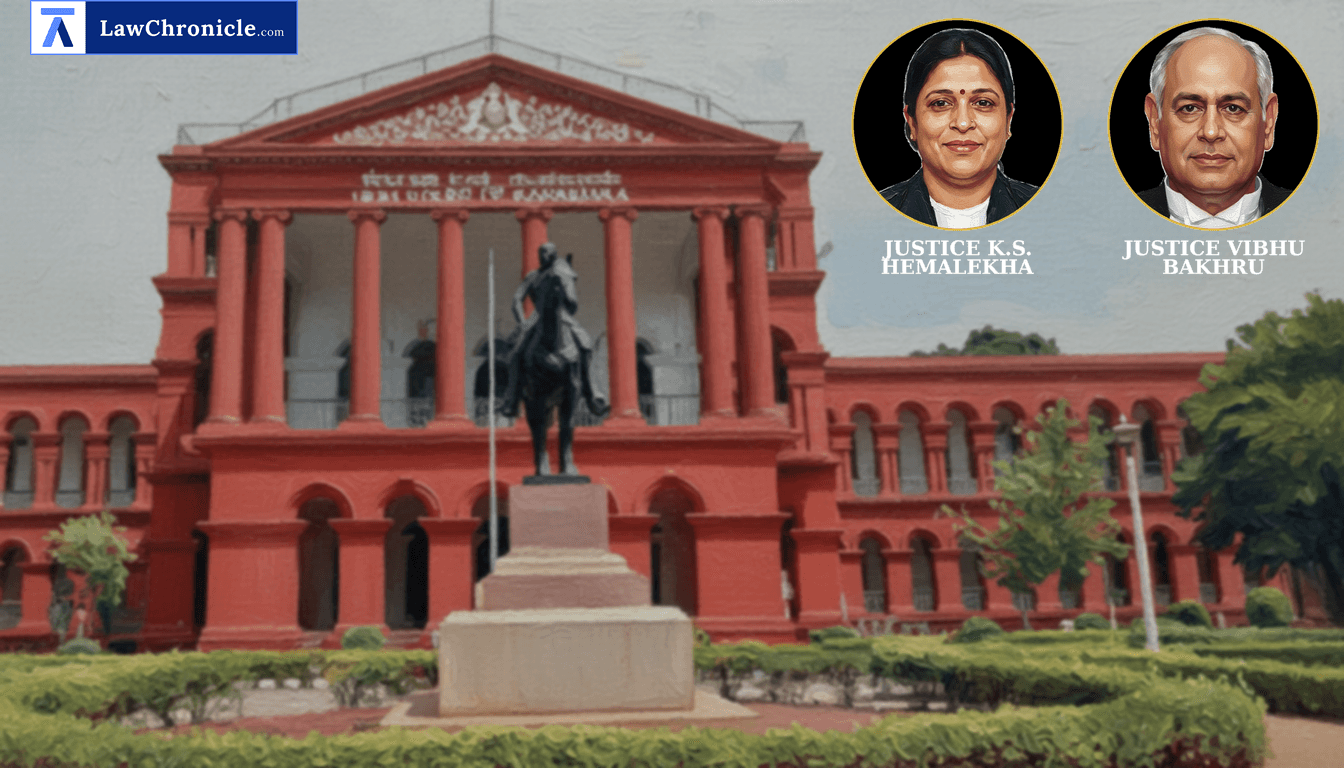
The Karnataka High Court has slammed the door on speculative claims for loss of profit in commercial contracts, ruling that contractors cannot be awarded damages for unexecuted works without leading specific evidence to substantiate actual losses. This verdict reinforces that judicial and arbitral awards for 'loss of profit' cannot be based on pure conjecture or presumptive percentages like 15% of the contract value, even in cases involving wrongful termination or foreclosure.
A Division Bench comprising Chief Justice Vibhu Bakhru and Justice K.S. Hemalekha dismissed a commercial appeal filed under Section 13(1-A) of the Commercial Court Act, 2015 read with Section 37 of the Arbitration and Conciliation Act, 1996. The appellant, a proprietary firm, challenged a Commercial Court order that refused to set aside an arbitral award which had rejected its claims for damages amounting to over ₹4.38 crores against the South Western Railway.
Arbitral Tribunal’s Findings and Judicial Review
The dispute arose from an agreement for the widening of a Road Under Bridge (RUB) in Bengaluru Station Yard. Despite multiple extensions, the work remained incomplete due to various site hindrances like high-tension lines and sewage pipes. Eventually, the Railways foreclosed the contract after the appellant furnished a No Claim Certificate (NCC). The Arbitral Tribunal had dismissed the claims noting that the appellant failed to prove it suffered actual loss and was debarred by the NCC under Clause 43(2) of the General Conditions of Contract.
Applying the Associated Provincial Picture Houses Ltd. v. Wednesbury Corporation principle, the High Court observed that findings of fact by a tribunal such as whether a delay was mutually handled or an NCC was voluntary cannot be interfered with unless they are perverse. The Court, in its reasoning, observed: "...the aforesaid findings of the Arbitral Tribunal - that Railways was not solely responsible for the delay; that the parties had decided to foreclose the contract by mutual discussion; and that the appellant had voluntarily issued the NCC - are findings of fact. As noted above, the said conclusions are based on materials on record. The said findings hence will not to be held to be perverse or unreasonable in the sense of the Wednesbury principle of unreasonableness. Thus, these findings cannot be held to vitiate the impugned award on the ground of patent illegality."
Strict Interpretation of Exclusionary Clauses
The appellant contended that seeking extensions under Section 17-A(iii) of the General Conditions of Contract did not waive the right to damages. However, the Court rejected this, pointing to the express prohibition within the clause itself. The Court noted: "As is apparent, the said clause expressly provides that any extension under clause 17A(iii) of the GCC, would not entitle the contractor to claim any damages or compensation."
Furthermore, the Court held that the claim for interest on Security Deposits was unsustainable as Section 16(3) of the General Conditions of Contract explicitly proscribed such payments.
Rationale on Loss of Profit Claims
Addressing the core legal argument regarding loss of profit, the Court distinguished the Supreme Court ruling in M/s. AT Brij Paul Singh and others V. State of Gujarat. It clarified that while loss of profit can be claimed for unexecuted works, it is not a "doctrine of law" that a fixed percentage must be awarded in every case without evidence.
Referring to Edifice Developers and Projects Engineers Limited V. Essar Projects (India) Limited and Nandi Infratech Pvt. Ltd. Vs. R. K. Bararia and others, the High Court emphasized that the contractor must demonstrate how the prolongation or foreclosure specifically caused financial injury. The Court stated: "No basis whatsoever has been indicated in the award for accepting 10% as a measure representing loss of profits. In the circumstances, the arbitral award to the extent that it allows the claim for loss of profits is based on pure conjecture and in the absence of any evidence whatsoever was correctly set aside."
Background:
The appellant entered into an agreement with the Railways on April 27, 2017, for works valued at approximately ₹12.77 crores. The project faced several underground utility hindrances. Between 2018 and 2021, the contract period was extended four times. In April 2021, the appellant furnished a 'No Claim Certificate' in the Railways' format, leading to the foreclosure of the contract. However, the appellant subsequently alleged that the NCC was obtained under coercion and sought arbitration for losses including idling of establishment, loss of profits, and loss of credentials. The Arbitral Tribunal rejected these, leading to the Section 34 challenge and the subsequent appeal before the High Court.
Key Takeaways:
Evidence Over Presumption
Contractors cannot rely on industry standards (like 10-15% profit margins) as a matter of right; they must lead oral or documentary evidence to prove actual financial loss.
Finality of No Claim Certificates
Once a 'No Claim Certificate' is issued voluntarily to facilitate foreclosure and final billing, it becomes extremely difficult to re-agitate claims in arbitration unless clear coercion is proved.
Clause-Based Restrictions
Extensions granted under specific clauses like 17-A(iii) of the Railway GCC act as a statutory bar against subsequent claims for damages arising from delays.
Ratio Decidendi:
A claim for loss of profits for unexecuted works following the foreclosure of a contract is not a presumptive entitlement. Such damages must be proved by the claimant with cogent evidence regarding investments made, potential projects deprived, or financial statements, and cannot be awarded based on conjecture or specific formulae like Hudson’s Formula in the absence of supporting data.
Case Details:
Case No.: COMMERCIAL APPEAL NO. 177 OF 2026
Case Title: M/S. N.N. Constructions v. Union Of India & Ors.
Appearances:
For the Petitioner(s): Sri Bapat Sampath Vinayaka Rao, Advocate
For the Respondent(s): Sri Shivakumar, CGC
Source: 2026 CaseBase(KAR) 224
Similar Articles
 Breaking News


