


Broken Chain of Circumstances: Gujarat HC Upholds Acquittal in Murder Case
 Copy Link
 Share
 Save
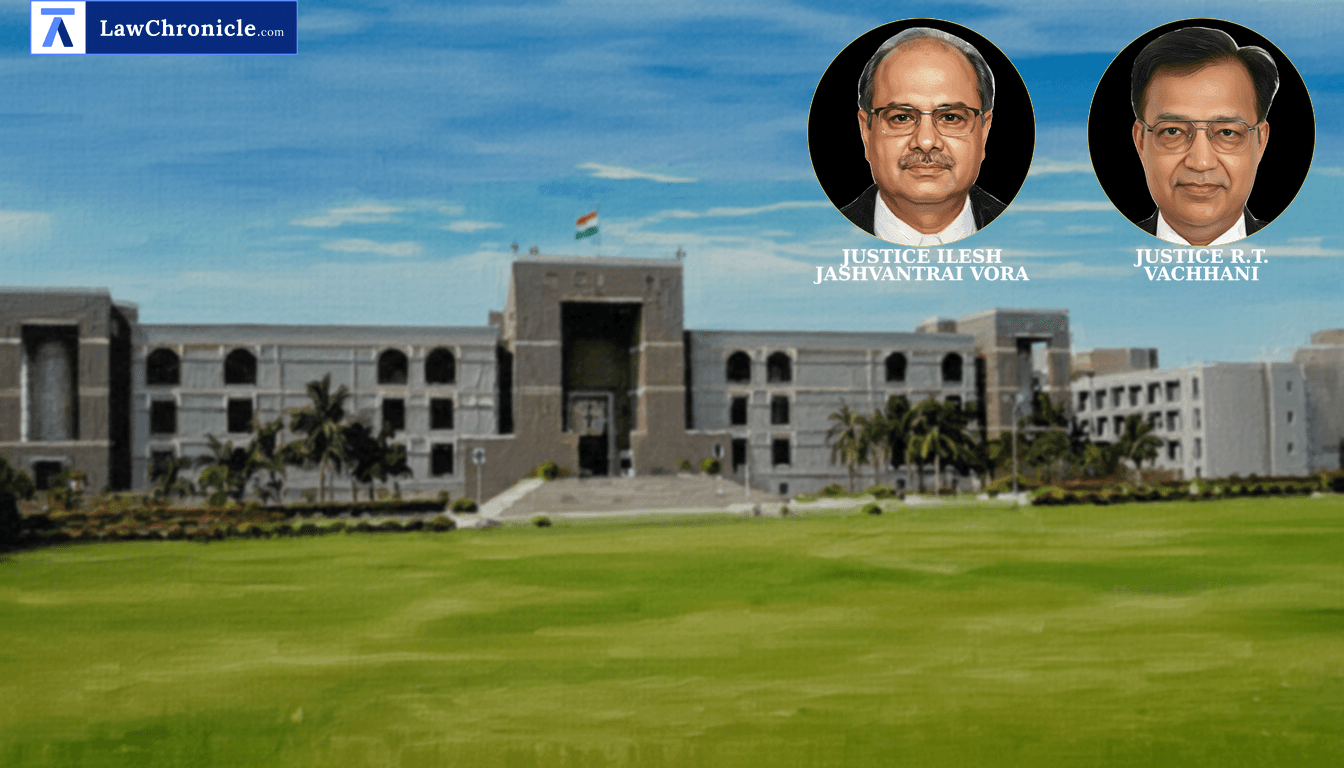
Criminal jurisprudence mandates that a conviction based on circumstantial evidence must be anchored by an unbreakable chain, ensuring the only possible conclusion is the guilt of the accused. The Gujarat High Court recently affirmed this principle by upholding the acquittal of a juvenile in a murder case, ruling that mere suspicion and scattered links cannot substitute for conclusive proof.
A division bench comprising Justice Ilesh J. Vora and Justice R. T. Vachhani heard an appeal filed by a victim-appellant challenging the acquittal order passed by the Principal Magistrate, Juvenile Justice Board, Nadiad. The appeal, preferred under Section 413 of the Bharatiya Nagarik Suraksha Sanhita, 2023 read with Section 101 of the Juvenile Justice (Care and Protection of Children) Act, 2015, contested the exoneration of a 'Child in Conflict with Law' who had been charged under Sections 302 and 201 of the Indian Penal Code, 1860.
Key Takeaways
Circumstantial Evidence Standard
For a conviction to stand, every single link in the chain of circumstances motive, last seen together, and recovery must be proven beyond reasonable doubt.
Suspicion vs. Legal Proof
Judicial findings cannot be based on mere suspicion or hearsay evidence, no matter how strong the suspicion against the accused might be.
Appellate Restraint in Acquittals
When two reasonable views are possible, an appellate court must not disturb an acquittal unless there is patent perversity or a misreading of evidence.
Hearsay Evidence Inadmissibility
Testimony based on what others said rather than personal knowledge lacks evidentiary value in establishing criminal liability.
Court Observations on 'Last Seen' Theory
The Court scrutinized the testimony of five main prosecution witnesses, including the complainant and the grandmother of the deceased. It observed that while the respondent was seen with the deceased, there was a significant time gap before the body was discovered, and other individuals were also seen in the deceased's company. The Court noted that the evidence presented was largely hearsay, with witnesses admitting during cross-examination that they had no personal knowledge of the actual incident.
The Court has following directions:
"In light of the above legal position and for the reasons recorded in the foregoing paragraphs, coupled with the fact that the case of the prosecution does not get support from the evidence recorded by the learned Juvenile Justice Board, the present appeal deserves to be dismissed and is accordingly dismissed while confirming the impugned judgment and order of acquittal."
The Court, in its reasoning, observed: "In a case of circumstantial evidence, the chain has to be complete in all respects so as to indicate the guilt of the accused and also exclude any other theory of the crime. The law is well settled on the above point... Thus, if the High Court found one of the links to be missing and not proved in view of the settled law on the point, the conviction ought to have been interfered with."
Ratio
In cases involving circumstantial evidence, the prosecution must establish a complete sequence of events including motive, the last seen theory, and recovery of the weapon. If even one link in this chain remains unproven or snapped, the benefit of doubt must accrue to the accused, as suspicion cannot take the place of evidence. Furthermore, an appellate court shall only reverse an acquittal if the judgment suffers from patent perversity or if no two reasonable views are possible.
Background
The case originated from a complaint filed in December 2017 regarding the disappearance and subsequent death of a youth named Sahil. His body was found floating in a canal at Aurangpura Sim with injuries to the neck and chest. The prosecution alleged that the respondent, a juvenile, was last seen with the deceased and had committed the murder. The Juvenile Justice Board acquitted the respondent, noting that the pancha witnesses had turned hostile and the evidence was primarily hearsay.
The appellant argued that the 'last seen' theory and medical evidence regarding neck compression were sufficient to convict. However, the respondent relied on Laxman Prasad Alias Laxman Vs. State of Madhya Pradesh and Munikrishna alias Krishna etc. Vs. State by Ulsoor PS to argue that a broken chain of circumstances necessitates acquittal. The High Court, citing Sharad Birdhichand Sarda vs. State of Maharashtra ( "(1984) 4 SCC 116": 1984 CaseBase(SC) 194) and Shailendra Rajdev Pasvan vs. State of Gujarat, agreed that the prosecution failed to establish a conclusive link, noting the absence of direct evidence and the possibility of other theories regarding the crime.
Case Details:
Case No.: R/CRIMINAL APPEAL NO. 3132 of 2025
Neutral Citation: 2026:GUJHC:60209-DB
Case Title: Samimbanu Babubhai Khalifa Versus State Of Gujarat & Anr.
Appearances:
For the Petitioner(s): MR. JAY G THAKER
For the Respondent(s): PUBLIC PROSECUTOR
Source: 2026 CaseBase(GUJ) 24144
Similar Articles

 Breaking News


