


Criminal Law Is Not An Automatic Consequence Of Matrimonial Failure: Allahabad HC
 Copy Link
 Share
 Save
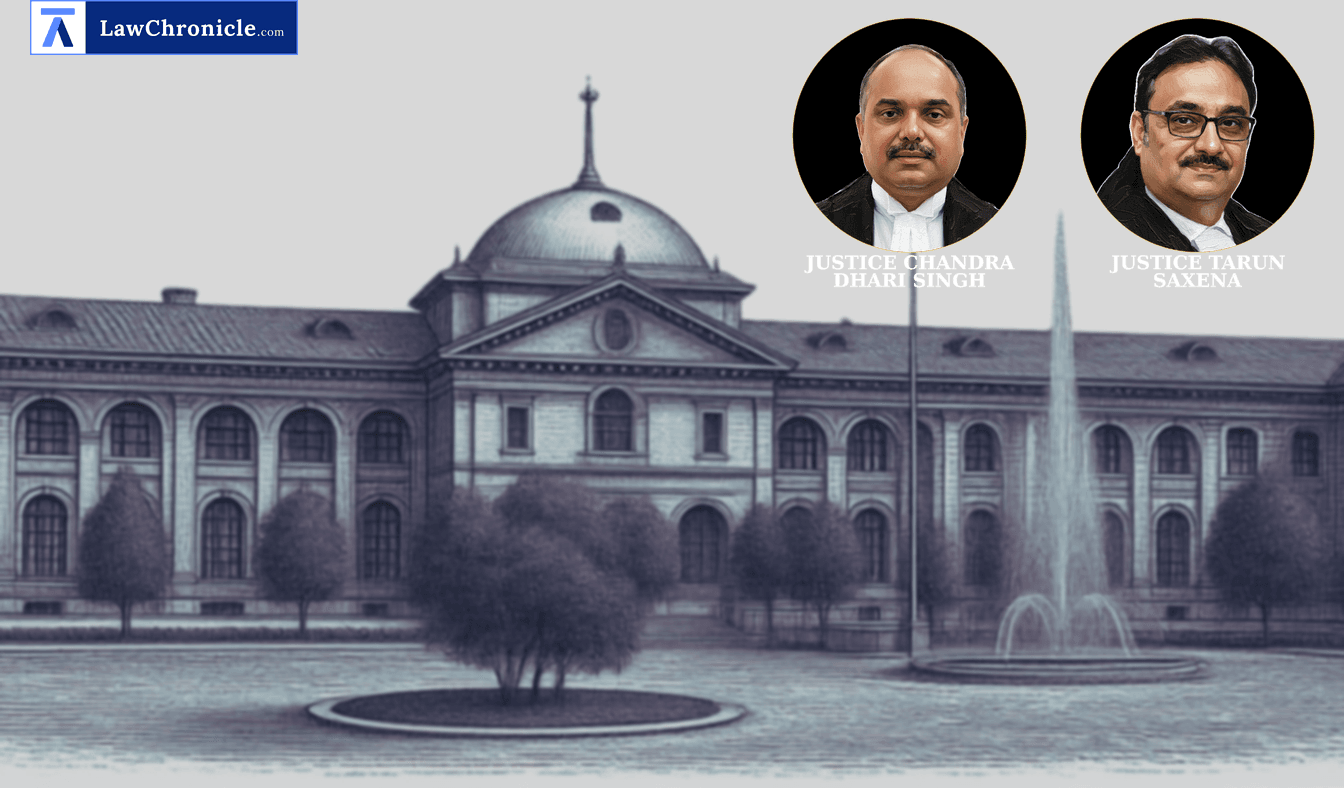
In a significant intervention against the misuse of penal provisions, the Allahabad High Court quashed a dowry harassment FIR, ruling that criminal law cannot be invoked mechanically as a retaliatory counterblast to divorce proceedings. The Bench emphasized that indiscriminate criminalization of matrimonial disputes based on vague and omnibus allegations threatens the very core of the institution of marriage and serves as a tool for personal vendetta.
A bench comprising Justice Chandra Dhari Singh and Justice Tarun Saxena heard the writ petitions seeking the quashing of an FIR registered under the Bharatiya Nyaya Sanhita, 2023 and the Dowry Prohibition Act, 1961. The Allahabad High Court examined whether the criminal process was being used to settle personal scores after the breakdown of a short-lived marriage.
Key Takeaways
Curbing Retaliatory Litigations
Future litigants cannot use criminal machinery as an automatic leverage tool once matrimonial adjudication has commenced in family courts.
Requirement of Specificity
General and omnibus allegations against relatives without distinct roles, dates, or instances will no longer suffice to sustain a criminal prosecution.
Protection of Marital Sanctity
Lower courts and police authorities must distinguish between genuine criminal victimization and the non-criminal collapse of human relationships to prevent systemic distortion of justice.
Misuse of Law by Married Women
The Allahabad High Court observed that while the protection of women is a constitutional imperative, the law must not become an instrument of harassment. It noted that the FIR lacked specific particulars regarding the alleged demands of Rs. 10 crores and Rs. 50 lakhs, failing to identify which individual made the demands or the specific occasions thereof.
The Allahabad High Court expressed concern over the institution of marriage in India that “Marriage is ordinarily a relationship of cohabitation, companionship, mutual trust and reciprocal obligation. Its legal and social character cannot be reduced either to a commercial transaction or to an instrument of coercion. At the same time, the social importance of marriage cannot justify compelling a spouse to remain in a relationship marked by violence, coercion or unlawful demands. The institution is preserved not by immunising wrongdoing, but by maintaining a principled distinction between genuine criminal conduct and the failure of matrimonial compatibility.”
Ratio
To constitute a legally sustainable allegation of dowry harassment or cruelty, the FIR must disclose a factual substratum consisting of specific overt acts, distinct dates, and individually attributed conduct; generalized and omnibus recitals that lack contemporaneous corroboration and appear as a counterblast to matrimonial litigation amount to an abuse of the process of law.
Background
The marriage between the parties was solemnized in November 2024 but collapsed within three months, with the wife leaving the matrimonial home in February 2025. After the husband filed for divorce under the Hindu Marriage Act, 1955 in May 2025, the wife's family lodged an FIR in June 2025 alleging demands for dowry and an attempt at strangulation.
The petitioners argued the case was a fabrication, relying on the principles in State of Haryana v. Bhajan Lal and R.P. Kapur v. State of Punjab ( "AIR 1960 SC 866": 1960 CaseBase(SC) 156). They highlighted the absence of any Medico-Legal Case (MLC) or prior complaints during the cohabitation period. The Court found the chronology significant, noting that the serious allegations emerged only after the divorce petition. Citing Kahkashan Kausar @ Sonam v. State of Bihar ( "(2022) 6 SCC 599": 2022 CaseBase(SC) 396) and Dara Lakshmi Narayana v. State of Telangana ( "2024 INSC 953": 2024 CaseBase(SC) 857), the Court held that implicating relatives without specific roles is impermissible.
Referring to Social Action Forum for Manav Adhikar v. Union of India ( "(2018) 10 SCC 443": 2018 CaseBase(SC) 14) and Sushil Kumar Sharma v. Union of India ( "(2005) 6 SCC 281": 2005 CaseBase(SC) 1108), the Allahabad High Court emphasized that the Bharatiya Nyaya Sanhita, 2023 should not be used to cause insurmountable agony to the husband's family. Since the allegations did not meet the tests laid down in Neeharika Infrastructure Pvt. Ltd. v. State of Maharashtra ( "(2021) 19 SCC 401": 2020 CaseBase(SC) 1378) and Rajiv Thapar v. Madan Lal Kapoor ( "(2013) 3 SCC 330": 2013 CaseBase(SC) 172), the Allahabad High Court allowed the writ petitions and quashed the proceedings to secure the ends of justice as per Constitution of India, 1950.
Case Details:
Case No.: CRIMINAL MISC. WRIT PETITION No. - 15316 of 2025
Case Title: Gaurav Jain and 2 others Versus State of U.P. and 3 others
Appearances:
For the Petitioner(s): Rajrshi Gupta, Swetashwa Agarwal, Syed Imran Ibrahim, Yash Raj Verma
For the Respondent(s): Jagdish Singh Bundela, G.A., Gaurav Srivastav, Prem Babu Verma, Anita Singh
Source: 2026 CaseBase(ALL) 1193
Similar Articles
 Breaking News


